Tuberculosis 2024
Annual tuberculosis report 2024
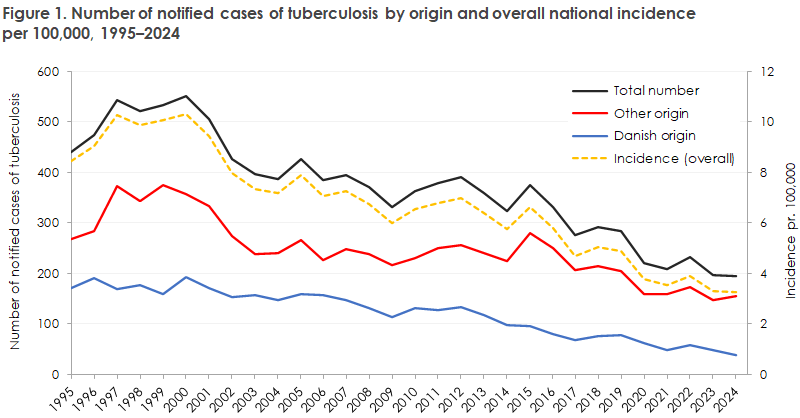
- In 2024, 194 cases of tuberculosis (TB) were notified in Denmark, corresponding to a frequency (incidence) of 3.3 new cases per 100,000.
- The reduction since 2000 has occurred steadily, apart from minor annual fluctuations, corresponding to an annual reduction of 0.3 cases per 100,000.
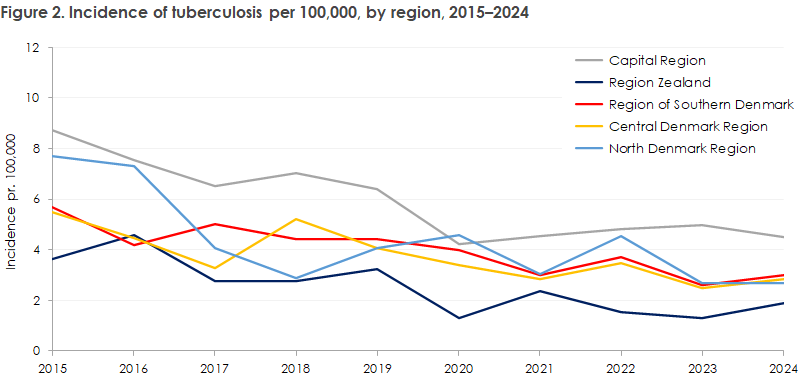
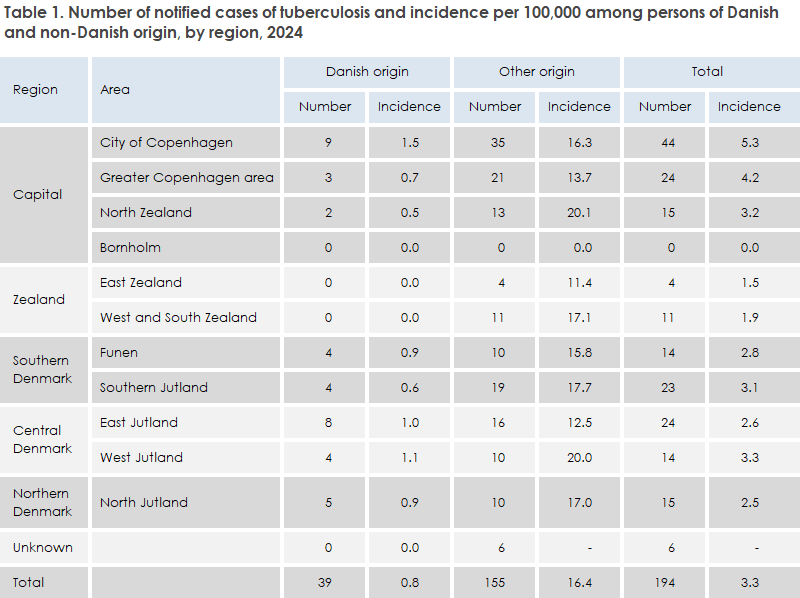
- There was variation in incidence between the geographical regions, ranging from 4.5 per 100,000 in the Capital Region to 1.9 per 100,000 in Region Zealand. The remaining three regions were at approximately the same level, with 2.7–3.0 cases per 100,000.
- 20% of TB cases occurred among persons of Danish origin, while 80% occurred among persons of non-Danish origin.
- The median age was 56 years for persons of Danish origin and 36 years for persons of non-Danish origin. Among persons of Danish origin, most cases occurred in the 50–69-year age group, while among persons of non-Danish origin, most cases occurred in the 20–49-year age group. Pulmonary TB remains the most common presentation (65%), while extrapulmonary forms of TB continue to be more frequent among persons of non-Danish origin.
- In total, 86 cases (44%) were presumed, according to the notifications, to have been infected in Denmark, 99 cases (51%) abroad, while nine cases (5%) had an unknown country of infection.
- The proportion of microscopy-positive pulmonary TB patients has increased compared with the previous year, from 45% to 50% among persons of Danish origin. This may be due to random variation, but it underscores the importance of maintaining and strengthening preventive efforts, particularly TB screening in high-risk settings. A lower number of microscopy-positive patients would mean a lower bacterial burden, leading to fewer complications for the individual patient and reduced transmission in the community.
- Four cases of isoniazid monoresistance, one case of rifampicin monoresistance, and three cases of multidrug-resistant (MDR) TB were detected. This is slightly fewer than last year’s five MDR cases and is therefore in line with previous years (2–3 cases annually). All cases were foreign-born, and at least one of the bacterial strains was of the Beijing type, which is often associated with MDR.
In 2024, 194 cases of tuberculosis were notified, 118 men (61%) and 76 women (39%). The median age for new cases was 41 years (range 0–88 years) for men and 39 years (range 5–84 years) for women.
Since 2000, there has been a steady reduction in the number of new TB cases, with minor annual fluctuations, from an incidence (number of new cases per year) of 10.3 per 100,000 in 2000 to 3.3 in 2024. This corresponds to an average annual reduction of 0.3 cases per 100,000 during the period, Figure 1.
National and regional occurrence of TB in 2024
In 2024, the overall incidence of TB in Denmark was 3.3 cases per 100,000 inhabitants. The Capital Region continues to have the highest incidence (4.5 per 100,000), and Region Zealand the lowest (1.9 per 100,000), Table 1. In the Capital Region, the incidence has been relatively stable since 2020, but apart from this, there have been no major changes in TB occurrence in the individual regions, Table 1 and Figure 2.
Origin and country of infection
Of the 194 notified cases, 39 (20%) were among persons of Danish origin (based on own and parents’ country of birth), comprising 29 men and 10 women. The median age for persons of Danish origin was 56 years, range 13–87 years.
A total of 155 (80%) cases were notified among persons of non-Danish origin, comprising 89 men and 66 women. The median age for persons of non-Danish origin was 36 years, range 0–88 years.
Figure 3 shows the age distribution of TB cases in 2024 by origin. Among TB cases in persons of non-Danish origin, the highest number of cases was seen in the 20–49-year age group, while among
TB cases in persons of Danish origin, the highest number was seen in the 50–69-year age group. This pattern is unchanged compared with previous years.
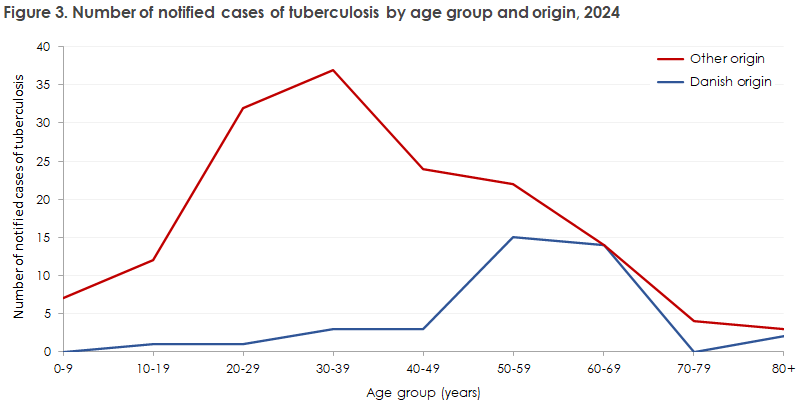
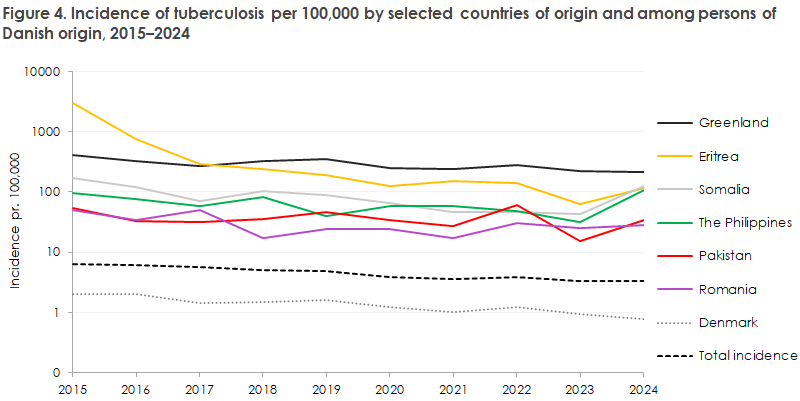
Figure 4 shows the incidence of TB in Denmark by countries of origin with the highest TB incidence. As in previous years, the incidence is highest among persons of Greenlandic origin (214 per 100,000 in 2024) and among persons from Somalia (123 per 100,000) and Eritrea (118 per 100,000). The incidence of TB among persons of Greenlandic origin has been very high over the past 10 years, a development that is discussed in more detail in this new publication.
The incidence of TB among persons from Eritrea, Somalia, the Philippines, and Pakistan has increased from 2023 to 2024, but overall, the incidence for these countries has been either stable or slightly declining over the past 10 years. It is, however, worth highlighting that the incidence among persons of Danish origin has now reached the WHO target for pre-elimination (<10/1,000,000).
Presumed country of infection
Based on the notifications, 86 (44%) persons were presumed to have been infected in Denmark and 99 (51%) abroad. For nine persons, the country of infection was unknown. The distribution between infections acquired in Denmark and abroad has remained unchanged over the past 10 years.
Among persons of non-Danish origin, 96 (62%) were presumed to have been infected abroad, 52 (34%) in Denmark, and the remaining seven (4%) had an unknown country of infection.
Localization of TB
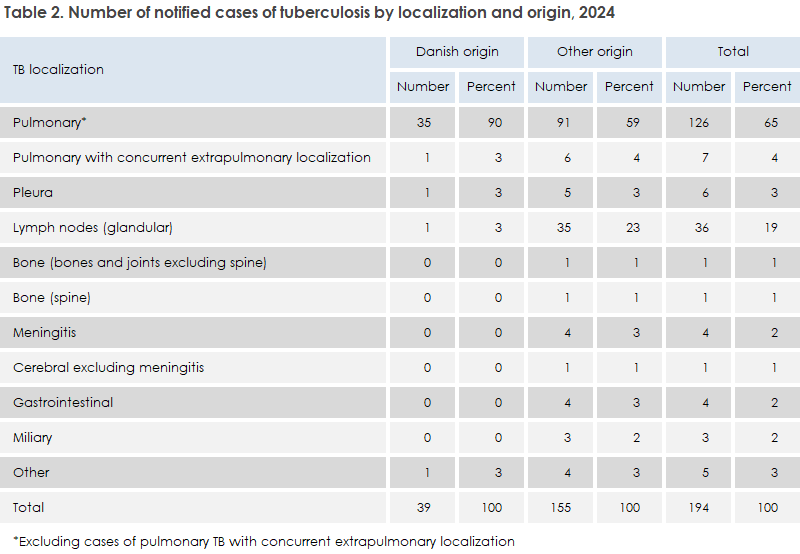
Pulmonary TB remains the most common localization for both persons of Danish origin and persons of non-Danish origin. Extrapulmonary TB occurred more frequently among persons of non-Danish origin (41%) compared with persons of Danish origin (10%), corresponding to what has been observed in previous years. In 2024, four cases of TB meningitis were notified, as well as one case of cerebral TB, Table 2.
Relapse
A total of 17 (9%) cases were notified as relapses. TB relapse is defined here as a new case of TB in a person who has previously had TB, regardless of whether this represents a relapse or reinfection. This is largely unchanged compared with previous years, when 9% of cases were relapse cases in both 2022 and 2023.
Tuberculosis and HIV infection
Of the notified TB cases in 2024, five persons were HIV-positive, including two with known HIV and three with newly diagnosed HIV. Of the total 194 notified TB cases, 136 persons tested HIV-negative, while the HIV status of the remaining 53 persons was not stated in the notification. It is unclear whether these persons were HIV-tested in connection with the TB diagnosis, or whether the high proportion with unknown HIV status is due to the absence of test results at the time of notification.
Tuberculosis among children
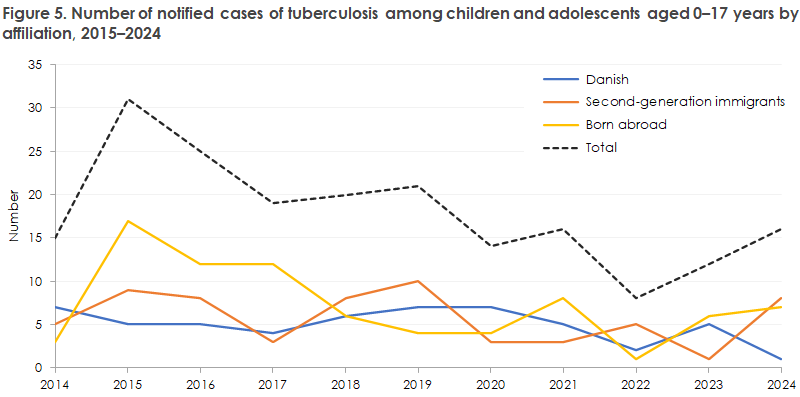
In 2024, 16 children and adolescents under 18 years of age with TB were notified. Nine were born in Denmark. Of the Danish-born children, eight were born to parents with ties to another country, and one child was born to Danish parents. Four of the Danish-born children were presumed to have been infected in Denmark and five were infected abroad. Of the seven children born abroad, six were stated as infected abroad and one in Denmark. Of the 16 children notified with TB, 12 had pulmonary TB, two had TB meningitis, one had lymph node TB, and one had another form of extrapulmonary TB.
Since 2015, the number of notified TB cases among children has declined from 31 in 2015 to 16 in 2024, although an increase has been observed in the past two years from eight cases in 2022 during the COVID-19 pandemic.
Occupational transmission
None of the notified cases in 2024 were reported as infected at work.
Microbiological development
In 2024, 83% of persons of Danish origin were notified with microbiologically confirmed TB, which represents an increase from 2023 (75%). Ideally, approximately 80% of all TB cases should be confirmed to avoid both over- and underdiagnosis of new cases. Furthermore, microbiological verification ensures species and resistance determination as well as genotyping for use in contact tracing.
In 2024, 21% of culture-positive pulmonary TB cases could not be confirmed by PCR analysis. It therefore remains important that the Danish diagnostic algorithm is followed, whereby all primary samples are cultured. This also ensures detection of possible atypical mycobacteria, which account for approximately 40% of annual patients with new mycobacterial findings. For extrapulmonary TB cases, even fewer of the culture-positive samples were PCR-positive for TB (68% in 2024).
Among the 38 notified cases that were not confirmed by culture in 2024, nine (24%) had a positive PCR test. One of these nine PCR-positive cases was also microscopy-positive; the remainder were negative. A negative culture despite positive PCR and/or microscopy may be due to patients having already started anti-tuberculosis treatment before samples were collected, or because formalin-fixed material was submitted, which cannot be cultured.
Among first-time notified cases, isoniazid monoresistance was detected in four (2%) patients. In 2024, three cases of multidrug-resistant (MDR) TB were detected. In Denmark, resistance in primary samples is detected genotypically, i.e., based on DNA-based methods such as PCR analyses and whole-genome sequencing of the bacterium. Any detected mutations are compared with the WHO catalogue of resistance mutations. If resistance mutations are detected, supplementary phenotypic (culture-based) resistance testing is performed and compared with the genotypic result.
This report is also mentioned in EPI-NEWS 5/2026.