National wastewater surveillance
In Denmark, both SARS-CoV-2 and influenza A are monitored in wastewater. The national wastewater surveillance system covers 49% of the population, and wastewater samples are collected from 29 wastewater treatment plants across the country, allowing the development of SARS-CoV-2 and influenza A to be monitored nationally and for SARS-CoV-2 also regionally.
SARS-CoV-2 status in wastewater as of 21.10.2026
In week 42 (October 12 - October 18) the national SARS-CoV-2 concentration in wastewater, indicating the amount of SARS-CoV-2 circulating in the population, is at a low level.
In Central Denmark Region the concentration is at a very low level and in Capital Region of Denmark, North Denmark Region, Region Zealand and Region of Southern Denmark the concentration is at a low level.
The national growth rate, which is the average weekly growth over the past four weeks (September 21 - October 18), is not calculated this week due to increased uncertainty caused by very low concentrations.
Influenza A status in wastewater as of 21.10.2026
The national influenza A concentration in wastewater, indicating the amount of influenza A circulating in the population, is at a very low level.
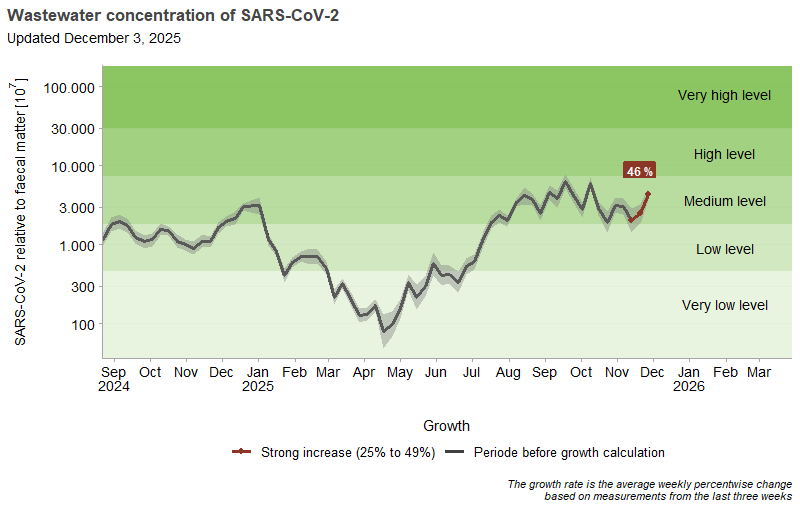
National concentration of SARS-CoV-2 in wastewater over time and the current growth rate
The figure below shows the concentration levels of SARS-CoV-2 in wastewater across all sampling locations, as well as this week's growth rate. The growth rate is categorized as follows:
- Very strong increase (> 50%)
- Strong increase (25% to 49%)
- Increase (10% to 24%)
- No growth (-9% to 9%)
- Decrease (-24% to -10%)
- Strong decrease (-49% to -25%)
- Very strong decrease (< -50%)
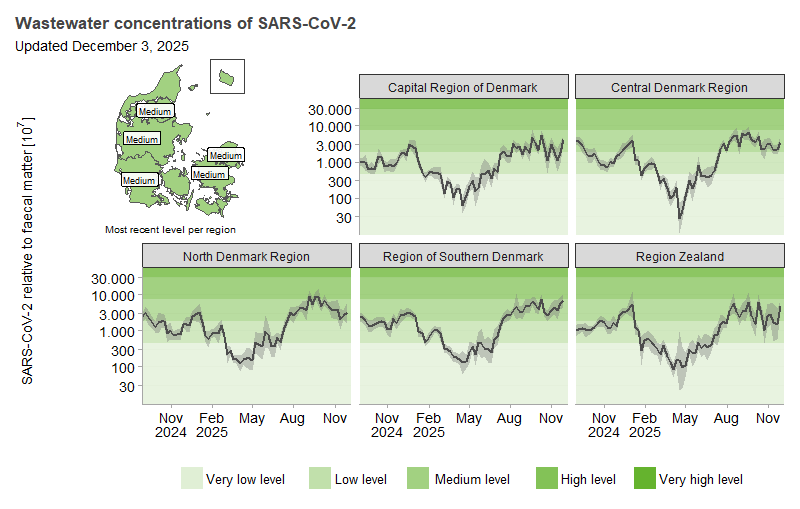
Regional concentration levels of SARS-CoV-2 in wastewater and development over time
The figure below shows the level of SARS-CoV-2 in wastewater for each region, along with the regional development of SARS-CoV-2 concentration over time.
National concentration of influenza A in wastewater over time
The figure below shows the concentration levels of influenza A in wastewater across all sampling locations.
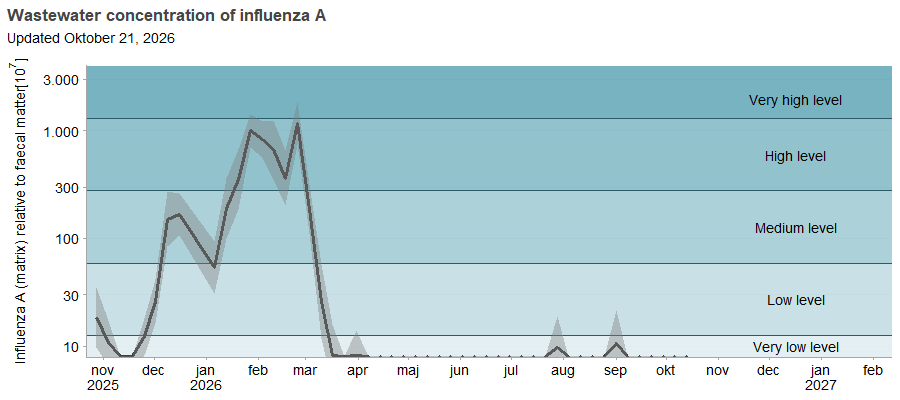
The concentration of influenza in wastewater is generally lower than the concentration of SARS-CoV-2. The concentrations therefore cannot be compared directly but should be assessed separately for each virus.
Download wastewater data
Data from the national wastewater surveillance (21.10.2026)
Information on the National Wastewater Surveillance
How is the national wastewater surveillance conducted?
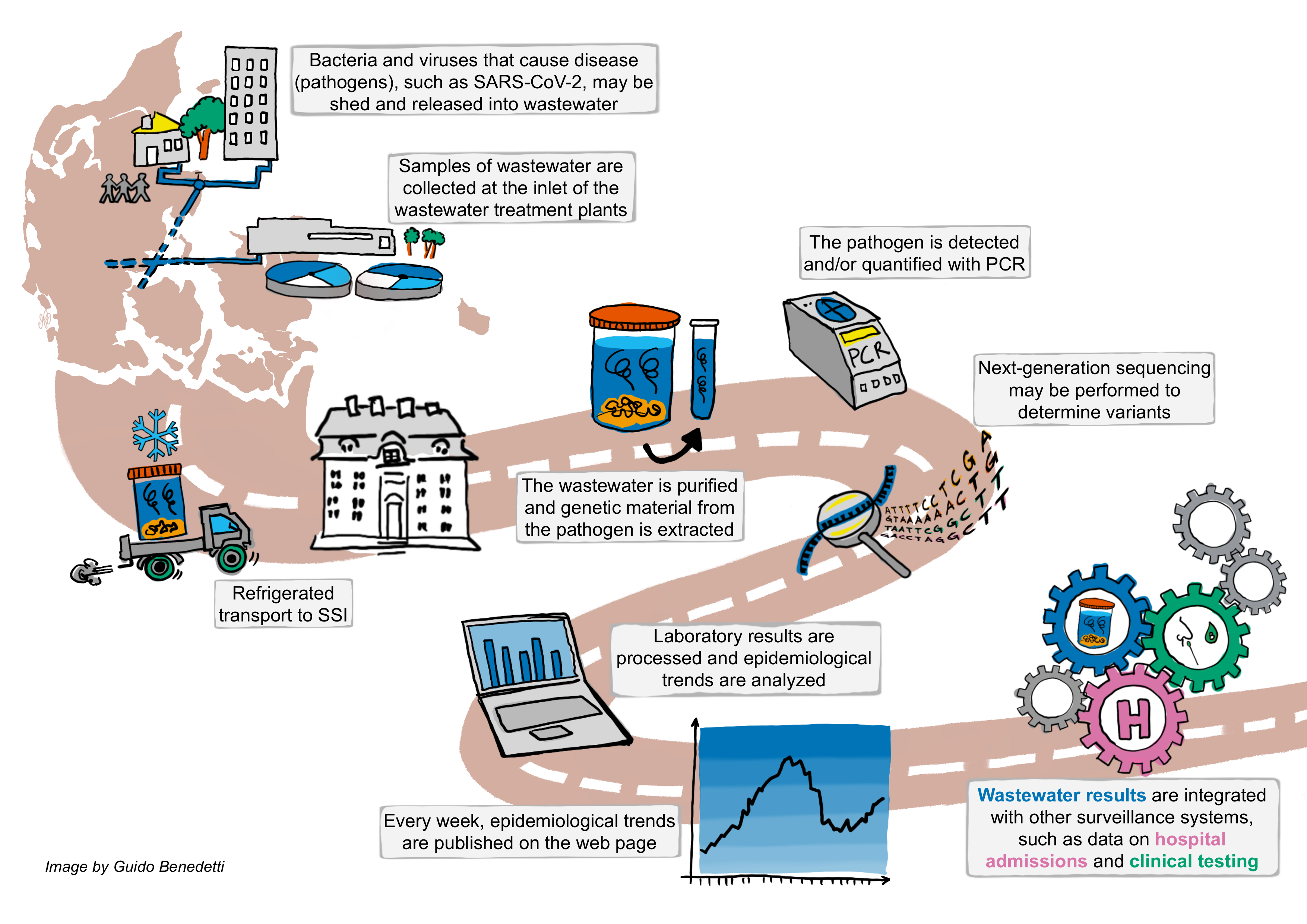
Where are viruses measured in wastewater?
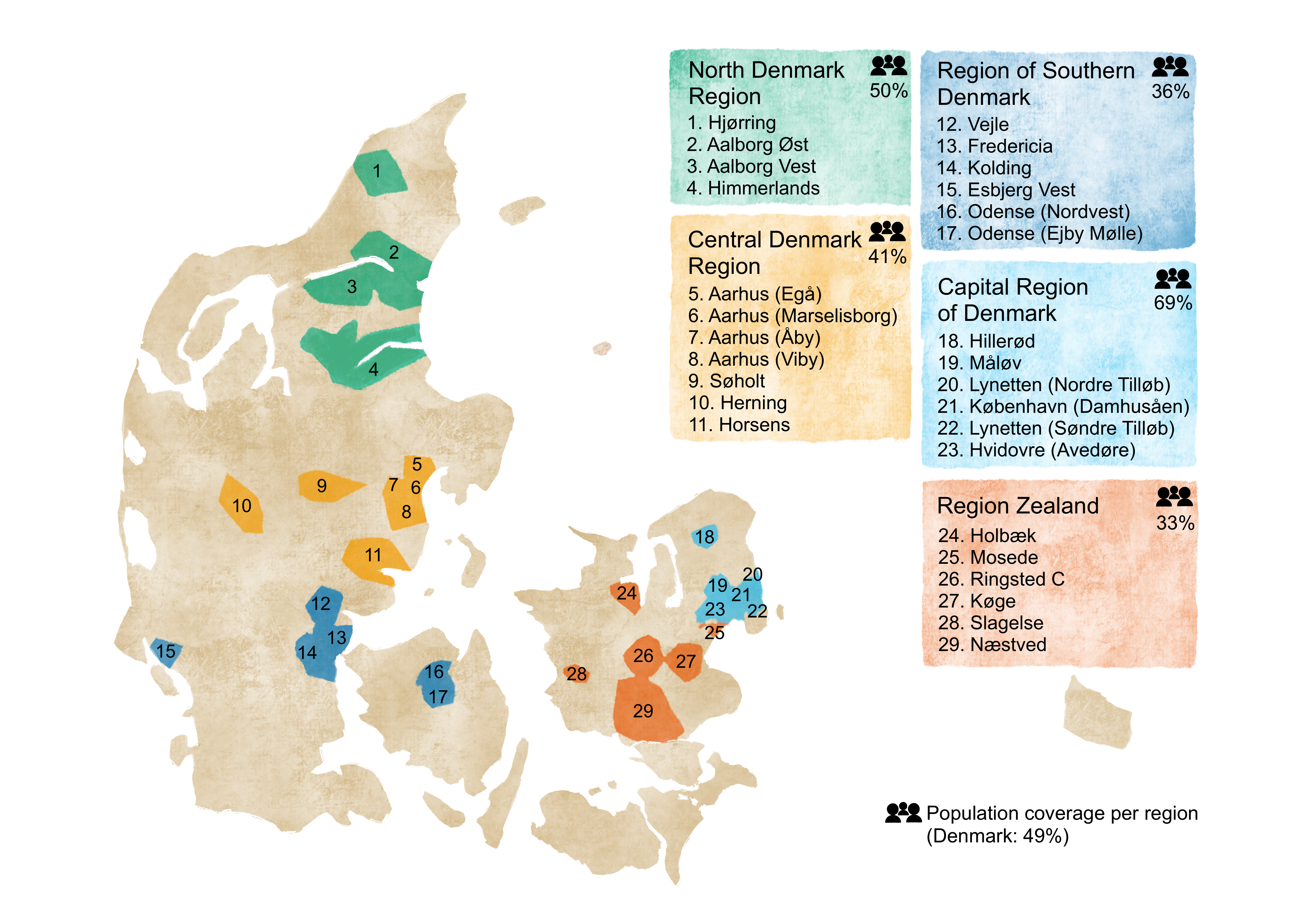
How are viruses measured in wastewater?
How are the wastewater measurement results reported?
Where can I learn more about the national wastewater surveillance?
Publications
Exploring bilateral collaboration for enhanced pandemic preparedness: A pilot study on joint wastewater surveillance in Denmark and Norway. Madslien, E. H., Krogsgaard, L. W., Gudde, A., Petrovic, K., Larsen, N. B., Shaw, D. S., Benedetti, G., & Hyllestad, S. (2026). Science of the Total Environment, 1027, 181654. https://doi.org/10.1016/j.scitotenv.2026.181654
Predicting hospital admissions due to COVID-19 in Denmark using wastewater-based surveillance. Gudde, A., Krogsgaard, L. W., Benedetti, G., Schierbech, S. K., Brokhattingen, N., Petrovic, K., Rasmussen, L. D., Franck, K. T., Ethelberg, S., Larsen, N. B., & Christiansen, L. E. (2025). Science of the Total Environment, 966, 178674. https://doi.org/10.1016/j.scitotenv.2025.178674
A survey of the representativeness and usefulness of wastewater-based surveillance systems in 10 countries across Europe in 2023. Benedetti, G., Wulff Krogsgaard, L., Maritschnik, S., Stüger, H. P., Hutse, V., Janssens, R., Blomqvist, S., Pitkänen, T., Koutsolioutsou, A., Róka, E., Vargha, M., La Rosa, G., Suffredini, E., Cauchie, H. M., Ogorzaly, L., van der Beek, R. F., Lodder, W. J., Madslien, E. H., Baz Lomba, J. A., & Ethelberg, S. (2024). Euro surveillance: European communicable disease bulletin, 29(33), 2400096. https://doi.org/10.2807/1560-7917.ES.2024.29.33.2400096
Results from the SARS-CoV-2 wastewater-based surveillance system in Denmark, July 2021 to June 2022. Krogsgaard, L. W., Benedetti, G., Gudde, A., Richter, S. R., Rasmussen, L. D., Midgley, S. E., Qvesel, A. G., Nauta, M., Bahrenscheer, N. S., von Kappelgaard, L., McManus, O., Hansen, N. C., Pedersen, J. B., Haimes, D., Gamst, J., Nørgaard, L. S., Jørgensen, A. C. U., Ejegod, D. M., Møller, S. S., ... Ethelberg, S. (2024). Water Research, 252. https://doi.org/10.1016/j.watres.2024.121223
Detection of Sequencing Reads from 5’-End Genomic and Subgenomic SARS-CoV-2 RNAs in Wastewater Sampled, Extracted and Sequenced Directly from Aircrafts, Airport Buildings, or Regular Wastewater Treatment Plants. Tang, M.-H. E., Bennedbaek, M., Gunalan, V., Qvesel, A. G., Thorsen, T. H., Rasmussen, L. D., Krogsgaard, L. W., Rasmussen, M., Stegger, M., & Alexandersen, S. (2023). Heylion 2024, May 15. https://doi.org/10.1016%2Fj.heliyon.2024.e29703
Early detection of local SARS-CoV-2 outbreaks by wastewater surveillance: A feasibility study. Nauta, M., McManus, O., Træholt Franck, K., Lindberg Marving, E., Dam Rasmussen, L., Raith Richter, S., Ethelberg, S. (2023) Epidemiology & Infection, 151, e28. https://doi.org/10.1017/S0950268823000146
First cases of SARS-CoV-2 BA.2.86 in Denmark, 2023. Rasmussen, M., Møller, F. T., Gunalan, V., Baig, S., Bennedbæk, M., Christiansen, L. E., Cohen, A. S., Ellegaard, K., Fomsgaard, A., Franck, K. T., Larsen, N. B., Larsen, T. G., Lassaunière, R., Polacek, C., Qvesel, A. G., Sieber, R. N., Rasmussen, L. D., Stegger, M., Spiess, K., Tang, M. E., … Jokelainen, P. (2023). Euro surveillance: European communicable disease bulletin, 28(36), 2300460. https://www.eurosurveillance.org/content/10.2807/1560-7917.ES.2023.28.36.2300460
Wastewater Surveillance in Europe for Non-Polio Enteroviruses and Beyond. Bubba, L., Benschop, K. S. M., Blomqvist, S., Duizer, E., Martin, J., Shaw, A. G., Bailly, J. L., Rasmussen, L. D., Baicus, A., Fischer, T. K., & Harvala, H. (2023). Microorganisms, 11(10), 2496. https://doi.org/10.3390/microorganisms11102496
SARS-CoV-2 Variants BQ.1 and XBB.1.5 in Wastewater of Aircraft Flying from China to Denmark, 2023. Qvesel, A. G., Bennedbæk, M., Larsen, N. B., Gunalan, V., Krogsgaard, L. W., Rasmussen, M., & Rasmussen, L. D. (2023).Emerging Infectious Diseases, 29(12). https://doi.org/10.3201/eid2912.230717
Predicting COVID-19 Incidence Using Wastewater Surveillance Data, Denmark, October 2021-June 2022. McManus, O., Christiansen, L. E., Nauta, M., Krogsgaard, L. W., Bahrenscheer, N. S., von Kappelgaard, L., Christiansen, T., Hansen, M., Hansen, N. C., Kähler, J., Rasmussen, A., Richter, S. R., Rasmussen, L. D., Franck, K. T., & Ethelberg, S. (2023). Emerging Infectious Diseases, 29(8). https://doi.org/10.3201/eid2908.221634