Rabies 2025
Rabies in humans
Rabies post-exposure prophylaxis 2025
In 2025, a total of 529 persons were assessed as having been exposed to possible rabies following animal bites and were started on rabies treatment with post-exposure prophylaxis (PEP). Of these cases, 26 persons had previously received pre-exposure prophylaxis (PrEP).
Post-exposure prophylaxis given following exposure in Denmark
In 2025, 46 persons were started on treatment against rabies following possible exposure in Denmark (PEP). Three of these had received PrEP. Among the 46 persons possibly exposed, 34 received human rabies immunoglobulin (HRIG).
The most frequent exposure in Denmark was bites or scratches from bats, which resulted in 38 persons being started on prophylactic treatment. In addition, eight persons were exposed through bites or scratches from illegally imported dogs. Denmark is free of rabies, apart from in bats, which are the only animals that give rise to rabies prophylaxis in Denmark.
Post-exposure prophylaxis given following exposure abroad
In 2025, 483 persons were started on PEP following possible exposure to rabies outside Denmark. Information on the country in which the exposure had occurred was available for 465 of the persons, while the country was not registered for the remaining 18, who had, however, been exposed in rabies-endemic countries.
Figure 1 shows that the increase in exposure to rabies abroad that began in 2022, following a period with very few exposures as a result of reduced travel activity during the COVID-19 pandemic, continued in 2023, 2024 and 2025.
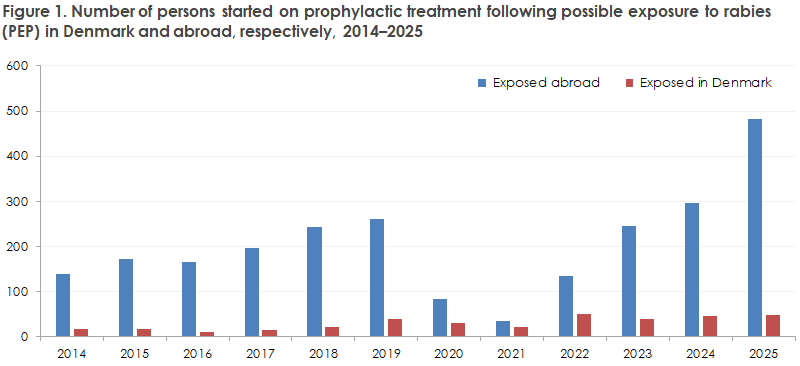
Among the 483 persons who were exposed to possible rabies abroad, 295 received HRIG (61%), of whom 145 did not receive treatment until they came to Denmark.
A large proportion of those who were started on PEP following bites abroad in 2025 were, as in previous years, exposed in Türkiye (145) or Thailand (69), but in 2025 many were also exposed in Indonesia, including Bali (40), Morocco (24) and Sri Lanka (22).
In 2025, cats (n=219, 45%) and dogs (n=166, 34%) were the most frequent causes of possible rabies exposure abroad. Figure 2 shows an increase in the number of dispensations following exposure to cat bites and scratches and, to a lesser extent, dog bites and scratches during the period 2022–2025. The remaining 69 persons (14%) were exposed to possible rabies from other mammals.
For 30 persons, information about the exposure was not available.
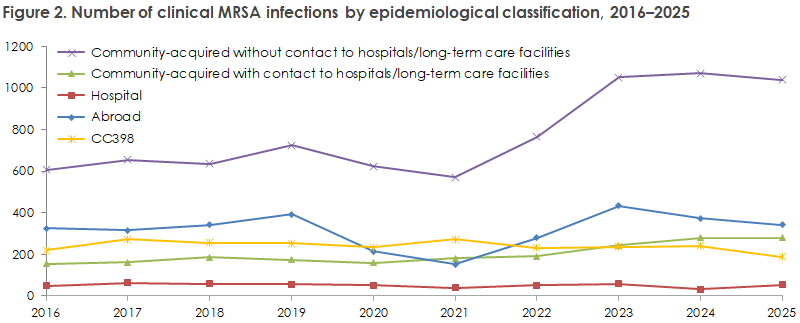
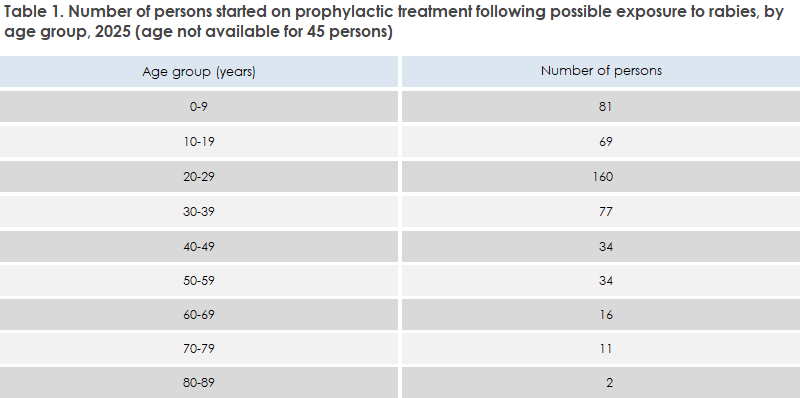
Table 1 shows the distribution of age groups for the persons who were started on prophylactic treatment following possible exposure to rabies in 2025 (age not available for 45 persons). As shown, rabies PEP was in the vast majority of cases given to young people.
Rabies in animals
Rabies is most often caused by classical rabies virus, but can also be caused by other lyssaviruses, including European Bat Lyssavirus (EBLV types 1 and 2), also called European bat rabies. EBLV occurs primarily in bats but can, in rare cases, be transmitted to other mammals.
Classical rabies remains endemic in large parts of the world, including parts of Eastern Europe, while the disease has been eradicated in most of Western Europe. In recent years, an increase in the number of rabies cases has been observed in the EU, particularly in areas bordering Ukraine. In 2025, 136 cases were registered in the EU, compared with 71 in 2022 and only 12 in 2020.
However, the importation of infected pets from rabies-endemic areas continues to pose a risk, and cases of rabies in dogs or cats illegally imported into the EU from Eastern Europe and North Africa are regularly reported. Classical rabies also occurs endemically in Greenland, where the virus circulates among Arctic foxes and can be transmitted to other mammals.
Animals tested for rabies in Denmark
Denmark has been free of classical rabies since 1982. Bat rabies, by contrast, occurs sporadically and was first detected in Denmark in 1985, EPI-NEWS 40/2025. Most recently, EBLV type 1 was detected in a serotine bat in 2009, while EBLV type 2 was detected in a saliva sample from a Daubenton's bat in 2015.
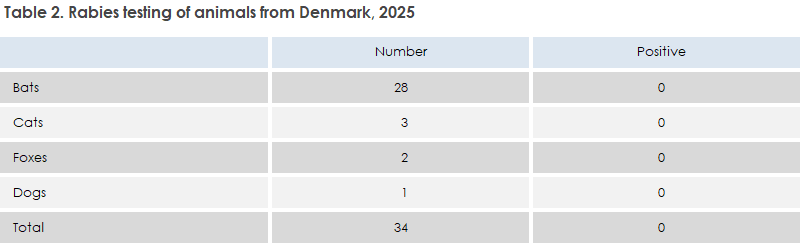
In 2025, 34 animals from Denmark were tested for classical rabies and/or bat rabies as part of passive surveillance. The animals tested comprised three cats, one dog, two foxes and 28 bats. Of the bats, seven were submitted on suspicion of rabies and 21 as animals found dead. All animals tested negative for rabies by PCR, Table 2.
Greenland
In 2025, six Arctic foxes from Greenland were submitted for rabies testing on the basis of clinical suspicion. Classical rabies virus was detected in all six animals, Table 3. By agreement with Statens Serum Institut, the tests were carried out at the Friedrich-Loeffler-Institut (FLI) in Germany.

This report is also discussed in EPI-NEWS 40/2026.