No 40 - 2026
Report on rabies prophylaxis and rabies testing in Denmark in 2025
Report on rabies prophylaxis and rabies testing in Denmark in 2025
This EPI-NEWS is published on 28 September on the occasion of World Rabies Day, which is marked every year on this date to focus attention on the prevention and control of rabies. Every year, approximately 59,000 people die from rabies, which is a preventable viral disease caused by lyssavirus.
For a detailed description of rabies post-exposure prophylaxis (PEP) as well as animals tested for rabies in Denmark in 2025, please refer to the annual report.
Marked increase in the number of persons receiving rabies prophylaxis after contact with animals abroad
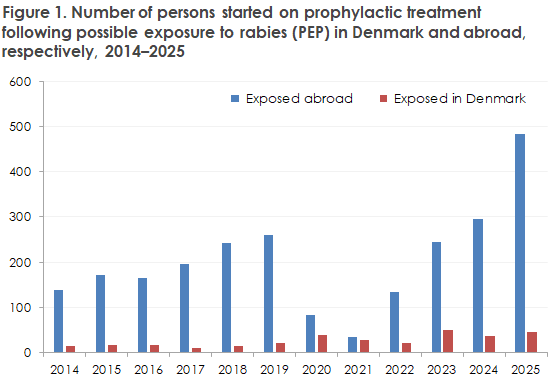
In 2025, a total of 529 persons were assessed as having been exposed to possible rabies and started post-exposure prophylaxis (PEP). The vast majority, 483 persons (91%), had been exposed to animals abroad. The largest number of PEP treatments were given following exposure in Türkiye and Thailand, but travel to, among other places, Indonesia, including Bali, Morocco and Sri Lanka, also resulted in several treatments.
The number of PEP treatments following possible rabies exposure abroad thus increased markedly. In 2025, the number was 65% higher than in 2024, which had otherwise been the year with the highest number recorded to date. At the same time, the figures show that access to human rabies immunoglobulin (HRIG) remains limited in many countries. Among the 483 persons who were exposed abroad, 295 (61%) received HRIG. Of these, 145 did not receive HRIG until after their return to Denmark.
The increase has continued in 2026
In autumn 2025, SSI therefore strengthened its advice to travellers, EPI-NEWS 40/2025. In addition to avoiding contact with animals in areas where rabies occurs, it is recommended to consider preventive rabies vaccination before travel, including for shorter trips, and particularly to destinations where access to rabies vaccine and especially HRIG may be limited. The marked increase has continued in 2026. Already by the end of August, more rabies PEP treatments had been dispensed than during the entirety of 2025.
HRIG is a limited resource globally, partly because the product is complex and expensive to manufacture, while demand is high. The supply situation in Denmark is currently sufficient, but it is important that PEP is used correctly and following a professional risk assessment, so that HRIG is given to those persons for whom treatment is indicated. HRIG is dosed according to body weight but is adapted to local anatomical conditions, as it must be infiltrated around the site of exposure.
In Denmark, the dispensing of rabies PEP is managed centrally through SSI. In light of the increasing number of treatments, SSI is currently examining, together with regional hospital pharmacies and several infectious diseases departments, the possibility of organising dispensation differently so that the procedure becomes simpler for both patients and the healthcare professionals administering the treatment.
Increasing demand is also seen in other countries
Denmark is not alone in this development. In the United Kingdom, the guidelines for the use of HRIG were adjusted in 2025 to prioritise treatment for persons with the greatest need and ensure appropriate use of the available supplies. On 10 September 2026, the US CDC likewise reported an increase in the use of rabies PEP.
The increasing demand may, among other things, be related to several rabies deaths in the Western part of the world over the past couple of years and the considerable media attention these have generated. Increased awareness of rabies is important, and persons with relevant exposure should always be offered PEP. At the same time, it is crucial that treatment is based on a specific risk assessment of the exposure.
Worldwide, the vast majority of human cases of rabies are caused by transmission from dogs. According to WHO, dogs are responsible for up to 99% of human rabies deaths, and around 40% of deaths occur among children under 15 years of age.
Travellers can reduce their risk
Danish travellers to countries where rabies occurs should avoid contact with animals, including animals that appear tame or healthy. Preventive rabies vaccination should be considered before travel to rabies-endemic areas, particularly if access to rabies vaccine and HRIG at the destination is limited. A completed preventive vaccination series (PrEP) means that HRIG can be avoided and only two vaccines are required as PEP. Separate recommendations apply where there is a risk of occupational exposure. In the event of a bite, scratch or other possible exposure, thorough and prompt washing of the wound with soap and water is an important part of the initial treatment. Thereafter, a healthcare assessment of the need for rabies PEP should be carried out as soon as possible.
In cases of doubt regarding indication, procedure or treatment, healthcare professionals are referred to SSI's website, where information on rabies, PEP and dispensing of treatment is available. General practice has a central role in the management of rabies PEP. Patients with possible rabies exposure should, to the greatest extent possible, be assessed and treated in general practice, which can contact SSI for advice and dispensing of rabies vaccine and HRIG. Emergency departments should, as a general rule, only be involved when special wound treatment is required, or outside general practice opening hours, for example in the evening and on weekends, if treatment cannot wait. This division of responsibilities is intended to ensure prompt and correct treatment while at the same time avoiding unnecessary contacts with emergency departments. If urgent advice is required, healthcare professionals can contact SSI during daytime hours at 3268 3037 and outside daytime hours at 4131 7404.
Rabies exposure in Denmark
There were 46 persons who were started on treatment following possible exposure to rabies in Denmark in 2025, the majority following bites/scratches from bats. This is at the same level as exposure in Denmark in recent years.
Rabies in animals
Denmark has been free of classical rabies since 1982, while European bat rabies occurs sporadically in Danish bats.
In 2025, three cats, one dog, two foxes and 28 bats from Denmark were tested for rabies. Of the bats, seven were submitted based on suspicion of rabies and 21 as animals found dead. All 34 animals tested negative.
Classical rabies occurs endemically in Greenland, where the virus circulates among Arctic foxes and can spread to other mammals. In 2025, six Arctic foxes from Greenland were tested on the basis of clinical suspicion, and all were positive for classical rabies virus.
In the EU, an increase in the number of cases of classical rabies has been observed in recent years, particularly in areas bordering Ukraine. In 2025, 136 cases were registered in the EU, compared with 71 in 2022 and 12 in 2020.
(S. Voss, A.-K. Rosenkrantz De Lasson, M. Wessman, Department of Infectious Disease Epidemiology and Prevention, B. Strandbygaard, K.M. Bay Tjørnehøj, B. Bødker Jensen, T.B. Rasmussen, Virology and Microbiological Preparedness)