MRSA – Annual report on disease occurrence, 2025
MRSA – Annual report on disease occurrence, 2025
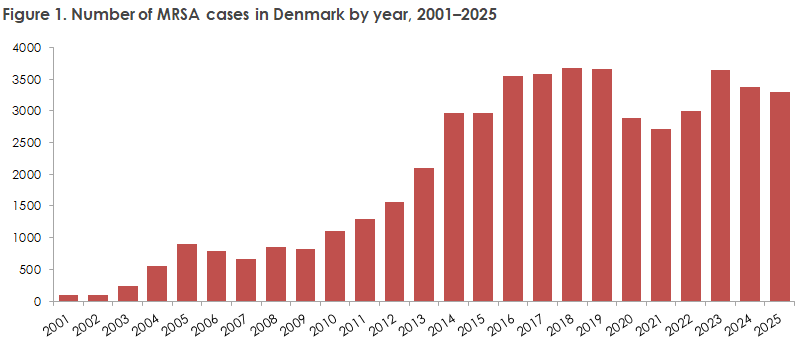
In 2025, a total of 3,301 individuals were diagnosed with methicillin-resistant Staphylococcus aureus (MRSA). Excluding the three years affected by the COVID-19 epidemic, this was the lowest number recorded since 2015. During the COVID-19 epidemic, the number of cases declined by approximately 20% as a result of restrictions on international travel and social contacts.
Epidemiological classification
MRSA cases are classified according to the presumed route of transmission as imported, hospital-acquired, community-acquired, or livestock-associated. In Denmark, livestock-associated MRSA is almost always caused by the MRSA clone CC398, which is closely associated with contact with live pigs, whereas the other presumed routes of transmission involve many different MRSA types.
Community-acquired MRSA is further subdivided according to whether the individual has had contact with hospitals or the long-term care sector within the preceding six months, and whether the individual has had contact (exposure) with a person known to be MRSA-positive.
Table 1 shows the distribution of notified MRSA cases according to the presumed route of transmission.
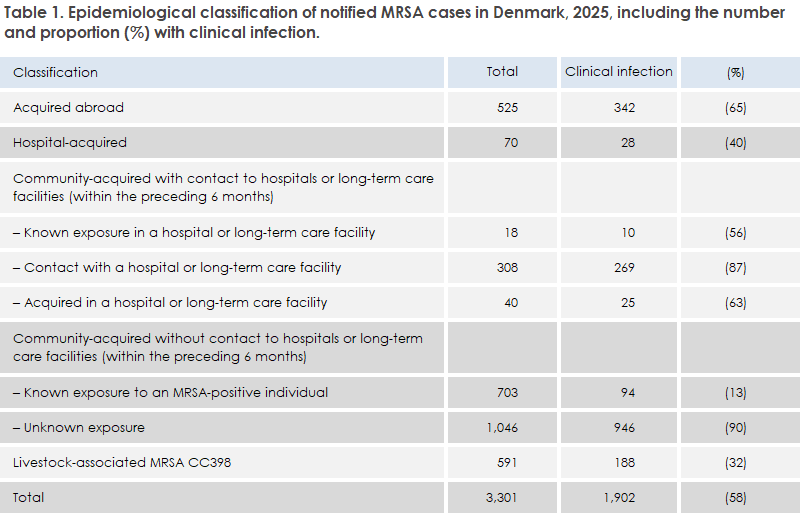
The majority of MRSA cases were acquired in Denmark (2,776), while acquisition abroad was reported for 525 cases (16%). During the COVID-19 epidemic, this proportion was lower, whereas before the COVID-19 epidemic it ranged between 15% and 20%. The number of hospital-acquired MRSA cases was 70 (83 in 2024 and 102 in 2023), continuing to account for only a small proportion of the total number of cases (2.1%). Community-acquired MRSA cases without contact with hospitals or the long-term care sector accounted for 1,749 cases in 2025 (53%). Of these, 703 (40%) had known exposure to a person with MRSA. The number of livestock-associated MRSA CC398 cases was 591, accounting for 18% of all MRSA cases. This is the lowest proportion since 2012, when livestock-associated MRSA CC398 accounted for 15% of all cases that year. The proportion peaked in 2014, when it represented 43% of all new MRSA cases. The decline in livestock-associated MRSA CC398 may be explained by the fact that surveillance includes only new cases; therefore, individuals who have previously tested positive are not registered again. The prevalence in pig herds remains above 90%.
Infections
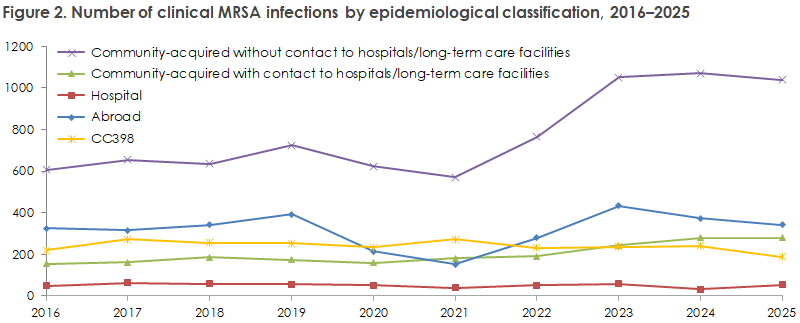
Clinical infection was the reason for specimen collection in 1,902 cases (58%). Most infections occurred among community-acquired cases without contact with hospitals or long-term care facilities (946 cases), followed by imported cases (342 cases) (Figure 2). The number of infections among imported cases was slightly lower than in the previous year (373 in 2024). MRSA was isolated from blood in 67 cases, corresponding to 2.8% of all Staphylococcus aureus bacteremia cases. The proportion of MRSA among bloodstream isolates of S. aureus is typically between 1.5% and 3%.
Among hospital-acquired cases, 28 patients were diagnosed with MRSA infection (40%), while 25 healthcare workers (63%) were diagnosed with MRSA infection. Among community-acquired infections, 94 cases had known exposure to a person with MRSA (Table 1). The number of community-acquired infections in individuals who had reported contact with hospitals or the long-term care sector within the preceding six months was 279 in 2025, similar to the number in 2024 (n = 278) (Figure 2).
Typing
MRSA of the CC398 lineage was identified by a specific PCR assay, which simultaneously determined whether the strain was the livestock-associated MRSA CC398 type (n = 591) or the human-associated variant (n = 55). Isolates with the characteristic livestock-associated MRSA CC398 profile were, as a rule, not spa typed, whereas all other isolates underwent strain typing.
The remaining 2,671 isolates belonged to 403 different spa types, grouped into 26 different clonal complexes (CCs). The five most common were t304/CC6 (n = 277), t127/CC1 (n = 148), t223/CC22 (n = 125), t688/CC5 (n = 124), and t002/CC5 (n = 113). MRSA spa type t688/CC5 was new to the top five compared with the previous year, whereas the other types have consistently ranked among the most common for several years. MRSA spa type t688 was most frequently identified in patients from the Capital Region of Denmark (n = 84; 68%) and was most often acquired in the community (n = 87; 70%) or imported from abroad (n = 24; 19%).
Outbreaks
Statens Serum Institut offers whole-genome sequencing of all isolates associated with outbreaks, thereby providing a more detailed characterization of isolates than spa typing alone. If an outbreak is caused by a clone belonging to a commonly occurring spa type, whole-genome sequencing can be an important tool for identifying and delineating the outbreak. This enables the true extent of the outbreak to be determined more accurately.
Through notifications of new cases, collaboration with the local MRSA units, and typing of submitted isolates, a total of 36 outbreaks were identified in hospitals, nursing homes, and other institutions.
These outbreaks involved 118 MRSA cases, including 56 with clinical infection and 62 identified through screening and contact tracing. Most outbreaks involved between one and five patients. The largest outbreak involved 18 patients and originated in a neonatal unit. Among the 36 outbreaks, seven occurred in neonatal units. Five of these outbreaks had begun in previous years, with additional patients identified during 2025. In addition, there were 15 outbreaks in nursing homes and associated with home-care services (39 patients in total) and 10 outbreaks in hospital departments other than neonatal units (24 patients).
Livestock-associated MRSA CC398
The number of livestock-associated MRSA CC398 cases (n = 591) was the lowest since 2012, when 232 cases were recorded. A total of 188 individuals (32%) had a clinical infection at the time of diagnosis, Table 1.
Contact with livestock, particularly pigs, remains the principal source of transmission of livestock-associated MRSA to humans. In total, 472 cases (80%) occurred in individuals with direct contact with pigs or among members of their households. The remaining 119 patients (20%) had no known contact with animals. Of these, 91 had a clinical infection. The proportion of infected individuals without known livestock contact was similar to that observed in recent years, suggesting that no new major transmission routes for livestock-associated MRSA to humans have emerged in Denmark.
Most patients with livestock-associated MRSA who had no known contact with livestock were classified as having community-acquired infection, either with or without contact with the healthcare system. In 2025, seven cases of bloodstream infection caused by livestock-associated MRSA CC398 were identified; two of these patients died within 30 days of the date of specimen collection.
MRSA can also be detected in livestock other than pigs, particularly horses and cattle, and only rarely in poultry. However, the prevalence of MRSA in these animal populations is much lower than in pig herds. In addition, hedgehogs are a natural reservoir of the mecC variant of MRSA. In 2025, detection of livestock-associated MRSA CC398 in humans with contact to animals other than pigs was limited and included 27 patients with cattle contact, 13 with horse contact, and one with poultry contact. Among the 37 patients with mecC MRSA in 2025, six reported contact with animals: horses (n = 2), pigs (n = 1), and other animals (n = 3).
Imported MRSA
The number of imported MRSA cases was 525, similar to the number recorded in 2024 (515). These cases accounted for 16% of all MRSA cases. Among the imported cases, 105 (20%) had a history of hospital contact abroad.
This report is also described in EPI-NEWS Week 26/2026.