Marine bacteria – annual summary 2020–2025
Vibrio and Shewanella Infections in Denmark, 2020-2025
Key Messages
- A total of 934 Vibrio or Shewanella infection episodes were reported during 2020–2025. In 2025, 141 episodes were reported.
- Both infections occurred primarily during the summer months.
- Coastal municipalities, particularly in Funen and Zealand, had the highest incidence, although cases occurred across the country.
- Older adults – especially men – were disproportionately affected.
- Clinical awareness should be increased during summer, particularly for wound, ear, or systemic infections following seawater or brackish-water exposure.
Introduction
Vibrio and Shewanella spp. are Gram-negative bacteria that naturally occur in marine waters, particularly in areas where freshwater mixes with seawater. Several non-cholera Vibrio species, including V. vulnificus, V. parahaemolyticus, and V. alginolyticus, can cause vibriosis, with clinical manifestations ranging from mild gastroenteritis to severe wound infections, septicaemia, and, in rare cases, necrotising fasciitis. V. vulnificus is associated with particularly severe disease and high mortality, especially among individuals with underlying conditions. Infections are typically linked to exposure to seawater or consumption of raw or undercooked seafood, notably oysters. The latter route of infection is believed to be of only minor importance in Denmark.
Shewanella spp. infections are usually mild with a clinical picture resembling that of Vibrio infections but severe outcomes have been reported, particularly in persons with comorbidities following marine exposure.
Environmental factors play a key role in the occurrence of these infections. Rising seawater temperatures associated with climate change have contributed to an increased incidence of Vibrio and Shewanella infections in northern Europe, particularly in brackish (low-salinity) waters such as the Baltic Sea. During warm summers and heatwaves, marked increases in infections have been observed. In Denmark, both Vibrio and Shewanella infections have shown a clear seasonal pattern and a positive association with higher seawater temperatures.
This report presents an overview of Vibrio and Shewanella infections in Denmark during 2020–2025, focusing on national trends, seasonality, geographic distribution, and demographic characteristics. A laboratory-based surveillance system at Statens Serum Institut is planned for implementation in 2026, after which routine annual reporting will be established.
More information about marine bacteria can be found in Sygdomsleksikon (in danish language).
Trends of marine bacteria episodes 2020–2025
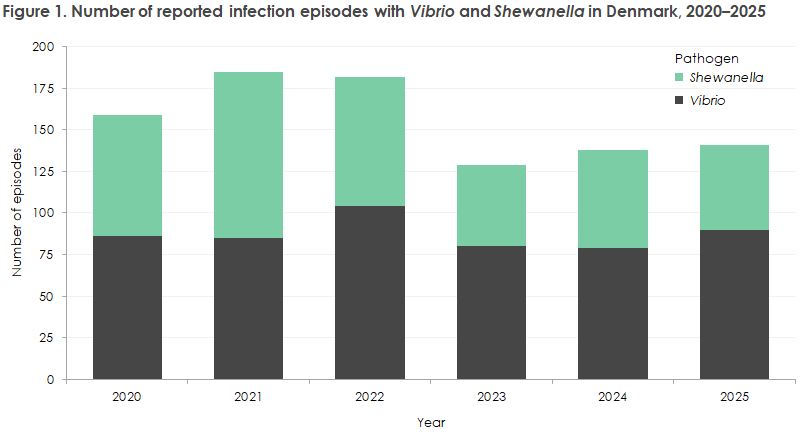
A total of 1,021 infection episodes of Vibrio and Shewanella infection episodes were reported through MiBa in Denmark during 2020–2025. Out of these, 87 (9%) episodes were travel-related. As travel-related episodes are not the focus of this report, they were excluded from the analyses presented here. This overview therefore includes 934 infection episodes of Vibrio or Shewanella (Figure 1). Annual episode counts showed moderate variation over the study period, ranging from 129 episodes in 2023 to 185 episodes in 2021.
Across all years, Vibrio spp. accounted for the majority of episodes (n=524), while Shewanella spp. contributed a slightly smaller but stable proportion (n=410). Despite year-to-year fluctuations, the level of episodes remained relatively consistent.
Seasonality of episodes
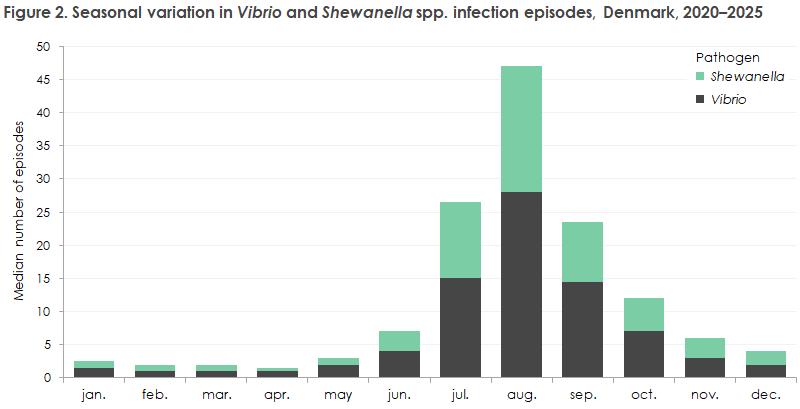
The median monthly number of marine bacteria episodes in Denmark during 2020–2025 showed a clear seasonal pattern (Figure 2). Episode counts were low during winter and spring, increased from June, and peaked in July and August before declining in autumn. Vibrio spp. accounted for the majority of episodes throughout the year. This seasonality trend is thought to reflect the link between infections related to marine bacteria, increased temperature of seawater, and summer recreational exposure.
Geographical Distribution
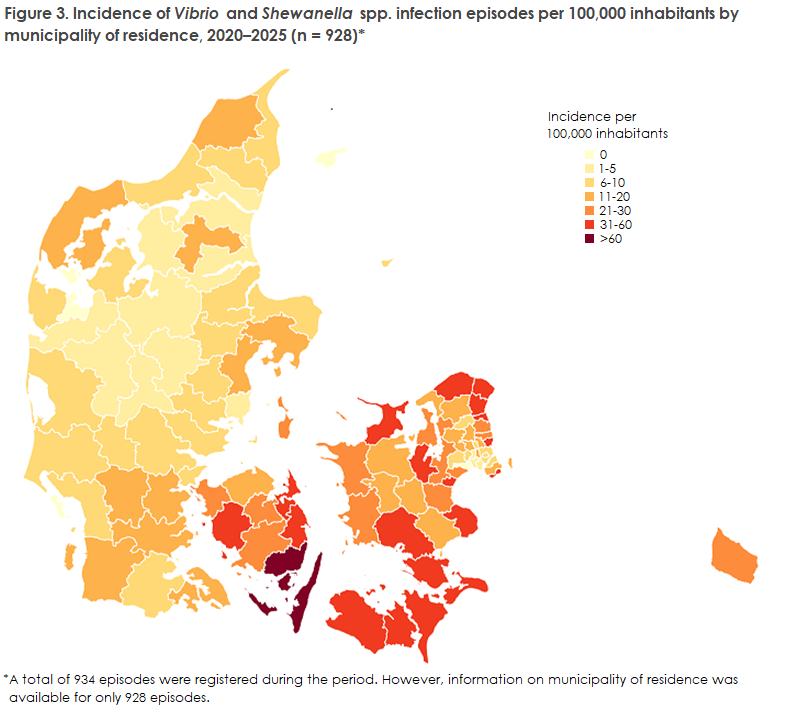
The geographical distribution of Vibrio spp. and Shewanella spp. episodes in Denmark during 2020–2025 is shown in Figure 3. Incidence varied across municipalities, ranging from no reported cases in some municipalities to markedly higher incidence levels in others.
Overall, higher incidence was more frequently observed in coastal and island municipalities, whereas lower incidence predominated in most inland areas. The majority of municipalities had incidence levels below 20 episodes per 100,000 population, while a smaller number reached incidence above 30 per 100,000 inhabitants. Very high incidence levels (>60 per 100,000 population) were confined to a limited number of municipalities.
The highest incidence during the study period was observed in Ærø (138.6 per 100,000; population approximately 5,800), Langeland (101.0 per 100,000; population approximately 11,900), and Svendborg (63.3 per 100,000; population approximately 60,000). These municipalities are coastal or island areas with relatively small populations, where even a limited number of episodes can result in high incidence rates.
Because the analysis of geographical distribution is based on residential addresses, the distribution does not necessarily reflect the location of exposure. Patients may have been exposed elsewhere (e.g. recreational areas, at a location of a summer house etc.) but this information is not captured in the available data. Therefore, the map shown in Figure 3 is not expected to fully reflect where the infections were acquired.
Demographic Patterns
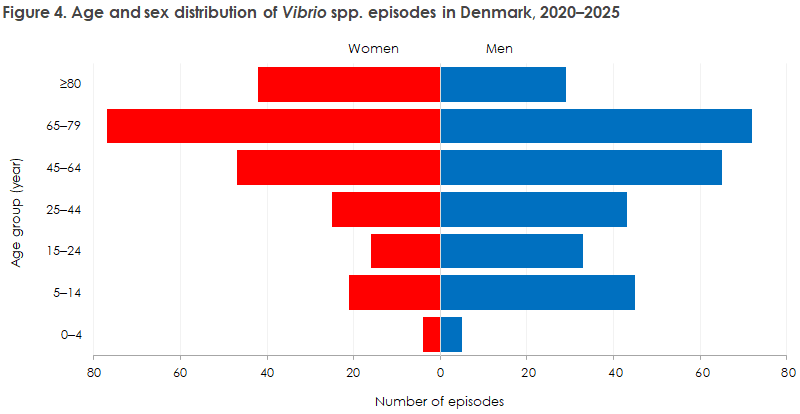
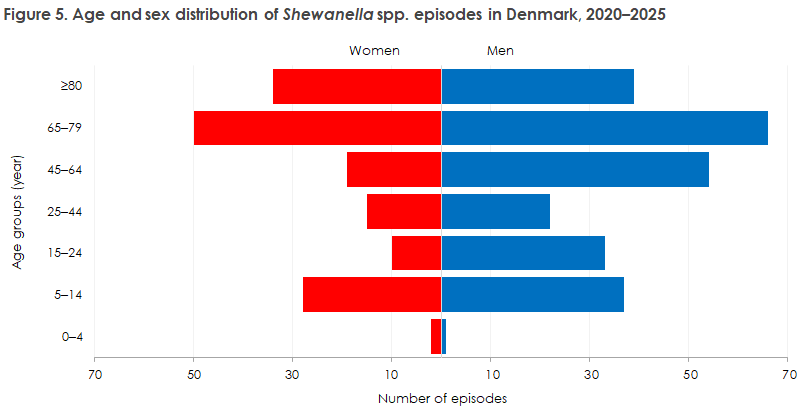
Figures 4 and 5 show the age group and sex distribution of the Vibrio spp. and Shewanella spp. episodes. For the 524 Vibrio spp. episodes, 230 were females (44%); out of the 410 Shewanella spp. episodes, 157 (38%) were female.
Across both pathogens, infections occurred predominantly among middle-aged and older adults, with the highest numbers observed in patients aged 45–64 years and 65–79 years, followed by those aged ≥80 years. Only a small number of cases were reported among children and younger adults. Overall, men were more frequently affected than women, particularly in the adult age groups, although sex differences were less pronounced among the older patients. The age–sex distributions were broadly similar for Vibrio spp. and Shewanella spp.
Discussion
Epidemiological patterns
Vibrio and Shewanella infections in Denmark during 2020–2025 showed consistent and predictable patterns. The pronounced summer seasonality and coastal clustering correspond with periods of elevated seawater temperatures and increased recreational water activity, which are known environmental drivers for both pathogens. Older adults—particularly men—were most frequently affected. Summer seasonality trends remained stable, and 2025 followed the established seasonal baseline for both pathogens.
Limitations
This analysis is based on routine diagnostic testing and likely underestimates the true incidence. Reported municipality reflects residence and not necessarily the location of exposure, which may misrepresent geographical patterns during peak travel periods. Incidence estimates in small municipalities can appear inflated due to small population denominators. Despite these limitations, the observed patterns are consistent with previous national and international findings and provide a reliable overview of trends in Denmark.
Conclusion
Infections caused by Vibrio spp. and Shewanella spp. represent a seasonal, seawater exposure-related public health concern in Denmark. Incidence is higher during the summer months, particularly among older adults and residents of coastal areas. The consistent warm-season pattern highlights the importance of heightened clinical awareness in summer, in particular in very warm summers, especially for wound, ear, and bloodstream infections following seawater exposure. Continued surveillance is essential to detect timely changes in incidence and seasonal trends.
This summary is also mentioned in EPI-NEWS 10/2026.