Annual report on imported malaria, 2019 to 2025
Annual report on imported malaria, 2019 to 2025
Presented here is a summary of the annual cases of malaria imported into Denmark during the period from 2019 to 2025.
The report includes all cases of malaria detected at the country's Departments of Clinical Microbiology (DCMs) and Statens Serum Institut (SSI). There are primarily four classical human malaria species (Plasmodium falciparum, Plasmodium vivax, Plasmodium ovale, and Plasmodium malariae), as well as the zoonotic malaria species, Plasmodium knowlesi, which is found in certain species of monkeys in Southeast Asia but which, in rare cases, can also be transmitted to humans via mosquito bites. The malaria cases were diagnosed using malaria microscopy, rapid antigen testing, and the molecular methods LAMP and PCR, often by a combination of several methods. In a few cases, additional analyses in the form of NGS (next-generation sequencing) were performed at SSI.
The report is based partly on the mandatory laboratory notifications submitted to SSI (i.e. until the introduction of the new Executive Order on Notifiable Infectious Diseases on 1 November 2023), and partly on data extracts from the Danish Microbiology Database (MiBa). For cases with missing information, such as the country of infection, these data were obtained through direct contact with the relevant hospitals.
Detected malaria cases, 2019–2025
A total of 381 cases were detected during this period, with the following numbers of cases per year: 72 in 2019, 32 in 2020, 38 in 2021, 67 in 2022, 70 in 2023, 63 in 2024, and 39 in 2025.
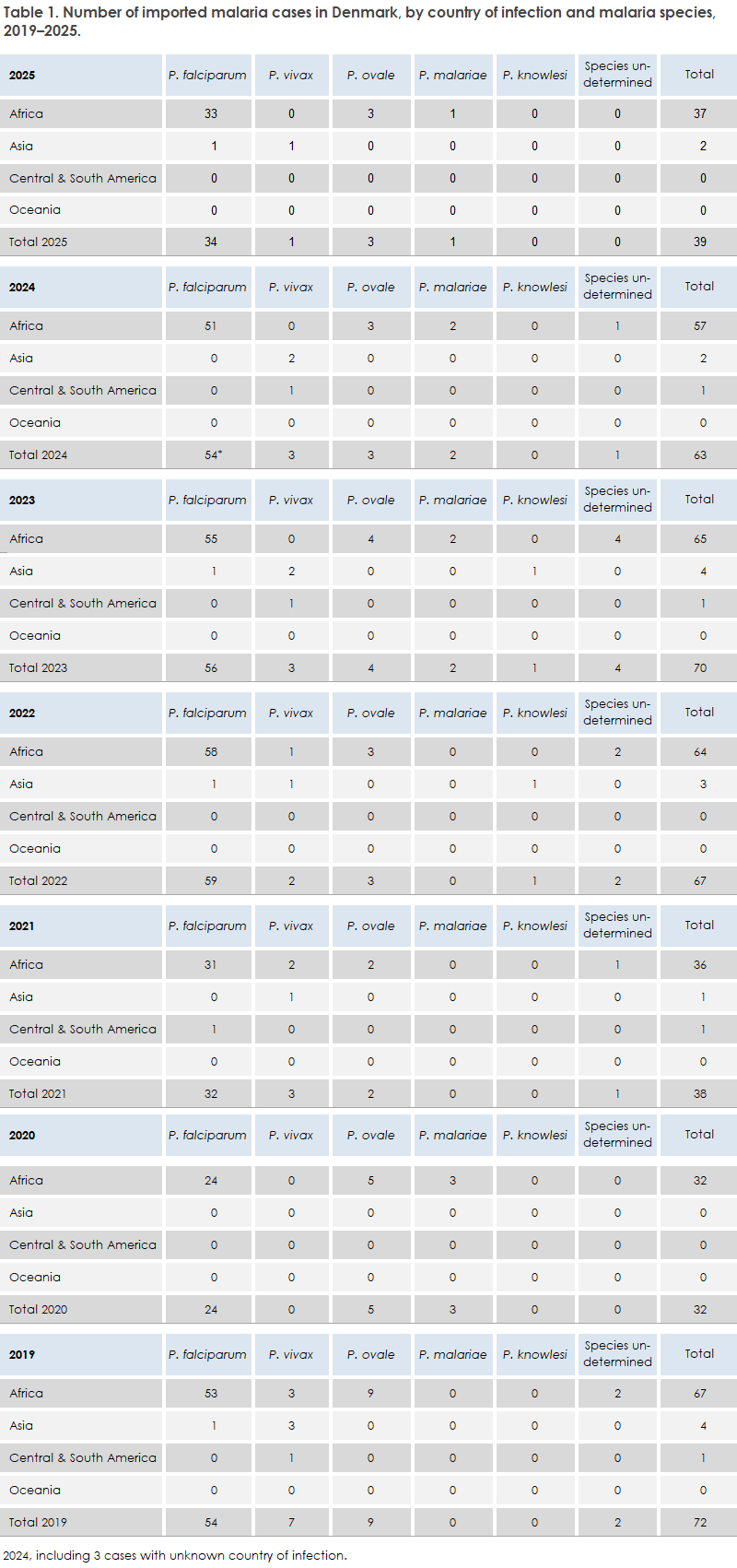
The number of malaria cases per year, stratified by malaria species and geographical region, is shown in Table 1.
The number and percentage distribution by malaria species for the period were as follows: P. falciparum 313 (82%), P. vivax 19 (5%), P. ovale 29 (8%), and P. malariae 8 (2%). In 10 cases, the malaria species was not specified, or the cases represented mixed infections. Unusually, two cases of P. knowlesi were detected, one in 2022 and one in 2023.
It was possible to obtain information on the country of infection for almost all cases (with the exception of three). The majority of cases, 358 (95%), were imported from Africa, 16 cases (4%) from Asia, and 4 cases (1%) from Central and South America. No cases were reported from Oceania.
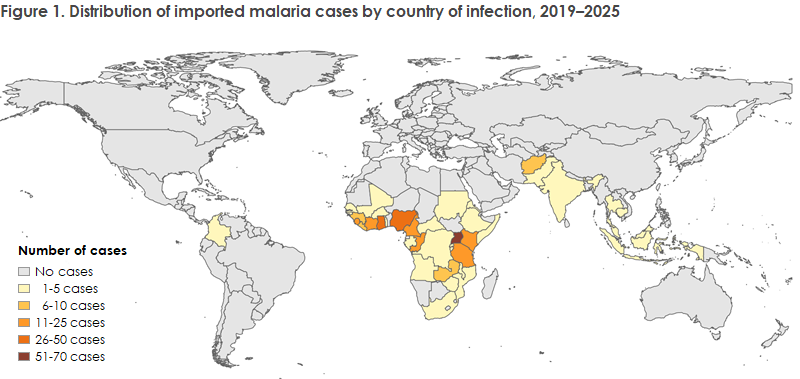
The distribution of the total number of malaria cases (across all malaria species) by country of infection for the period 2019–2025 is shown in Figure 1. From Africa, particularly high numbers of cases were imported from Uganda, Nigeria, and Ghana, while from Asia, the largest numbers of cases were imported from Afghanistan, Pakistan, and India. It is important to note that these figures do not take into account the number of travelers returning from each country but only show the absolute numbers of cases.
Among the cases imported from Africa, the majority, 305 (85%), were caused by P. falciparum. Among the cases imported from Asia, the majority, 10 (63%), were caused by P. vivax, although four cases caused by P. falciparum were also imported from Asia.
The two detected cases of P. knowlesi were imported from Malaysia (Borneo) and Indonesia, respectively. In both cases, the individuals were most likely Danish tourists.
The median age of the reported malaria cases was 38 years (range 1 to 88 years). Overall, 64% of those infected were men and 36% were women. A slightly higher proportion (59%) of the imported malaria cases occurred among travelers of non-Danish ethnic origin.
Historical trend in annual imported malaria cases
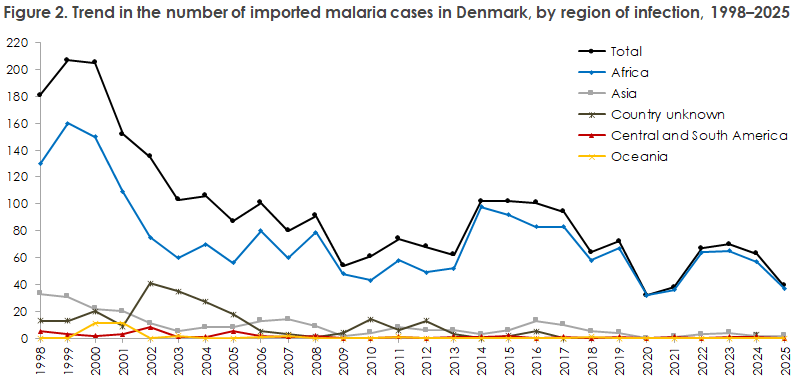
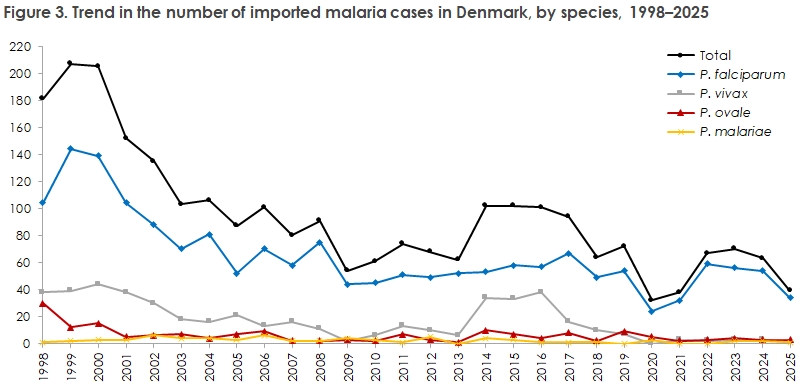
The trend in the number of malaria cases imported into Denmark since 1998, by geographical region, is shown in Figure 2, while the trend in the number of cases by malaria species is shown in Figure 3.
Overall, the trends illustrate a gradual decline in imported malaria in Denmark since the 1990s, accompanied by an increasing concentration of P. falciparum cases among travelers returning from Africa.
During the reporting period 2019–2025, a marked decline was observed in 2020 and 2021, coinciding with the reduced travel activity during the coronavirus pandemic. In 2022, 2023, and 2024, the number of cases returned to approximately the same level as in the years immediately preceding the pandemic, but the number declined again in 2025.
Rare cases of zoonotic malaria among travellers returning from Southeast Asia
In 2022, the first imported case of Plasmodium knowlesi was detected in Denmark, in a traveler returning from Malaysian Borneo. A second case of P. knowlesi malaria was detected in 2023, this time in a traveler returning from Indonesia. In both instances, the individuals were most likely Danish tourists.
The diagnosis of P. knowlesi can only be established using molecular methods, which are increasingly being used for malaria diagnostics in Danish microbiology laboratories. At the same time, data from Southeast Asia suggest that P. knowlesi is more widespread than previously assumed. It is important to be aware of this additional malaria risk for travelers, particularly during stays involving overnight accommodation in jungle areas, although the overall risk remains low.
This report is also described in EPI-NEWS Week 25/2026.