No 25 - 2026
Imported malaria, 2019 to 2025
Imported malaria, 2019 to 2025
Malaria remains one of the most serious health risks for travelers in many tropical areas. Here, a brief status is presented of the number of imported cases of malaria to Denmark during the period 2019–2025. The overview includes all cases of malaria detected at the country's Departments of Clinical Microbiology (DCMs) and Statens Serum Institut (SSI).
There are primarily four classical human malaria types (Plasmodium falciparum, Plasmodium vivax, Plasmodium ovale and Plasmodium malariae), as well as the zoonotic type of malaria, Plasmodium knowlesi, which is found in certain species of monkeys in Southeast Asia but which, in rare cases, can also be transmitted to humans via mosquito bites.
For a more detailed description of the malaria cases imported to Denmark during the years 2019–2025, refer to the annual report on SSI's website.
Detected malaria cases during the period 2019–2025
A total of 381 cases were detected during this period, with the following numbers of cases per year: 72 in 2019, 32 in 2020, 38 in 2021, 67 in 2022, 70 in 2023, 63 in 2024, and 39 in 2025.
The number and percentage distribution by malaria type during the period were as follows: P. falciparum 313 (82%), P. vivax 19 (5%), P. ovale 29 (8%), P. malariae 8 (2%). In ten cases, the malaria type was not specified, or the cases were mixed infections.
The majority of the cases were imported from Africa, a total of 358 (95%), while 16 cases (4%) were seen among travelers from Asia and four cases (1%) from Central and South America. No cases were seen from Oceania.
Notably, two cases of P. knowlesi were detected in travelers returning from Southeast Asia: one case in 2022 following travel in Malaysian Borneo and one in 2023 following travel in Indonesia.
The median age of the reported malaria cases was 38 years (range 1 to 88 years). A total of 64% of those infected were men and 36% were women. A slightly higher proportion, 59%, of the imported malaria cases was seen among travelers of ethnic origin other than Danish.
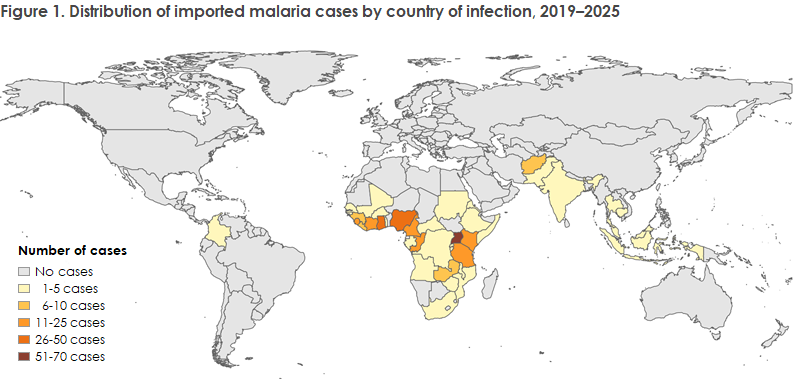
The distribution of malaria cases (across malaria types) by country of infection is shown in Figure 1. From Africa, particularly many cases were imported from Uganda, Nigeria, and Ghana, while from Asia, the greatest number of cases were imported from Afghanistan, Pakistan, and India. However, it is important to note that these figures do not take into account the number of travelers returning from the individual countries but only show the absolute numbers of cases.
Among the cases imported from Africa, the majority (85%) were caused by P. falciparum, whereas the cases imported from Asia were predominantly (63%) caused by P. vivax; however, four cases caused by P. falciparum were also seen from Asia.
Historical trend in annual imported malaria cases
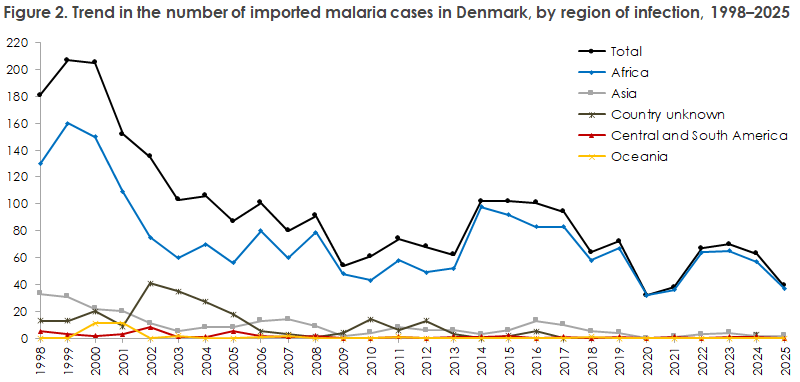
The trend in the annual number of imported malaria cases in Denmark since 1998, by geographical region, is shown in Figure 2. Overall, there has been a steady decline since the late 1990s, with an increasing proportion of cases originating from Africa.
A marked decline in imported malaria cases was observed in 2020 and 2021, coinciding with the reduced travel activity during the coronavirus pandemic. In 2022, 2023, and 2024, the number of cases returned to the same level as in the years before the pandemic but declined again in 2025.
It is always important to be aware of the potential risk of malaria – before, during, and after travel
As the figures show, the risk of malaria for travelers continues to consist primarily of falciparum malaria in Africa, which accounts for the vast majority of malaria cases imported into Denmark. This is despite the fact that the number of Danish travelers to Africa is lower than the number travelling to, for example, Southeast Asia, where the malaria risk is substantially lower than in Africa.
Although the number of malaria cases imported into Denmark has fortunately been declining for several years, malaria remains a potentially serious and fatal infection that travelers themselves, travel medicine clinics, and treating physicians must always keep in mind. In most cases, malaria can be prevented, diagnosed, and treated effectively, yet severe disease courses continue to occur because of insufficient awareness, resulting in delayed diagnosis and treatment. An example of this occurred in Denmark during the winter of 2025, when a Danish boy developed severe, life-threatening cerebral malaria after a family holiday in Indonesia, where, in what was presumed to be a low-risk area, he acquired P. falciparum malaria, as described in a case report in the Ugeskrift for Læger. Examples such as this underscore the importance of never overlooking the potential risk of malaria for travelers—before, during, and after travel.
In addition to the well-known human malaria species, Denmark has in recent years recorded a total of three cases of zoonotic malaria, acquired from monkeys via mosquito bites during travel involving stays in jungle areas of Southeast Asia. Besides the two P. knowlesi cases mentioned above in travelers returning from Malaysia in 2022 and Indonesia in 2023, an unusual case of the malaria species P. cynomolgi was detected in a Danish tourist returning from Thailand in 2018, EPI-NEWS 27a+b, 2019. Such exotic malaria cases further emphasize the importance of maintaining awareness of malaria risk among travelers in many parts of the world, although the most important risk to be aware of remains falciparum malaria in Africa.
(L.S. Vestergaard, A.V. Søndergaard, Department of Infectious Disease Epidemiology and Prevention, Jonas Kähler, Data Integration and Analysis, H.V. Nielsen, M. Øyangen, Bacteria, Parasites and Fungi)