HIV 2024
Annual report HIV 2024
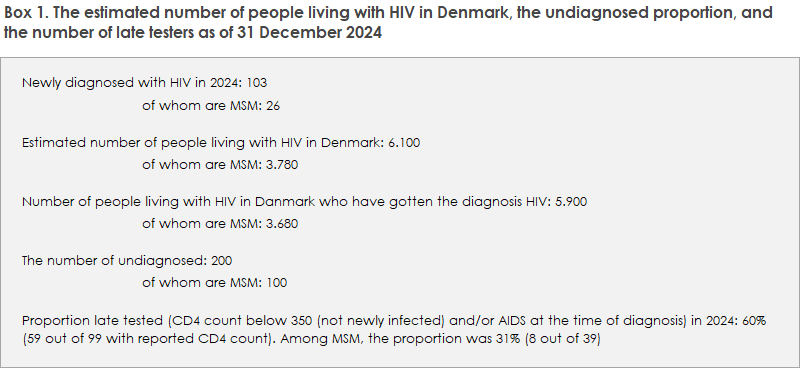
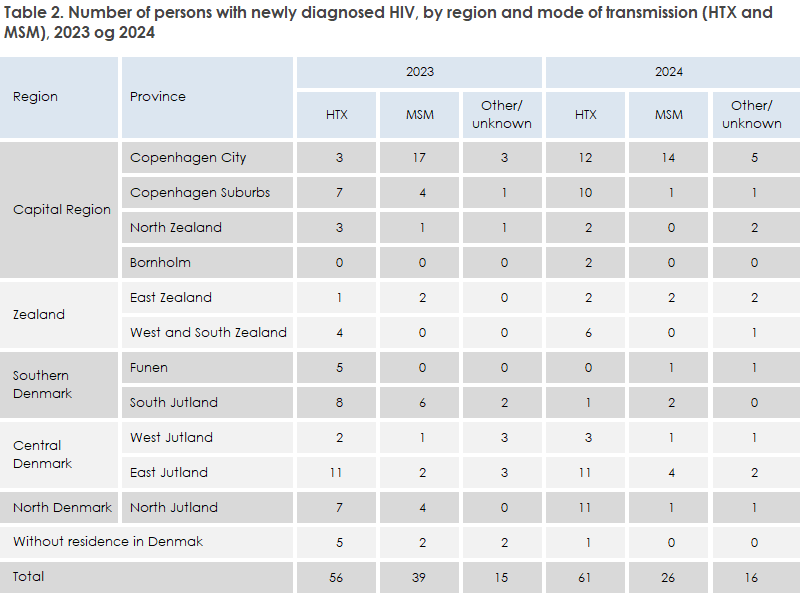
- In 2024, 103 people were reported with newly diagnosed HIV, as well as 99 people who had already been diagnosed abroad.
- Among the newly diagnosed, 65 were either Danes infected in Denmark or abroad, or immigrants infected after arriving in Denmark. The remaining 38 were immigrants infected before arriving in Denmark. These 38 could therefore not have been reached by Danish HIV prevention measures.
- Among the newly diagnosed, there were 26 men who have sex with men (MSM) and 61 heterosexually infected persons (HTX), of whom 36 were men and 25 were women (including two trans women). The remaining 16 were reported with other (4) or unknown mode of transmission (12).
- 69% of MSM and 42% of HTX were infected in Denmark.
- Among newly diagnosed MSM, 58% were immigrants. The proportion was 49% for HTX.
- Among MSM, 31% were late testers. The same applied to 66% of HTX.
- Immigrants, asylum seekers etc. should be tested for HIV as soon as possible after arrival to Denmark. This allows for rapid treatment of HIV-positive individuals and reduces the risk of onward transmission.
- All MSM who are not known to have HIV should be tested for HIV once a year. In addition, MSM who have an active sex life and who do not consistently use condoms should be tested for HIV and other sexually transmitted infections more frequently, e.g. every 3 months, and may be offered PrEP (Pre-Exposure Prophylaxis, HIV medication taken before exposure). PrEP has proven to provide by far the best protection against HIV and can be credited for the sharply declining incidence of HIV among MSM in Denmark.
- Treatment immediately after diagnosis ensures that people who are known to be HIV-positive do not pose any risk of onward transmission of HIV, as well-treated HIV-positive individuals cannot transmit the virus.
- Prevention of HIV transmission includes:
o condom use
o TasP (Treatment as Prevention, i.e. having unprotected sex only with HIV-positive persons known to be in effective treatment)
o PrEP (Pre-Exposure Prophylaxis, HIV medication taken before exposure)
o PEP (Post-Exposure Prophylaxis, HIV medication taken immediately after exposure)- The prevalence of HIV resistance has not changed significantly in recent years. Resistance to non-nucleoside inhibitors (NNRTI resistance) is by far the most common.
- None of the 150 patients who were tested for resistance had resistance with a resistance score ≥15 against both emtricitabine (FTC) and tenofovir (TDF), the two nucleoside inhibitors (NRTI) that PrEP (Truvada®) consists of. However, three people were found to have TDF resistance and three people had FTC resistance.
In 2024, 202 cases of HIV were reported, including 135 men and 67 women (including four trans women), table 1.
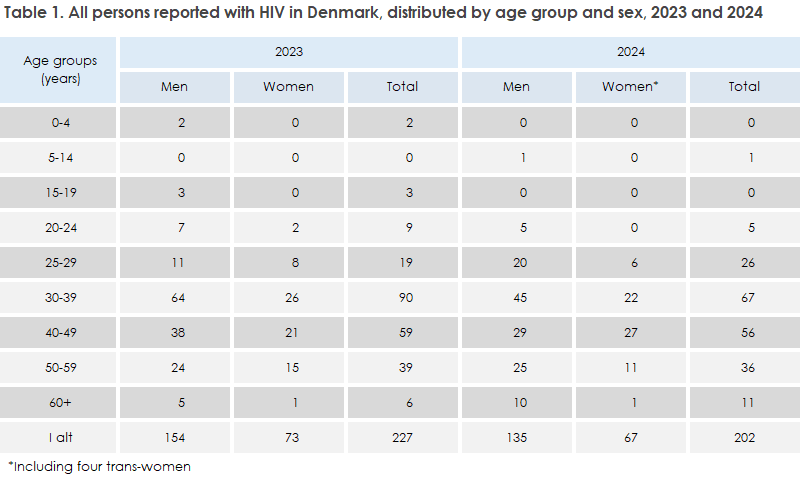
In 2024, the median age for men was 41 years (range 14–74 years) and for women also 41 years (range 25–68 years).
Among the 202 reported cases, 99 people (49 %) had previously been diagnosed with HIV abroad; of these, two were born in Denmark and 34 were from Ukraine. Twenty of the reported Ukrainians had already been diagnosed with HIV before arriving in Denmark, while 14 were first diagnosed after arrival.
In 2024, no children infected in Denmark were reported.
Origin, country of infection and mode of transmission among newly diagnosed
Among the 103 who were diagnosed with HIV for the first time, 51 (50 %) were born in Denmark and 52 (50 %) were born abroad, including two tourists.
There were 26 reported men who have sex with men (MSM), 36 men who have sex with women (MSW) and 25 women who have sex with men, including two trans women (WSM). In addition, four people were reported with other modes of transmission (injecting drug use, tattooing abroad or mother-to-child transmission abroad), and 12 were reported with unknown route of transmission, of whom four were born in Denmark and eight born abroad.
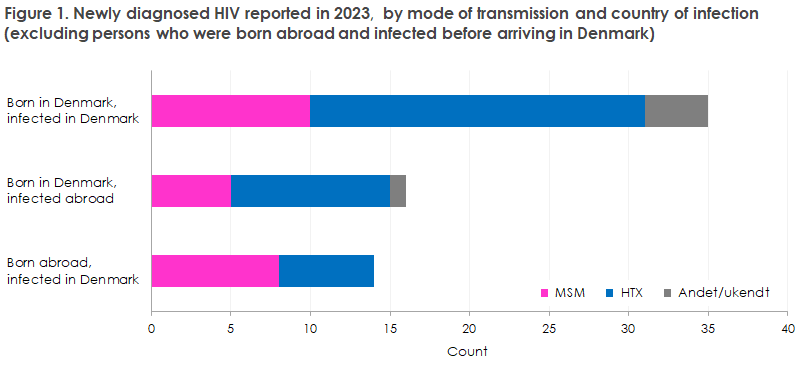
Of the 26 MSM, 10 (38 %) were born in Denmark and infected in Denmark, eight (31 %) were born abroad and infected after arrival in Denmark, five (2 %) were born in Denmark and infected abroad.
The remaining three (12 %) were born abroad and infected before arriving in Denmark.
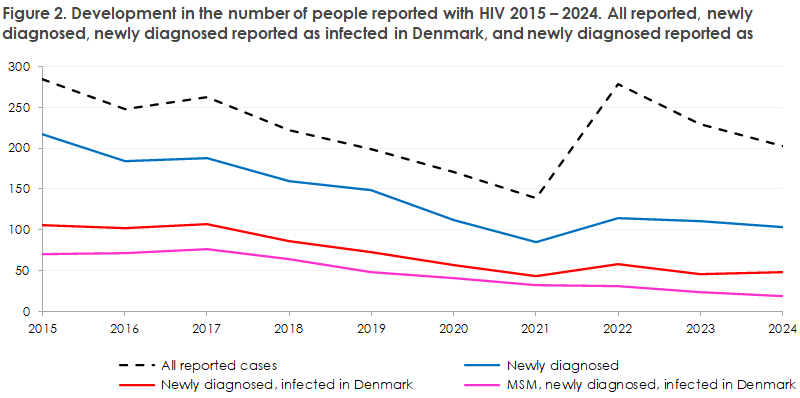
The 26 newly diagnosed MSM are even fewer than were registered last year (when the number was 39), and constitute the lowest number of MSM recorded since HIV surveillance began in 1990.
Among 59 heterosexually infected persons (HTX), 20 (34 %) were born in Denmark and infected in Denmark, five (8 %) were born abroad and infected after arrival in Denmark, while ten (17 %) were born in Denmark and infected abroad, four of them in Thailand. The remaining 24 (41 %) were born abroad and infected before arriving in Denmark.
In total, 65 people (63 %), who were born in Denmark and/or infected in Denmark, represent the number for whom prevention efforts in Denmark have not been sufficient. The remaining 38 people (37 %) were born abroad and infected before arriving in Denmark.
Pregnancy
In 2024, three pregnant women with HIV were identified, all born abroad. All three were found HIV positive via pregnancy screening. In addition to these three with newly diagnosed HIV, the pregnancy screening identified 16 women with known, well-treated HIV.
CD4 count at diagnosis – late testers
Among the 103 people diagnosed with HIV for the first time in 2024, information was available for 99 (96 %) on CD4 count at diagnosis and/or information on recent infection (recent negative test and/or acute HIV illness) or information on AIDS at diagnosis. For the remaining four, these data could not be obtained.
The CD4 count is a marker of the HIV virus’ impact on the cellular immune system. Everyone diagnosed with HIV is offered to start treatment immediately, regardless of CD4 count at diagnosis. In this report, a CD4 count below 350 and/or AIDS at the time of diagnosis continues to be used as a marker of late testing. Conversely, the CD4 count at diagnosis can be very low if the person is tested shortly after infection, and such a person may therefore be incorrectly classified as a “late tester” based on CD4 count alone. Therefore, when a person is reported with HIV to the national surveillance at Statens Serum Institut (SSI), specific questions are asked to obtain information that can show whether this is a newly infected person with a low CD4 count (symptoms of acute HIV, recent negative HIV test, etc.).
Among the 99 people with a reported CD4 count at the time of diagnosis, 59 (60 %) had a CD4 count lower than 350 cells per µl and/or were diagnosed with AIDS, while 40 (40 %) had a CD4 count of 350 or higher or were diagnosed with acute HIV.
The proportion of late testers has increased in parallel with the decrease in the number of new diagnoses (the proportion was between 47 % and 55 % in 2018–2021 and 56–60 % in 2022–2023).
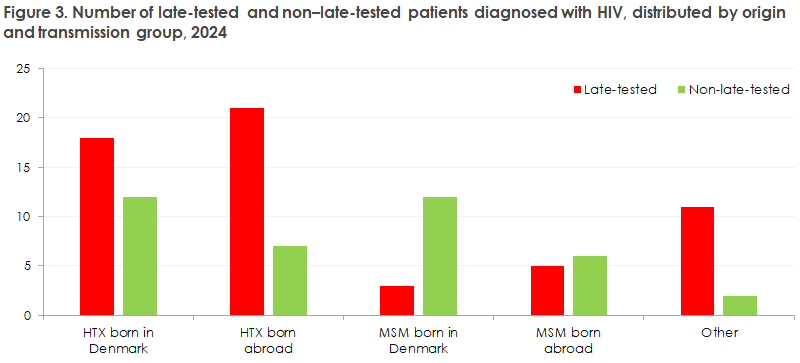
In total, 98 reported cases included information about CD4 count, origin and mode of transmission. The proportion of late testers differs depending on mode of transmission and origin. Among all MSM, the proportion of late testers was 31 % (eight out of 26). Among MSM born abroad, the proportion of late testers was 45 % (five out of 11) in 2024, whereas it was 20 % (three out of 15) for MSM born in Denmark. There are still fewer and fewer Danish MSM being diagnosed with HIV, and the numbers are too small to say anything definitive about the significance of these differences.
Among HTX, the picture is somewhat clearer, as 58 % (18 out of 31) of those born in Denmark were late tested, and 75 % (21 out of 28) of those born abroad were late tested.
All four who were reported with another mode of transmission were late tested. Of ten reported without a known mode of transmission but with information on CD4 count, eight (80 %) were late tested.
Figure 3 shows the distribution of late testers and non-late testers by origin and transmission group.
Prevention potentials
Over a number of years, the number of new HIV diagnoses in Denmark has declined. Contributing factors include frequent testing, especially of MSM, early initiation of treatment (TasP, Treatment as prevention), which prevents treated HIV-positive persons from transmitting the infection, and – especially – PrEP (Pre Exposure Prophylaxis, HIV medicine taken before exposure, offered to MSM).
To further prevent HIV transmission among MSM, it is important that the physician who diagnoses an MSM with gonorrhoea, syphilis or chlamydia/LGV tests the person for HIV and – if he is HIV negative – offers the patient PrEP. In 2024, the Danish Health Authority updated the specialty plan for infectious diseases so that PrEP can now be dispensed at main function level. For some MSM, there may be a barrier to taking the initiative to seek PrEP treatment themselves, and therefore physicians may advantageously suggest it.
Likewise, being bisexual may possibly have a negative impact on a patient’s initiative to seek both HIV testing and PrEP treatment, which staff at testing sites should also be aware of.
With regard to heterosexually transmitted HIV, it is particularly important to test immigrants from countries with a high prevalence of HIV soon after their arrival. The Danish Health Authority’s guidance from 2013 states that people from Africa, Asia, South America and Eastern Europe should be considered for HIV testing at their first contact with the healthcare system, regardless of the reason for contact.
It may be difficult to identify people at risk of HIV infection among Danish-born heterosexuals. However, there are some opportunities to prevent infection in this group. These may include single individuals who go on “sex holidays” to the Far East or Africa, or people who frequent swinger clubs.
To prevent onward transmission from people with unrecognised HIV, physicians must also be aware of patients with so-called signal or indicator diseases, for example hepatitis (A, B, C), anal cancer, etc.
AIDS
In 2024, 23 of the 103 newly diagnosed with HIV (22 %) were reported with AIDS, as they were diagnosed with an AIDS-defining illness at the same time as the HIV diagnosis. Among these were 11 HTX, four MSM, two people with another mode of transmission and six people without a stated mode of transmission. The most common AIDS-defining diagnosis was Pneumocystis jirovecii pneumonia.
A total of 41 people reported with HIV died in 2024. Of these, four were diagnosed in 2024, two in 2023, and the remaining between 1989 and 2016. As information in the Cause of Death Registry is published with at least a one-year delay, it is not possible during the current year of death to assess what proportion of the deceased died of an HIV-related disease and who died of something else.
Retrospectively, however, experience shows that about one quarter of deaths among HIV-positive people have an HIV-related cause.
Checkpoint
Checkpoint is the AIDS Foundation’s testing clinics in Copenhagen, Gentofte, Frederiksberg, Aalborg, Aarhus and Odense for LGBT+ people and others at high risk of HIV, where one can be tested for, among other things, HIV and syphilis, with or without an appointment, and receive the result immediately. In total, three men and one trans woman tested HIV positive for the first time; one was born in Denmark and the others were born abroad.
Resistance among treatment-naive people with newly diagnosed HIV
The Virus Genomics Section at SSI has compiled all HIV-1 infected individuals included in the national surveillance during the period 01.11.2023–17.08.2025. The period covers all samples for resistance determination since submission was made mandatory in November 2023 (cf. Executive Order on notification of infectious diseases). In total, 318 patients with HIV-1 were reported in the period, of whom samples were submitted from 236 (74,2 %). A larger proportion of these (26,4 %) could not be analysed due to low viral load or other exclusion reasons, and the analyses therefore covered 152 of the 318 reported persons (47,8 %). Of these, 150 were examined in the pol gene, 40 in both the pol and integrase genes, and two exclusively in the integrase gene. In total, 65 of the reported persons were infected in Denmark, 75 were infected abroad and, for ten, the country of infection was unknown.
For the assessment of resistance, the ECDC definition of pre-treatment drug resistance (PDR) was used. According to the definition, PDR includes all cases of clinically relevant resistance with a score ≥15 according to the Stanford HIVdb algorithm version 9.8. Resistance was investigated for the four main classes of antiretroviral drugs used in HAART: non-nucleoside inhibitors (NNRTI), nucleoside inhibitors (NRTI), protease inhibitors (PI) and integrase inhibitors (INSTI). The genotypes in this report were determined using COMET version 2.4.
For the pol gene (PI, NRTI and NNRTI), the overall PDR prevalence was 13,3 % (20/150) in the period. To account for the fact that some samples may have been taken after treatment initiation, samples with and without resistance ≤14 days between estimated diagnosis date and sampling date (15/130; 11,5 %) were compared with samples >14 days (5/20; 25,0 %); the difference was not statistically significant (Fisher’s exact test, p>0.05).
NNRTI resistance was by far the most common and was seen in 17 of the 20 cases, of which ten had NNRTI resistance alone, five had NRTI+NNRTI resistance, and two had NRTI+NNRTI+INSTI and PI+NNRTI resistance, respectively. In addition, there was one case of NRTI resistance and two cases of PI resistance alone. No separate cases of INSTI resistance were seen in the 42 samples analysed.
Among those infected in Denmark, resistance was found in seven of 65 (10,8 %), and among those infected abroad, 13 of 75 (17,3 %) had resistance, while no resistance was seen among the ten with unknown country of infection. NNRTI resistance was the most frequent both among those infected in Denmark (six of seven) and among those infected abroad (11 of 13).
No significant difference (Fisher’s exact test, p>0.05) is seen in resistance between those infected in Denmark and those infected abroad, nor is any difference seen in the overall prevalence of resistance compared with last year’s report (Hiv 2023).
The Danish Health Authority recommends Pre Exposure Prophylaxis (PrEP) for people in specific risk groups. PrEP (Truvada®) consists of the two nucleoside inhibitors (NRTI): emtricitabine (FTC) and tenofovir (TDF). Among the newly diagnosed in the period, there were three persons with TDF resistance and three persons with FTC resistance (HIVdb score ≥ 15). The three with TDF resistance all had a potentially low level of resistance (HIVdb score 10) against FTC. However, none of the individuals had resistance with an HIVdb score ≥ 15 against both FTC and TDF. It is assessed that none of these people have received PrEP.
HIV-1 subtypes among newly diagnosed patients
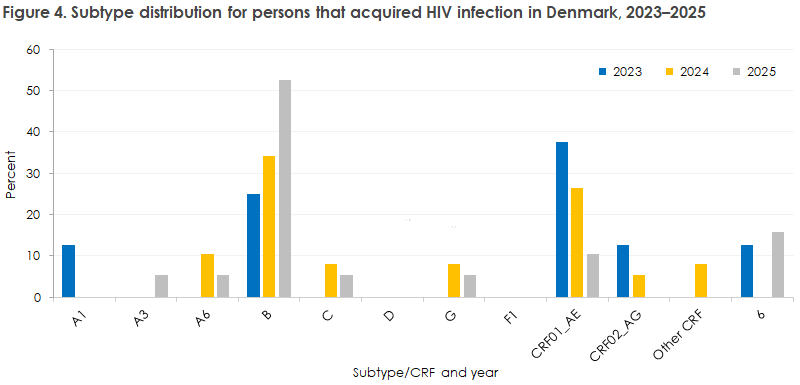
Among newly diagnosed persons infected in Denmark, figure 4, subtype B increased from 25 % in 2023 to 52 % in 2025, while CRF01 decreased from 37 % in 2023 to 10 % in 2025. Unknown recombinants were not seen consistently over the period but were the second most frequent at 16 % in 2025.
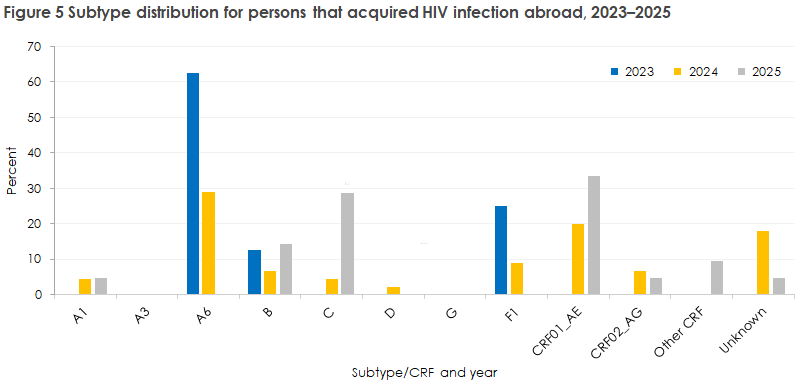
For people infected abroad, figure 5, subtype A6 was dominant in both 2023 and 2024, but it has not yet been seen in 2025. Here, CRF01 was instead the most frequent. Subtype A6, which among others is dominant in Ukraine, can carry the compensatory mutation L74I in the integrase gene, which can promote resistance to INSTI. The mutation was detected in all A6 integrase sequences, which made up eight of the 42 sequenced. In addition, L74I occurred sporadically in subtype B and F1.
Throughout the period there has been ongoing contact between SSI and the departments of infectious diseases and clinical microbiology regarding the submission of samples in relation to the new executive order on surveillance of HIV-1 resistance. For practical information on sample submission, scope and order codes, see page 42 of the handbook. All samples from newly reported HIV-1 patients must be submitted under order code R-2060 before treatment is initiated in Denmark.
Collection and updating of epidemiological information takes place continuously between EPI-NYT issues, and changes in data from report to report may therefore occur. Integrase coverage was only introduced in September 2024 and is therefore still relatively low. Similarly, coverage of the pol gene was low in 2023, as the scheme only began in November, and the figures for 2025 are likewise preliminary.
This annual report is also described in EPI-NYT 49a/2025.