No 49a - 2025
HIV 2024 /
SSI publishes annual report for the Danish HIV cohort 2024
HIV 2024
For a detailed report on HIV in Denmark 2024, please see the Annual Report for HIV.
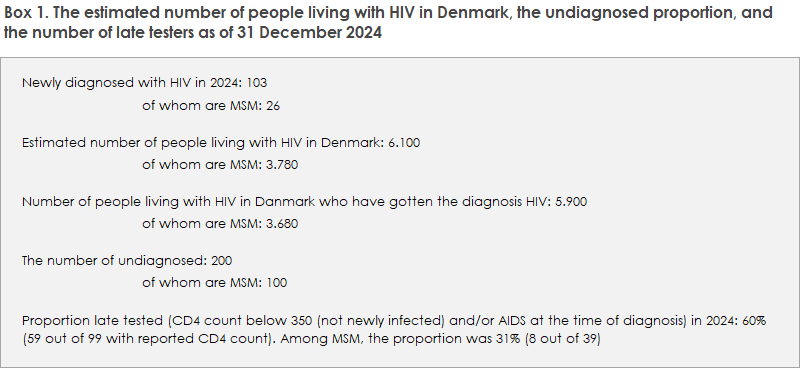
In 2024, 202 cases of HIV were reported, of which 135 were men and 67 were women (including four trans women). The median age was 41 years for both men and women.
About half (49%) of the cases were people who had already been diagnosed abroad, many of them from Ukraine. Among the 103 first-time diagnoses, half were born in Denmark and half abroad.
Mode of transmission among people newly diagnosed with HIV in 2024
There were 26 men who have sex with men (MSM) who were diagnosed with HIV for the first time in 2024. This is, again this year, the lowest number since surveillance began in 1990.
For those infected heterosexually, the number was 61 people, including two trans women. The remaining four people were reported with other transmission routes such as drug use, tattooing, or mother-to-child transmission abroad. For 12 people, there was no known route of transmission.
Pregnant women
Three pregnant women were newly diagnosed with HIV in 2024, all through routine pregnancy screening, EPI-NEWS 45/2025. In addition, the screening identified 16 women with known, well-treated HIV.
Late testers
Among the 103 new diagnoses, 60% had a low CD4 count (<350) or AIDS at diagnosis – indicating late testing. This is especially the case among those infected heterosexually, particularly immigrants, where three-quarters were tested late. For MSM, the proportion was lower (31%).
AIDS and deaths
23 people (22%) had AIDS at the same time as their HIV diagnosis in 2024. A total of 41 deaths were registered among people living with HIV in Denmark, though not all were directly HIV-related.
Resistance
As of November 2023, resistance testing became mandatory. Among the 150 people tested, 13% had resistance to at least one drug, especially non-nucleoside inhibitors (NNRTIs). The prevalence was roughly the same among people infected in Denmark and abroad and at the same level as in previous years.
The number of new HIV diagnoses is falling – but efforts must be maintained
The number of new HIV diagnoses in Denmark continues to fall. This development is mainly due to early treatment initiation and the preventive medicine PrEP. To maintain this positive trend, it is crucial that PrEP is offered in a targeted manner to MSM, and that healthcare personnel remember to bring up the topic when an HIV-negative man who has sex with men is diagnosed with another sexually transmitted infection – even if the patient has not requested it.
Among heterosexually infected individuals, the challenges are greater. The group consists of both people from high-endemic areas and Danish-born individuals, where a total of 63% in 2024 were infected in, or born in, Denmark. Here, prevention has not been sufficiently effective. It is a diverse group, which makes it difficult to propose general recommendations, but a common feature is that many are diagnosed late. Therefore, it is important that healthcare personnel always consider HIV as a possible explanation for unexplained symptoms. HIV can affect anyone – regardless of gender, age, origin, or sexuality – and an HIV test is a simple, quick, and inexpensive way to obtain clarity.
People arriving in Denmark with a known HIV diagnosis and in treatment pose no transmission risk. It is instead the undiagnosed individuals who are not yet aware of their status who require targeted intervention. Rapid detection and treatment are key to breaking transmission chains and ultimately eliminating HIV. Pregnancy screening is a good example of a well-established and well-functioning preventive effort that effectively prevents congenital HIV (as well as hepatitis B and syphilis), EPI-NEWS 45/2025.
Globally, however, the situation is challenged. The unstable global situation and decreasing funding for organisations working to combat HIV and AIDS threaten progress. If the goal of ending HIV as a global health threat is to be achieved, continued political will, stable funding, and strong collective efforts are required – both in Denmark and internationally.
SSI publishes annual report for the Danish HIV cohort 2024
For the first time since taking over the Danish HIV cohort, Statens Serum Institut is publishing the annual report for 2024.
The cohort has followed people living with HIV in Denmark since the mid-1990s and provides invaluable insight into the development of HIV-treatment over time.
The publication coincides with World AIDS Day, which is an ideal opportunity to highlight the HIV-field and the continued efforts for people living with HIV.
Here you can also find more information about the cohort and how you can apply for access to the data if you wish to use them for research.
M. Wessman, Department of Infectious Disease Epidemiology and Prevention, J. Fonager, R. Datcu, Virology and Microbiological Preparedness