No 45 - 2025
Screening of pregnant women for hepatitis B, HIV and syphilis, 2024 /
Blood donor screening 2024
Screening of pregnant women for hepatitis B, HIV and syphilis, 2024
- In 2024, 65,331 blood type analyses were performed among pregnant women.
- 99.9% of all pregnant women who had a blood type analysis were tested for both hepatitis B, HIV and syphilis.
- A total of 93 pregnant women were found positive for hepatitis B, of whom 71 were already known to have hepatitis B, and 22 for whom SSI had not received a notification and/or had positive hepatitis B diagnostics in MiBa before the pregnancy screening test.
- A total of 19 pregnant women were found positive for HIV. Among these, 3 women were newly diagnosed with HIV, while the remaining 16 were known HIV-positive and already in treatment.
- A total of 15 pregnant women were diagnosed with active syphilis in 2024.
- All children born to mothers who tested positive for hepatitis B in the 2024 pregnancy screening received both the 1st hepatitis B vaccine and hepatitis B immunoglobulin within 48 hours after birth.
Screening of pregnant women for hepatitis B was introduced on 1 November 2005, and for HIV and syphilis on 1 January 2010. There is now an annual report for 2024.
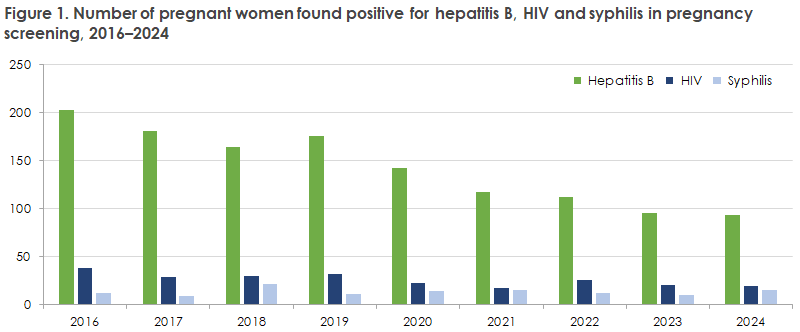
In 2024, 65,331 blood type analyses were performed among pregnant women. Almost all of these (99.9%) were tested for both hepatitis B, HIV and syphilis. The development in the number of positives for hepatitis B, HIV and syphilis respectively, since 2016, is shown in Figure 1.
Thus, the vast majority of pregnant women choose to accept the offer of screening for hepatitis B, HIV and syphilis, which makes it possible to prevent almost all potential cases of mother-to-child transmission of the three diseases. This makes Denmark a unique country and is fully in line with WHO’s goal of triple elimination of congenital syphilis, HIV and hepatitis B. This is particularly relevant today, when the number of cases of congenital syphilis is exploding in other countries such as the USA.
Pregnant women with hepatitis B
A total of 93 pregnant women were found positive for hepatitis B in 2024. 71 of these were already known to have chronic hepatitis B, and 22 for whom SSI had not received a notification and/or had positive hepatitis B diagnostics in MiBa before the pregnancy screening test.
91% of the pregnant women who tested positive for hepatitis B were born abroad. The most frequent countries of origin among pregnant women with hepatitis B were China, Romania, the Philippines, Somalia and Vietnam. This reflects the distribution of hepatitis B prevalence among the population in Denmark. The remainder were either second-generation immigrants (4%) or of Danish origin (5%) — all born before the introduction of general screening of pregnant women for hepatitis B in 2005.
Pregnant women with HIV
A total of 19 pregnant women were found positive for HIV. Among these, 3 women were newly diagnosed with HIV, while the remaining 16 were known HIV-positive and already in treatment. None of the pregnant women with newly diagnosed HIV were Danish (two were from Ukraine and one from Kenya). Two of the pregnant women with known HIV were Danish, while the remainder were predominantly from sub-Saharan Africa.
Pregnant women with syphilis
A total of 15 pregnant women were diagnosed with active syphilis. A confirmatory syphilis test was performed on 97% of the women who tested positive in the screening test. Three women never had a confirmatory syphilis test performed, despite several reminders from Statens Serum Institut and/or their general practitioner. Although a large proportion of the screening tests are false positives, it remains extremely important to perform an extended analysis as soon as possible to finally confirm or rule out the result.
Syphilis as a cause of intrauterine fetal death in 2024
An ethnically Danish woman in her second pregnancy, with a previously uncomplicated pregnancy and birth, presented at week 37+2 of pregnancy to the maternity ward with the experience of reduced fetal movement over the past day. On arrival, intrauterine fetal death (IUFD) was confirmed. Normal 1st and 2nd trimester scans had been performed. In addition, normal growth scans had been performed at gestational age 30 and 35. The woman had been screened in the 1st trimester for HIV, hepatitis and syphilis with negative screening results. Ten days before presentation, the screening had been repeated by chance. The renewed screening test came back positive for syphilis less than a day before the IUFD was confirmed.
The case highlights the seriousness of syphilis infection during pregnancy. When a syphilis screening is positive, it is the responsibility of the requesting doctor to follow up with a confirmatory test as soon as possible. The case also illustrates that a negative screening in the 1st trimester does not rule out infection around the time of conception, as the incubation period can be up to 90 days.
Furthermore, infection can occur after the time of screening. Therefore, attention should be paid to the fact that women at increased risk of infection, including those with a bisexual partner or multiple sexual partners during pregnancy, may be screened again in the 3rd trimester.
In 2024, 53% of pregnant women found with syphilis were born in Denmark and 47% were born abroad. Thus, syphilis in Denmark is no longer seen exclusively among men who have sex with men or immigrants from countries with high prevalence, but has again been introduced among heterosexual Danes.
The pregnant woman should also be informed that if she has syphilis, HIV or hepatitis B, she can be treated so that the child is not infected. In addition, the pregnant woman should be informed about the importance of her sexual partner(s) also being tested and, if necessary, treated.
High vaccination coverage among children born to women with hepatitis B
Immediately after birth, the child is given an injection of hepatitis B immunoglobulin and the first dose of hepatitis B vaccine. The vaccine is given intramuscularly on the lateral anterior part of one thigh, and the immunoglobulin is given intramuscularly on the lateral anterior part of the other thigh. The Danish Health Authority recommends that the vaccine and immunoglobulin be given before the woman leaves the delivery room. However, vaccination and immunoglobulin can be given up to 48 hours after birth; after that, the effect is doubtful.
100% of all children born to mothers who tested positive for hepatitis B in the 2024 pregnancy screening received both the 1st hepatitis B vaccine and hepatitis B immunoglobulin within 48 hours after birth.
To ensure that the child remains protected against hepatitis B infection, it must receive three additional hepatitis B vaccines. These should be given by the general practitioner at one month, two to three months, and one year after birth. Two months after the final vaccine, the child’s general practitioner must test the child’s hepatitis B status.
93% of all children born to mothers who tested positive for hepatitis B in the 2024 pregnancy screening received at least three hepatitis B vaccines. The proportion who have received the fourth and final hepatitis B vaccine cannot yet be determined, as not all children have reached one year of age yet.
Pregnant women with positive test results must be referred to a specialist department
It is important that general practitioners refer pregnant patients who have tested positive for any of the three infections to a specialist department, even if the patient has no symptoms of infection.
Just as the pregnant woman should be treated for HIV and syphilis, pregnant women with high HBV viral load (>10⁶ IU/ml) can often be offered treatment around week 28, which can reduce the risk of intrauterine transmission, according to treatment guidelines for hepatitis prepared by the Danish Society for Infectious Diseases and the Danish Society for Gastroenterology and Hepatology.
Center for Pregnant Women with Infections
The Center for Pregnant Women with Infections at Hvidovre Hospital is an interdisciplinary knowledge center that aims to ensure that pregnant women with acute or chronic infections, or who are exposed to infection during pregnancy, receive the best possible examination and treatment — and to provide information to all pregnant women and their relatives about infections during pregnancy.
Under the Center for Pregnant Women with Infections, a national advisory hotline has been established where healthcare professionals can call for advice on infectious diseases, antibiotic use and prophylaxis, including vaccination, during pregnancy and breastfeeding. The hotline is staffed by a specialist in infectious diseases and the advice is given in close collaboration with obstetricians and fetal medicine specialists. For opening hours and contact information, see the Center for Pregnant Women with Infections.
Flowchart for hepatitis B vaccination of children
The flowchart for hepatitis B vaccination of newborns where the mother has known or unknown hepatitis B status has just been updated and can now be found on SSI’s website.
(L.H. Holm, M. Wessman, Department of Infectious Disease Epidemiology and Prevention)
Blood donor screening 2024
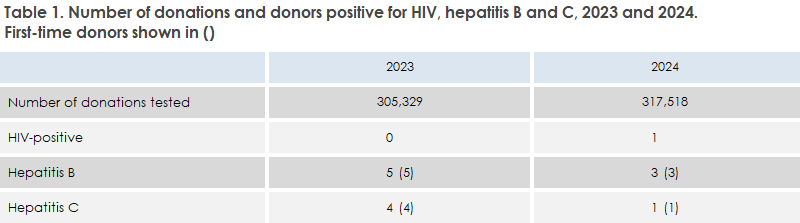
In 2024, 317,518 blood donations were screened. For comparison, 305,329 blood donations were screened in 2023, see Table 1. Overall, there has been a decline in the number of positive donors since Statens Serum Institut began reporting these figures in 1989, see Figure 2.
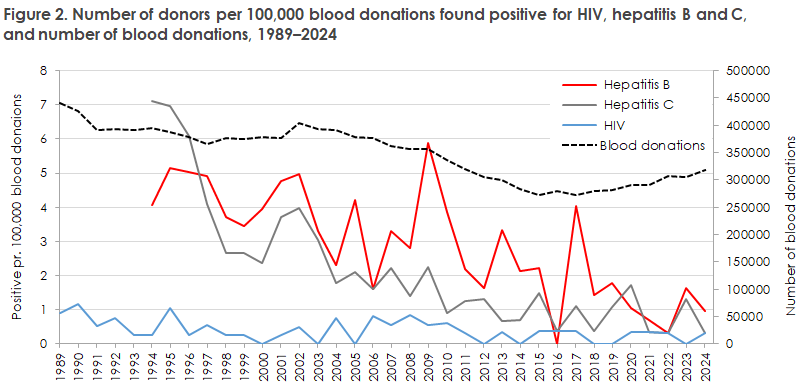
The Department of Infectious Disease Epidemiology and Prevention has data on blood screening for HIV since 1986, and for hepatitis B and C since 1994, see Figure 2.
HIV
One HIV-positive donor was found in 2024. The person was of Danish origin and was found HIV-positive for the first time through the blood donor screening. The infection was heterosexually transmitted in Denmark from a person already known to be HIV-positive and originating from a high-endemic area.
Hepatitis B
In 2024, three individuals were found positive for hepatitis B. All were first-time donors. Two of the three were born abroad and were presumed infected at birth, while the third was a second-generation immigrant also infected at birth (before the establishment of pregnancy screening in Denmark).
Hepatitis C
In 2024, one person was found positive for hepatitis C. It has not been possible to determine the mode of infection for this person, as no obvious risk factors were identified.
Comment
The number and incidence of positive donors in Denmark remained very low in 2024. It is encouraging that the number of blood donations increased compared with the previous year, particularly in light of the easing of donor eligibility criteria adopted in 2024, which may hopefully help to further increase the number of blood donors in the coming years. It is important that Denmark maintains a high proportion of blood donors to ensure a stable blood supply for Danish hospitals. The eased criteria remain safe for patients and help to reduce discrimination, as they do not distinguish based on gender or sexual orientation.
The Danish Patient Safety Authority publishes the annual report “Statement on the Blood Product Area”, which provides a more detailed description of the blood transfusion field.
(L.H. Holm, M. Wessman, Department of Infectious Disease Epidemiology and Prevention)