Imported cases of chikungunya in Denmark, 2010–2025
Imported cases of chikungunya in Denmark, 2010–2025
Chikungunya is a mosquito-borne viral disease that occurs in tropical and subtropical areas and globally has shown increasing spread since the 2000s. In Denmark, the disease is seen exclusively as an imported infection among travellers and occurs relatively rarely, with a total of 30 confirmed cases during the period 2010–2025. The occurrence is characterised by episodic increases, most recently in 2025, when nine confirmed cases were detected among Danish travellers. The disease is most often asymptomatic but can cause prolonged and severe joint pain.
Since November 2023, chikungunya has been notifiable by the country’s diagnostic laboratories to Statens Serum Institut (SSI), which monitors its occurrence. This report describes the number of imported chikungunya cases during the period 2010–2025 and the available travel information.
Chikungunya
Chikungunya is a mosquito-borne viral disease caused by chikungunya virus (CHIKV). The name originates from the Kimakonde language of southern Tanzania and means “that which bends up”, referring to the characteristic stooped posture of patients with pronounced joint pain. CHIKV circulates in tropical and subtropical areas and was first identified during an outbreak in Tanzania in 1952.
Since a major outbreak in Kenya in 2004, the occurrence of chikungunya has increased, and the disease has become more widespread globally. The virus is transmitted to humans through bites from the mosquitoes Aedes aegypti and Aedes albopictus (Asian tiger mosquito). Changing climatic and environmental conditions as well as urbanisation have contributed to the spread of the vectors to new geographical areas and thereby increased the risk of local transmission, including in non-endemic areas such as Europe, where the tiger mosquito is increasingly observed. Here, outbreaks will depend on transmission to mosquitoes from travellers returning from endemic areas. There are no known vectors for CHIKV in Denmark.
In symptomatic persons, the disease typically develops 2–12 days after a bite from an infected mosquito. Symptoms include sudden-onset fever, pronounced joint pain, muscle tenderness, headache, nausea, fatigue and rash. The joint pain is often disabling and usually lasts for days to weeks, but in some cases may persist for months or years. Without the characteristic joint pain, the course of disease may be mild and, in some cases, remain undiagnosed. Most patients recover completely, but complications involving the eyes, heart and central nervous system have been reported. Persons at the extremes of the age spectrum are at increased risk of severe disease, including newborns infected perinatally and elderly persons with comorbidity.
There is no specific antiviral treatment for chikungunya, and treatment is primarily symptomatic. Severe cases may require hospital admission with supportive treatment. For further information, reference is also made to SSI’s disease encyclopaedia under Chikungunya. For travellers to areas where chikungunya occurs, prevention is important and consists mainly of avoiding mosquito bites.
In Denmark, the chikungunya vaccines Ixchiq and Vimkunya are authorised.
Laboratory diagnostics and case definition
In terms of laboratory diagnostics, an acute chikungunya infection can be detected by several methods. During the first days of illness, the diagnosis can be made by detecting viral RNA using RT-PCR. Detection of CHIKV IgM and CHIKV IgG in a blood sample indicates current or recent infection, but antibodies may be absent during the first days of illness. The serological diagnosis should therefore, if possible, be confirmed by examination of paired blood samples to detect an increase in titre or seroconversion.
In this report, a “confirmed case” is defined according to ECDC’s case definition as detection of CHIKV RNA in a clinical sample or detection of CHIKV IgM confirmed by a neutralisation test or a four-fold increase in titre in paired blood samples. As the false-positive rate for the aforementioned tests is low, these laboratory results can stand alone without detailed information about the patient’s symptoms and travel history.
A “probable case” is reported when CHIKV IgM is detected in a blood sample. However, false-positive IgM test results may occur. In addition, for probable cases, information on febrile illness as well as documentation of a stay in an area with current occurrence of chikungunya within two weeks before symptom onset must be available. Due to the possible false-positive IgM test results, and because the Danish Microbiology Database (MiBa) does not contain information on symptoms and contains travel information only to a limited extent, only confirmed cases of chikungunya are included in this report.
Number of imported cases of chikungunya in Denmark, 2010–2025
During the period 2010–2025, a total of 30 confirmed cases of chikungunya were registered in Denmark. The occurrence of travel-related chikungunya in Denmark is shown in Figure 1. During the period, there were on average fewer than two confirmed cases annually, varying from zero to nine cases per year. For information, there were 57 probable cases during the period, with an annual average of fewer than four cases. As these cases are uncertain, they are not described in further detail.
For the number of confirmed cases, episodic peaks were observed in 2014, 2019 and 2025, with three, eight and nine cases, respectively.
During the period 2020–2022, a decrease in occurrence was observed, reflecting reduced travel activity during the COVID-19 pandemic.
The actual number of Danish travellers who become infected with CHIKV is, however, considered to be higher than the number registered. This is due, among other things, to underreporting of mild or asymptomatic infections, as well as cases where the course of illness has ended before return to Denmark and therefore is not diagnosed or registered in the Danish healthcare system.
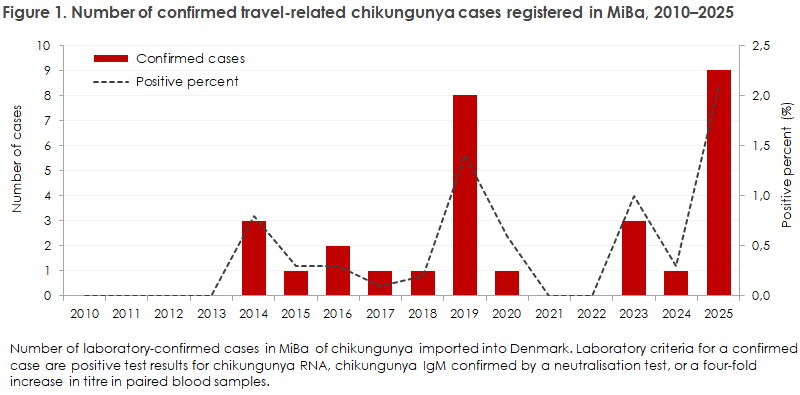
Figure caption: Number of laboratory-confirmed cases in MiBa of chikungunya imported into Denmark. Laboratory criteria for a confirmed case are positive test results for chikungunya RNA, chikungunya IgM confirmed by a neutralisation test, or a four-fold increase in titre in paired blood samples.
Travel activity, age and sex distribution among infected persons
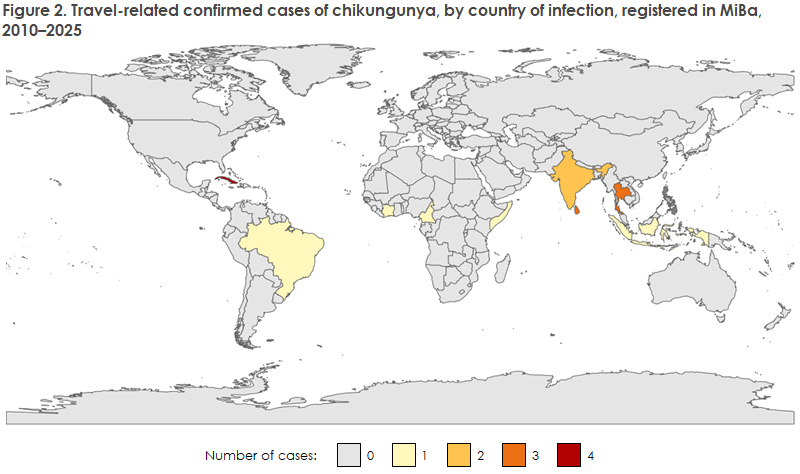
Travel activity is not systematically registered in MiBa in connection with testing for chikungunya virus, but can be stated as free text in requisitions from clinicians. Overall, travel information is available for 18 of the 30 confirmed cases. In all of these cases, travel to destinations outside Europe was stated. If several travel destinations were stated for the same patient, the first country stated was registered as the country of infection. The geographical distribution of cases with known travel information is shown in Figure 2. Among confirmed cases with travel information, the largest number of cases was related to travel in Cuba, where there were four cases during the period, all of which were registered in 2025.
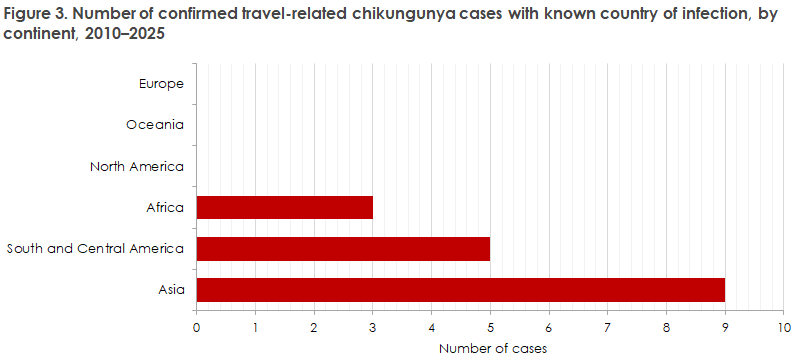
By continent, Asia was the most frequent region of infection, with a total of nine registered cases during the 16-year period. Five cases were registered from South and Central America and three from Africa, Figure 2.
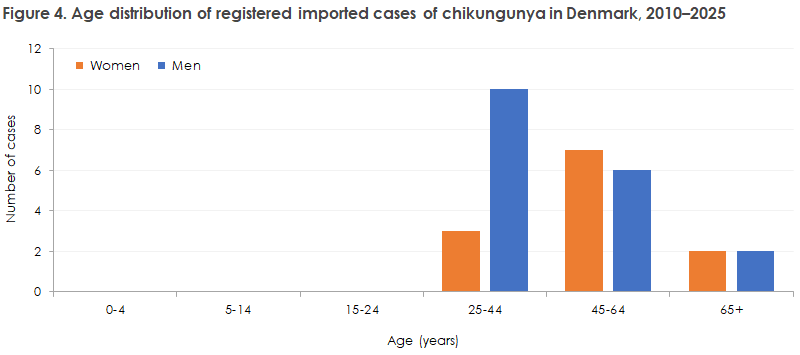
The distribution of laboratory-confirmed chikungunya cases by age and sex shows that the majority of cases occur among adults in the working-age groups between 25–44 and 45–64 years. In the 25–44-year group, there is a predominance of men, with a total of three cases among women and 10 among men. In the other groups, an overall equal sex distribution is observed, Figure 4. For both sexes, no cases were registered among persons under 24 years of age. This may reflect milder symptoms among children and younger adults, but the observed age and sex distributions probably also reflect differences in travel activity to chikungunya-endemic areas.
This report is also discussed in EPI-NEWS 36/2026.