No 36 - 2026
Imported cases of chikungunya in Denmark, 2010–2025
Imported cases of chikungunya in Denmark, 2010–2025
Chikungunya is a mosquito-borne viral disease that occurs in tropical and subtropical areas and globally has shown increasing spread since the 2000s. In Denmark, the disease is seen exclusively as an imported infection among travellers and occurs relatively rarely. For a more detailed review of the disease and the detected imported cases, refer to the Annual Report for 2010–2025.
Chikungunya is caused by infection with chikungunya virus (CHIKV). The name originates from the Kimakonde language of southern Tanzania and means “that which bends up”, referring to the characteristic stooped posture of patients with pronounced joint pain. CHIKV circulates in tropical and subtropical areas. The virus is transmitted to humans through bites from the mosquitoes Aedes aegypti and Aedes albopictus (Asian tiger mosquito). The disease is most often asymptomatic but can cause prolonged and severe joint pain.
Case definitions and detected cases in Denmark
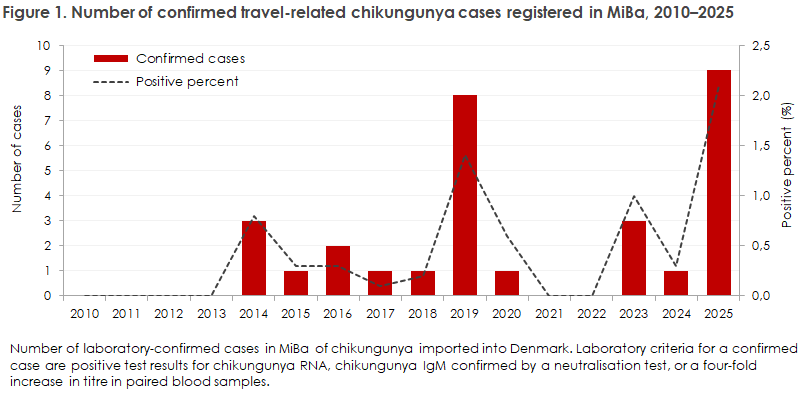
In the current report, confirmed cases defined according to ECDC’s case definition are included as detection of CHIKV RNA in a clinical sample or detection of CHIKV IgM confirmed by a neutralisation test or a four-fold increase in titre in paired blood samples. During the period 2010–2025, a total of 30 confirmed cases of chikungunya were registered in Denmark. The occurrence of travel-related chikungunya in Denmark during this period is shown in Figure 1.
A “probable case” is defined as detection of CHIKV IgM (“acute antibodies”) in a blood sample. However, false-positive IgM test results may occur. In addition, for probable cases, information on febrile illness as well as documentation of a stay in an area with current occurrence of chikungunya within two weeks before symptom onset must be available. There were 57 probable cases during the period. As these cases are uncertain, they are not included in the annual report.
The actual number of Danish travellers who become infected with CHIKV is, however, considered to be higher than the number registered. This is due, among other things, to underreporting of mild or asymptomatic infections, as well as cases where the course of illness has ended before return to Denmark and therefore is not diagnosed or registered in the Danish healthcare system.
Prevention
The primary prevention is to avoid mosquito bites by minimising areas of bare skin and using mosquito repellents. Aedes mosquitoes bite during the day but have their greatest activity a couple of hours after sunrise and correspondingly a few hours before and just after sunset at dusk.
In Denmark, the chikungunya vaccines Ixchiq and Vimkunya are authorised. On the basis of reports of rare serious adverse reactions, the European Medicines Agency (EMA), in connection with a periodic safety update (PSUR) in July 2026, restricted the indication of the Ixchiq vaccine to include only persons at high risk of becoming infected with chikungunya virus.
This is a rare infection among Danish travellers, and so far, there are no national recommendations on the use of the vaccines.
(A.V. Søndergaard, P.H. Andersen, L.S. Vestergaard, Department of Infectious Disease Epidemiology and Prevention, B. Bødker, Virological Surveillance and Specialised Diagnostics)