Wastewater Surveillance of Infectious Diseases at Statens Serum Institut
Annual report 2025
Purpose of the report
This annual report is the first since wastewater-based surveillance was established by Statens Serum Institut (SSI) in 2021. The report presents the results of wastewater-based surveillance of infectious diseases since the system was initiated, with a particular focus on 2025. It also describes how infectious diseases are monitored in wastewater. In addition, the report outlines the international collaborations in wastewater surveillance to which SSI contributed in 2025. Finally, it highlights some of the future perspectives for wastewater surveillance in the coming years.
Main points
- SSI has monitored SARS-CoV-2 in wastewater since 2021.
- Results from the wastewater surveillance are published weekly on SSI’s websites: Spildevandsovervågning and Wastewater surveillance.
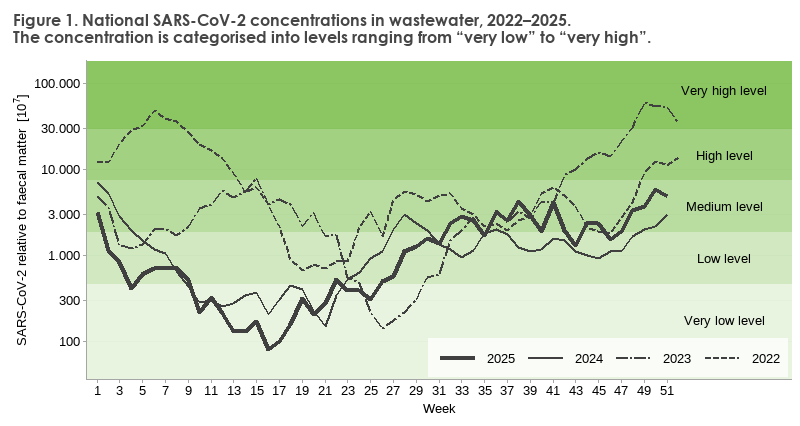
- In recent years, an increasing seasonal pattern has been observed for SARS-CoV-2, which was also evident in 2025. In general, concentrations—and thus transmission levels—are lowest during the summer months and highest in autumn and winter, with a peak in December/January.
- SARS-CoV-2 levels in both 2024 and 2025 have generally been lower than in 2022 and 2023.
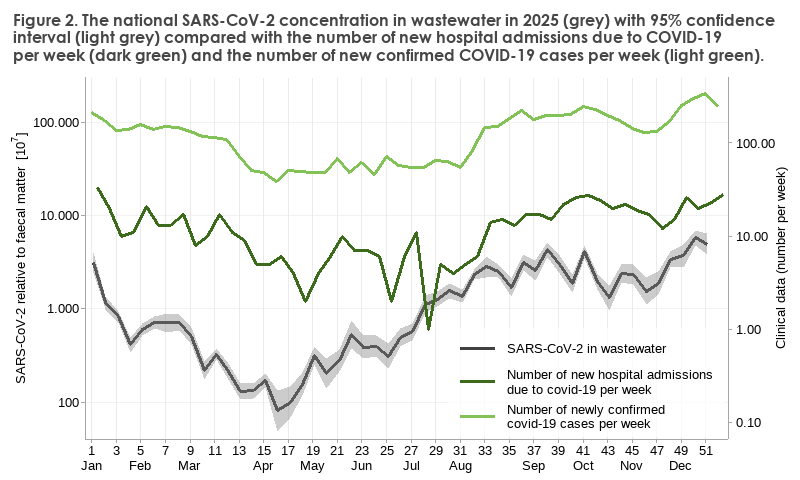
- Wastewater surveillance results are integrated with data from clinical surveillance and are used to predict COVID-19-related hospitalisations in the near future.
- In 2025, influenza A was added to wastewater-based surveillance. Method development is still ongoing, and results are currently used for internal purposes only.
- SSI coordinates a large EU project (EU-WISH), involving 26 countries, aimed at supporting the development, harmonisation, and institutionalisation of wastewater-based surveillance.
- In 2026, significant efforts will focus on preparing for the implementation of the European Urban Wastewater Directive, including the incorporation of antimicrobial resistance (AMR).
Wastewater surveillance in 2025
SARS-CoV-2
Since 2021, SSI has monitored the concentration of SARS-CoV-2 in wastewater. The results have been published continuously on SSI’s website (Wastewater Surveillance) with weekly updates.
Overall, the transmission of SARS-CoV-2 has exhibited a clear seasonal pattern since 2023, with the highest levels observed during the winter months (Figure 1). Accordingly, concentrations in wastewater are high during winter and decline throughout spring to reach a low level. Concentrations rise again during summer, remain relatively stable during autumn, and increase again in December, with the highest levels measured around Christmas.
In 2025, the concentration of SARS-CoV-2 began to decline already in January, earlier than in previous years. Thereafter, concentrations followed the typical seasonal pattern and closely resembled the trend observed in 2024. Overall, levels remained lower than in 2022 and 2023 and only briefly reached high levels in December.
The level of SARS-CoV-2 transmission in the population is also monitored through the number of patients hospitalised with COVID-19 and due to COVID-19. Notably, in 2025, high levels of SARS-CoV-2 in wastewater were not accompanied by a corresponding increase in hospitalisations, as had been observed in previous years (Figure 2). This pattern of widespread transmission without substantial increases in hospitalisations has also been observed across Europe (European Centre for Disease Prevention and Control, 2025a, 2025b). Several factors may explain this. There is now widespread immunity in the population, both from previous infections and vaccination. In addition, the dominant SARS-CoV-2 variant, a subvariant of Omicron, appears to cause less severe disease than the variants that dominated in the beginning of the pandemic.
A new initiative in 2025 is the development of a prediction model to estimate current and future hospitalisations due to COVID-19 based on SARS-CoV-2 concentrations in wastewater. As hospitalisation data are often delayed, this model is used as part of preparedness efforts to assess the current situation. The model has also been described in a scientific publication (Gudde et al., 2025). An overview of publications related to wastewater surveillance is available on SSI’s website (Statens Serum Institut, 2026).
Influenza
As a new initiative, SSI began measuring the concentration of influenza A virus in wastewater in 2025. The results are not yet published, as the method is still being optimized. However, the data are used internally to assess influenza transmission levels as a supplement to clinical surveillance systems, and are expected to be published from the 2026/2027 winter season.
Method for wastewater surveillance
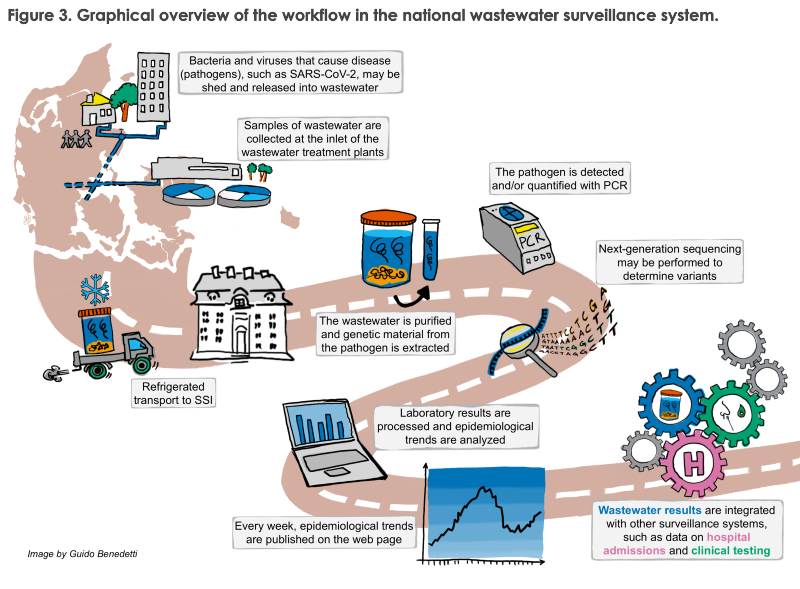
Individuals infected with SARS-CoV-2 or influenza shed viral particles in their feces, which can then be detected in wastewater. Wastewater surveillance measures the overall level of infection in the population independently of testing behavior and healthcare-seeking, and thus includes all infected individuals who shed the virus, regardless of symptom severity. When combined with clinical surveillance, this provides a broader monitoring system that informs both transmission and disease burden.
In 2025, SSI measured concentrations of SARS-CoV-2 and influenza in wastewater from 29 treatment plants strategically distributed across the country, collectively covering 49% of the population (Figure 3). Samples were collected twice weekly using automated samplers that collected wastewater over a 24-hour period. These composite samples were transported from the treatment plants to SSI by a transport company. At the Department of Virology and Microbiological Preparedness at SSI, the samples were purified and analysed using reverse transcription quantitative polymerase chain reaction (RT-qPCR) to estimate the number of viral particles per litre of wastewater. For SARS-CoV-2, the N1 and N2 gene regions are measured, and for influenza A, the matrix gene is measured.
Wastewater may be diluted to varying degrees, for example due to rainwater, and the number of users connected to the sewage system may vary between catchment areas. This is accounted for by also quantifying, using RT-qPCR, the naturally occurring plant virus pepper mild mottle virus (PMMoV). PMMoV is ingested through the diet and excreted in feces and can therefore be used as an indirect measure of the amount of fecal matter in wastewater.
The laboratory results are subsequently analysed statistically at the Department of Infectious Disease Epidemiology and Prevention at SSI. For SARS-CoV-2, wastewater results are reported weekly as:
- A weighted average of the concentration of SARS-CoV-2/PMMoV in wastewater. This weekly weighted average over the past 15 months is presented in a graph for each region and as a national average. Based on these data, five levels are defined, ranging from very low to very high.
- A growth rate, describing the change in the national level based on data from the most recent three weeks.
International collaboration
In 2025, SSI strengthened its role as a key international actor in wastewater surveillance, a field that is now becoming well established as an important tool in overall disease surveillance.
As coordinator of the “EU-Wastewater Integrated Surveillance for Public Health” (EU-WISH), a European collaboration involving 62 partners from 26 countries, SSI has contributed to advancing efforts toward greater harmonisation and improved comparability of wastewater data across countries. A highlight of 2025 was a major international EU-WISH meeting in Dublin. The workshop brought together more than 150 experts from over 30 countries, focused on prioritising wastewater parameters, and helped set the direction for Europe’s future efforts (EU-WISH International Workshop). In addition to its coordinating role, SSI also contributes to EU-WISH projects on epidemiology and the development of laboratory procedures. Progress within EU-WISH can be followed through its newsletter (EU-WISH News).
SSI has also expanded its global collaboration through the GLOWACON network (Global Consortium for Wastewater and Environmental Surveillance for Public Health), which works to strengthen and promote wastewater surveillance as a tool for public health monitoring worldwide. GLOWACON supports the institutionalisation of wastewater and environmental surveillance in public health systems and facilitates data sharing and standardisation across countries.
Finally, in 2025 SSI participated in a partnership with India, involving the exchange of methods and experiences. This collaboration resulted in a series of webinars and a workshop in Delhi, where SSI shared expertise on laboratory analyses and statistical methods for wastewater-based surveillance (Strategic Sector Cooperation with India).
In addition, a collaboration has been established with Aarhus University, which, on behalf of the Danish Health Authority, conducts periodic monitoring of the use of illicit drugs in Denmark.
Wastewater samples collected by SSI are also shared with Aarhus University—see the Aarhus University website for further information.
Wastewater surveillance in the coming years
The implementation of the revised European Urban Wastewater Directive in 2025 marks an important step towards broader and more systematic disease surveillance in Europe based on wastewater. The directive requires EU Member States to carry out wastewater-based surveillance to monitor disease trends in the population. As part of this, surveillance of multiple pathogens as well as antimicrobial resistance (AMR) will be required, and Member States must provide national reporting of results at the EU level (with ECDC expected to serve as the central recipient).
In 2026, work is underway at the governmental level to translate the directive into Danish legislation through a collaboration between the Ministry of the Environment and the Ministry of the Interior and Health, with participation from SSI. Consequently, substantial technical and national methodological development work will take place throughout 2026 to support the implementation of the directive and to strengthen the robustness of the surveillance system.
As part of this expansion to include additional pathogens, SSI expects to publish results from wastewater surveillance of influenza from the 2026/2027 winter season. In addition, preparations will be made in 2026 for the inclusion of further pathogens. At the same time, work with-in EU-WISH will continue, with a focus on consolidating the networks established across Europe and institutionalising wastewater-based surveillance.
References
Communicable disease threats report - week 31: European Centre for Disease Prevention and Control. (2025a). Vol. Week 31.
Communicable disease threats report - week 43: European Centre for Disease Prevention and Control. (2025b). (Issue Week 43).
Predicting hospital admissions due to COVID-19 in Denmark using wastewater-based surveillance
Gudde, A., Krogsgaard, L. W., Benedetti, G., Schierbech, S. K., Brokhattingen, N., Petrovic, K., Rasmussen, L. D., Franck, K. T., Ethelberg, S., Larsen, N. B., & Christiansen, L. E. (2025). . Science of the Total Environment, 966(October 2024), 178674.
https://doi.org/10.1016/j.scitotenv.2025.178674
National spildevandsovervågning af SARS-CoV-2. Statens Serum Institut. (2026).
https://www.ssi.dk/sygdomme-beredskab-og-forskning/sygdomsovervaagning/c/covid-19---spildevandsovervaagning