Listeria annual report 2023–2025
Listeria annual report 2023–2025
Listeriosis
Invasive listeriosis is a rare but serious foodborne infection caused by the bacterium Listeria monocytogenes, which primarily affects individuals with weakened immune systems due to disease or treatment (e.g. cancer, hematological disorders, kidney disease, and diabetes), advanced age, or pregnancy. The incubation period is longer than for most other foodborne infections, typically 2–3 weeks. L. monocytogenes can persist in food production environments for extended periods and may therefore give rise to outbreaks with multiple patients over a short time, as well as prolonged outbreaks where cases occur sporadically over several years.
Listeriosis in 2023–2025
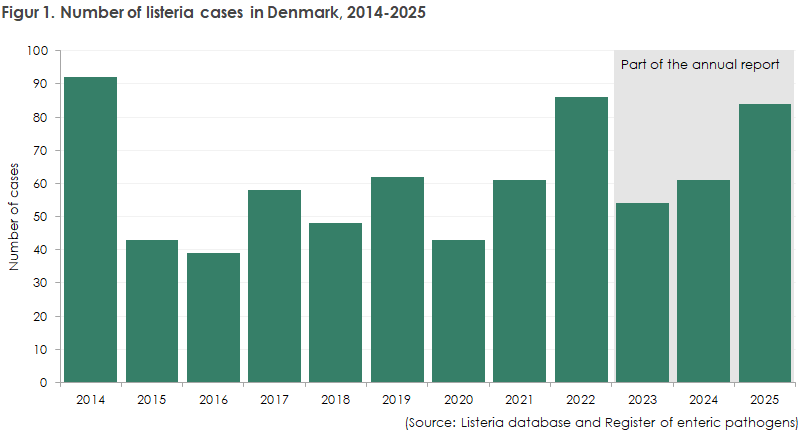
In the period 2023–2025, a total of 199 cases of invasive infection with L. monocytogenes were recorded, Figure 1. There were on average 66 cases per year [range 54–84], corresponding to an incidence of 1.1 per 100,000 population in Denmark per year.
Age and sex distribution
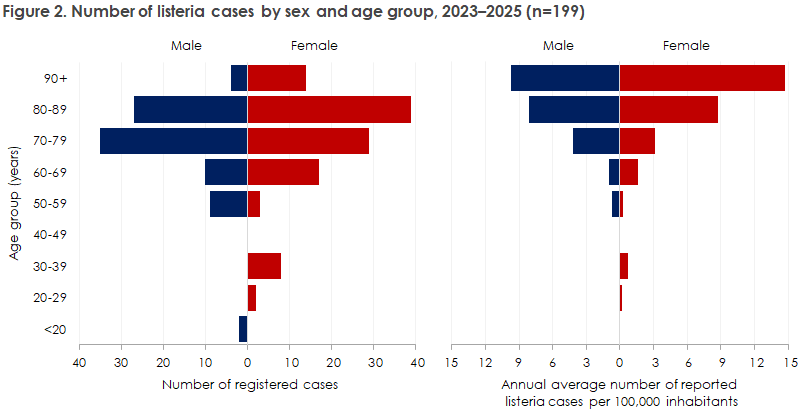
Figure 2 shows the total number of cases and the annual incidence per 100,000 population of listeriosis in 2023–2025, by sex and age group (infections in pregnant women and/or their unborn/newborn child are registered as a single case and attributed to the mother). The number of cases per 100,000 population increased with age. Overall, 82% of listeriosis cases were in individuals over 65 years of age, and 56% were women.
Geographical distribution
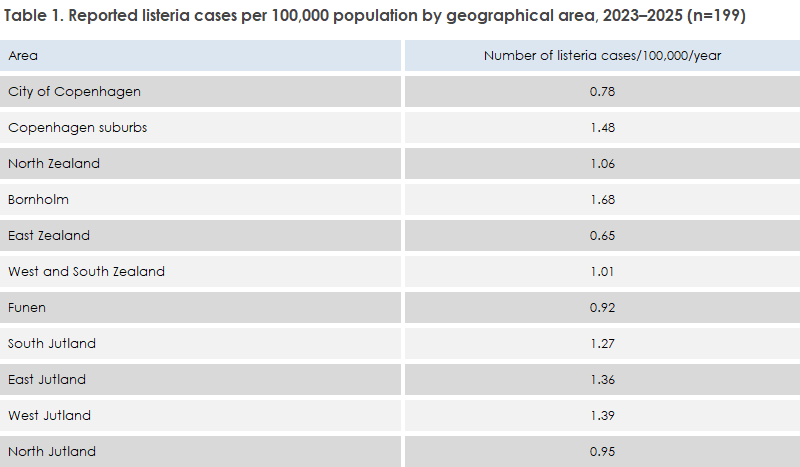
In the period 2023–2025, listeriosis cases were reported in all regions of Denmark, and the average annual incidence varied between 0.65 and 1.7 cases per 100,000 population, Table 1.
Clinical manifestation and severity
L. monocytogenes was detected in cerebrospinal fluid in 20% of patients; a further 78% of infections were identified in blood cultures, and 2% were identified in other sample materials, e.g. placenta.
A total of nine cases of listeriosis in pregnant women were recorded (1–5 per year). Among these, outcomes included miscarriage, stillbirth, or death of the child shortly after birth.
All individuals with listeriosis in the period 2023–2025 were hospitalized in connection with their infection, including four admissions lasting less than 12 hours. Of the 199 patients, 45 (23%) died within 30 days of infection (all-cause mortality). This is in line with previous reports (Listeriosis – occurrence 2014–2018 and Listeria annual report 2019–2022).
Outbreaks
In the period 2023–2025, 10 major genetic clusters/outbreaks with seven or more cases were identified, corresponding to 38% of patients in the period. Six of the outbreaks began before 2023, and four began in 2023 or later.
Outbreak investigations identified various ready-to-eat fish products as the source of four of the major outbreaks.
Fish cakes: In 2022, an outbreak with listeria ST7 linked to fish cakes produced in Denmark was observed. In autumn 2024, the same type of listeria caused a new outbreak. In total, seven cases were identified with this type. Interviews and trace-back investigations pointed to fish cakes from the same producer as in 2022, and comparison of bacteria from patients and environmental samples showed they were identical. The fish cakes were recalled from shops on November 2, 2024.
In autumn 2025, a new outbreak was identified (ST7, but distinct from the outbreak described above). A total of 11 cases were recorded. The outbreak investigation showed that fish cakes were again the source, but this time from another Danish producer. Comparison of bacteria from patients and product samples from the company showed that the bacteria were identical. The fish cakes were recalled from shops on September 10, 2025.
Other fish products: In the period 2018–2024, two listeria outbreaks caused by ready-to-eat fish products were linked to the same Danish fish producer. One outbreak included eight cases with listeria type ST8, while the other included 20 cases with ST1607. In addition to Danish cases, cases with the same sequence type were also reported in other European countries.
Unknown source: The source of the remaining six outbreaks, each with 7–12 cases, remains unknown. One of these outbreaks is described on SSI’s outbreak website:
Outbreak of invasive listeria infection sequence type 403 in Denmark.
Surveillance and notification obligation
L. monocytogenes is isolated by culture or detected by PCR at clinical microbiology departments in Denmark. According to the Executive Order on notification of infectious diseases (BEK no. 865 of 20/06/2025), isolates from all patients with invasive infection must be submitted to Statens Serum Institut (SSI). Due to the severity and outbreak potential, SSI has performed whole genome sequencing on all available isolates from invasive infections since 2014. This enables identification and investigation of clusters of genetically related bacteria (same type) and thus potential outbreaks.
At SSI, the multi-locus sequence type (MLST) is determined and named using established international nomenclature (sequence type; ST). Subsequently, the shared part of the genome is analyzed using core-genome MLST (cgMLST). By comparing sequences, it is possible to determine the number of allele differences between them. Genetically related Listeria bacteria are defined as having ≤7 allele differences. In addition, all patients are interviewed, if possible, to map exposures in the month prior to illness.
SSI received isolates for genome sequencing from 97% of all invasive listeriosis cases, and it was possible to interview approximately 60% of cases during the period.
Outbreak investigation and collaboration with the Danish Veterinary and Food Administration and the National Food Institute, DTU
Information from whole genome sequencing and interviews is continuously used to identify or verify possible sources of infection in outbreaks, and sequences from patient isolates are regularly compared with isolates from food or production environments. Investigation of listeria outbreaks is carried out in collaboration with the Danish Veterinary and Food Administration and the National Food Institute, DTU, under the auspices of the Central Outbreak Management Group.