HIV 2025
Annual Report HIV 2025
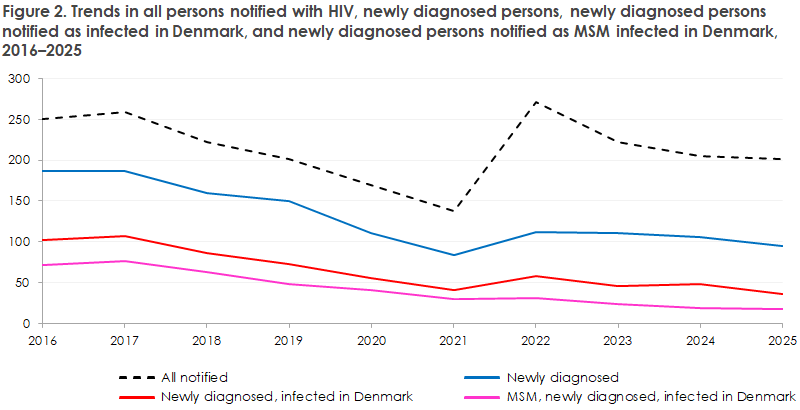
- In 2025, 94 persons with newly diagnosed HIV were notified, as well as 107 persons who had already been diagnosed abroad.
- Among those newly diagnosed, 61 were either Danes infected in Denmark or abroad, or immigrants infected after arrival in Denmark. The remaining 33 were immigrants infected before arrival in Den-mark. These 33 could therefore not have been reached by Danish HIV prevention measures.
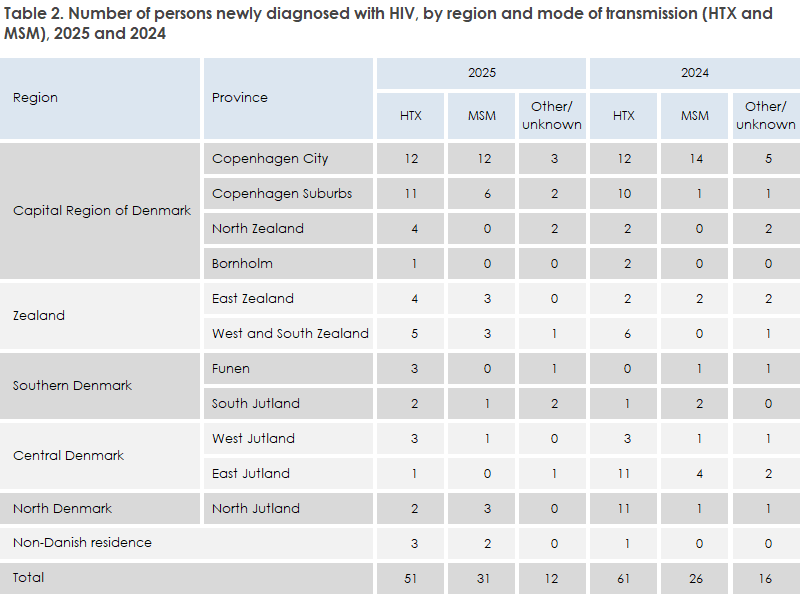
- Among those newly diagnosed, 31 were men who have sex with men (MSM) and 51 were heterosex-ually infected (HTX), of whom 32 were men and 19 women (including one trans woman). The remain-ing 12 were notified with another (5) or unknown mode of transmission (7).
- 55% of MSM and 29% of HTX were infected in Denmark.
- Among newly diagnosed MSM, 42% were immigrants. The proportion was 49% for HTX.
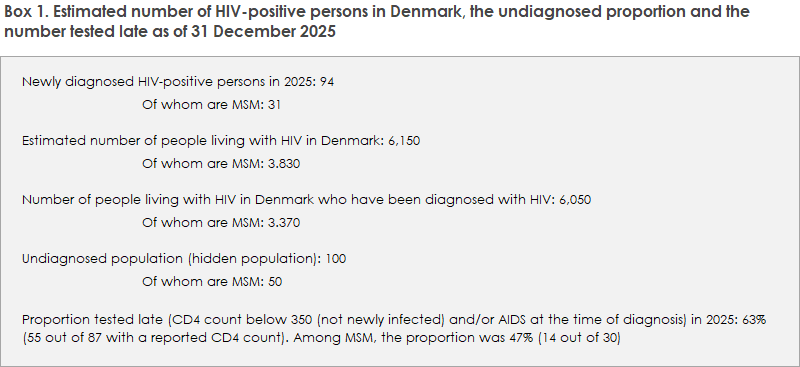
- Among MSM, 30% were diagnosed late. The same applied to 60% of HTX.
- Immigrants, asylum seekers, etc. should be tested for HIV as soon as possible after arrival in Denmark. This allows for rapid treatment, and thereby a good prognosis, and also reduces the risk of further transmission.
- All MSM without known HIV should be tested for HIV once a year. In addition, MSM who have an ac-tive sex life and who do not consistently use condoms should be tested for HIV and other sexually transmitted infections more frequently, e.g. every 3 months, and possibly be offered PrEP (Pre-Exposure Prophylaxis, HIV medicine taken before exposure). PrEP has been shown to provide by far the best prevention against HIV and can be credited with the sharply declining occurrence of HIV among MSM in Denmark.
- Treatment immediately after diagnosis means that persons known to be HIV-positive pose no risk of further transmission of HIV, as well-treated HIV-positive persons cannot transmit the infection.
o Prevention of HIV transmission includes:
o Condom use
o TasP (Treatment as Prevention, i.e. only unprotected sex with HIV-positive persons known to be receiving effective treatment).
o PrEP (Pre-Exposure Prophylaxis, HIV medicine taken before exposure).
o PEP (Post-Exposure Prophylaxis, HIV medicine taken immediately after exposure).- The overall prevalence of HIV resistance (PDR) has not changed in recent years. Resistance to non-nucleoside inhibitors (NNRTI resistance) is the most frequently occurring.
- One of the 76 patients examined had HIV-1 with resistance to both drugs (FTC and TDF) in PrEP (Truvada®). In addition, 1 of 76 also had resistance to integrase inhibitors (EVG and RAL).
In 2025, 201 cases of HIV were notified, of whom 141 were men and 60 women (including three trans women), Table 1.
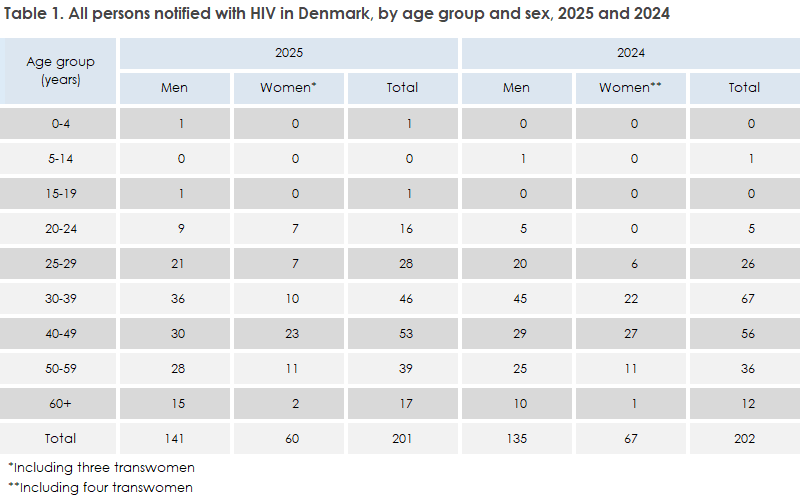
In 2025, the median age for men was 42 years (range 0–79 years) and for women it was 41 years (range 22–77 years).
While the 201 notified cases represent the number of persons who have been added to the population of people living with HIV (PLWH) in Denmark, a large proportion of these had already been notified with HIV in another country. These should therefore not be included in the number of persons with newly diagnosed HIV in Denmark.
Among the 201 notified cases, 107 persons (53%) had previously been diagnosed with HIV abroad, of whom six were born in Denmark and 40 were from Ukraine. Thus, 94 persons (47% of those notified) were diagnosed with HIV for the first time.
No children were notified as being infected or born with HIV in Denmark in 2025.
Origin, country of infection and mode of transmission among newly diagnosed persons
Among the 94 who were diagnosed with HIV for the first time, 46 (49%) were born in Denmark and 48 (51%) were born abroad, including three tourists and four persons who were staying illegally in the country.
There were 72 men and 22 women notified. Among these were 31 men who have sex with men (MSM), 32 men who have sex with women (MSW), and 19 women who have sex with men (WSM), including one trans woman. In addition, five persons were notified with other modes of transmission (intravenous drug use, cosmetic surgery abroad or mother-to-child transmission abroad), and seven were notified with an unknown route of transmission.
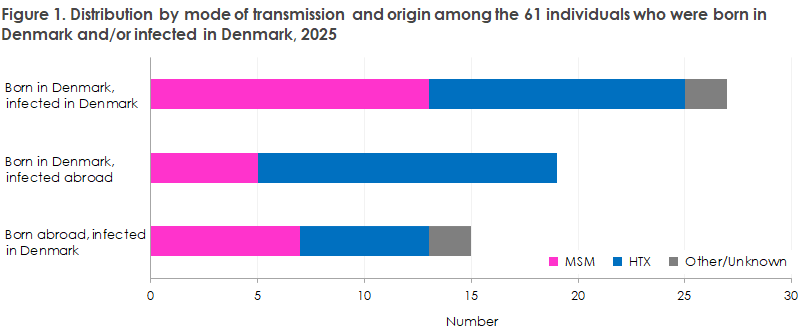
Of the 31 MSM, 13 (42%) were born in Denmark and infected in Denmark, four (13%) were born abroad and infected after arrival in Denmark, while five (16%) were born in Denmark and infected abroad. The final nine (29%) were born abroad and infected before arrival in Denmark (Figure 1).
Among 51 persons infected heterosexually (32 men and 19 women), 12 (24%) were born in Denmark and infected in Denmark, three (6%) were born abroad and infected after arrival in Denmark, while 14 (27%) were born in Denmark and infected abroad, of whom seven were infected in Thailand. Three were infected while staying with family abroad after they had migrated to Denmark (6%).
The final 19 (37%) were born abroad and infected before arrival in Denmark (Figure 2).
Among the 12 persons with other (intravenous drug use, mother-to-child transmission or nosocomial transmission) or unspecified modes of transmission, two were born in Denmark and infected in Denmark (both notified with an unknown mode of transmission), two were born abroad and infected in Denmark (one through intravenous drug use and one with an unknown mode of transmission), while eight were born and infected abroad before arrival in Denmark.
Altogether, 61 persons (65%) who were born in Denmark and/or infected in Denmark/infected after arrival in Denmark constitute the number for whom prevention efforts in Denmark were insufficient.
The remaining 33 persons (35%) were born abroad and infected before arrival in Denmark.
Table 2 provides an overview of persons newly diagnosed with HIV, by region and mode of transmission (HTX and MSM).
Pregnancy
In 2025, three pregnant women with newly diagnosed HIV were notified, all born abroad. All were found to be HIV-positive through antenatal screening. In addition to these three with newly diagnosed HIV, 17 women with known, well-treated HIV were identified through antenatal screening.
CD4 count at diagnosis – diagnosed late
Among the 94 persons diagnosed with HIV for the first time in 2025, information on CD4 count at diagnosis and/or information on recent infection (recent negative test and/or acute HIV disease) or information on AIDS at diagnosis was available for 87 (93%). For the remaining seven, this information could not be obtained.
The CD4 count is a marker of the effect of HIV on the cellular immune system. Everyone diagnosed with HIV is offered treatment immediately, regardless of CD4 count at diagnosis. A CD4 count below 350 and/or AIDS at the time of diagnosis continues to be used in this report as a marker of late diagnosis. Conversely, the CD4 count at diagnosis may be very low if the person is tested shortly after infection has occurred and may therefore incorrectly be regarded as a “late tester” on the basis of the CD4 count. When a person is notified with HIV to the national surveillance system at Statens Serum Institut (SSI), information that may show whether the person is newly infected with a low CD4 count (symptoms of acute HIV, recent negative HIV test, etc.) is therefore specifically requested.
Among the 87 persons with a reported CD4 count at the time of diagnosis, 45 (53%) had a CD4 count below 350 cells per µl and/or had been diagnosed with AIDS, while 42 (48%) had a CD4 count of 350 or above or had been diagnosed with acute HIV.
The proportion diagnosed late fluctuates somewhat, having decreased in 2025, but in previous years it increased alongside the decrease in the number of new diagnoses (the proportion was between 47% and 55% in 2018–2021 and 56–60% in 2022–2024).
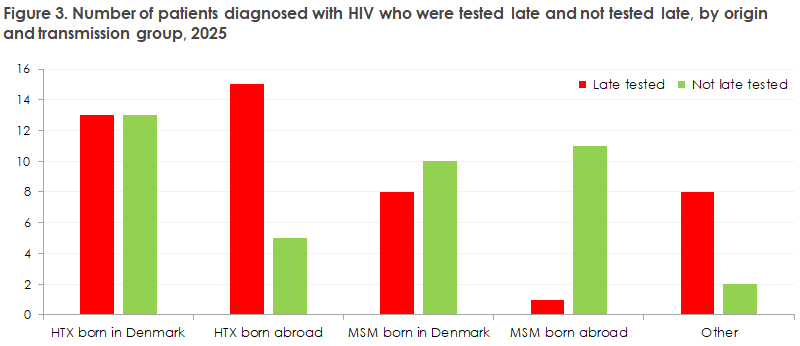
Among HTX, the proportion diagnosed late was 60%. In this group, the picture is somewhat clearer, as 50% (13 out of 26) of those born in Denmark were diagnosed late, and 75% (15 out of 20) of those born abroad were diagnosed late.
Among the ten who were notified with another or unknown mode of transmission, eight were diagnosed late, seven of whom were born abroad.
Figure 3 shows the distribution of those diagnosed late and those not diagnosed late, by origin and transmission groups.
Prevention potential
For a number of years, the number of new HIV diagnoses in Denmark has been declining. Contributing factors include frequent testing, particularly of MSM, early initiation of treatment (TasP, Treatment as Prevention), which prevents treated HIV-positive persons from transmitting the infection further, and particularly PrEP (Pre-Exposure Prophylaxis, HIV medicine taken before exposure, which is offered to MSM).
To further prevent HIV transmission among MSM, it is important that the clinician who finds an MSM positive for gonorrhoea, syphilis or chlamydia/LGV tests him for HIV and, if he is HIV-negative, offers the patient PrEP. In 2024, the Danish Health Authority updated the speciality plan for infectious diseases so that PrEP can now be provided at main-function level. For some MSM, there may be a barrier to taking the initiative themselves to seek PrEP treatment, and clinicians may therefore usefully suggest this.
Likewise, being bisexual may possibly have a negative influence on the patient’s initiative to seek both HIV testing and PrEP treatment, something that staff at testing sites should also be aware of.
With regard to heterosexually transmitted HIV, it is particularly important to test immigrants from countries with a high prevalence of HIV quickly after arrival. The Danish Health Authority’s guidelines from 2013 state that persons from Africa, Asia, South America and Eastern Europe should be considered for HIV testing at their first contact with the healthcare system, regardless of the reason for contact.
It can be difficult to identify persons at risk of HIV infection among heterosexuals born in Denmark.
There are, however, some opportunities to prevent infection in this group. These may include single persons who go on “sex holidays” to the East or Africa, or persons who frequent swinger clubs.
To prevent further transmission from persons with undiagnosed HIV, clinicians should also be aware of patients with so-called indicator diseases, for example hepatitis (A, B, C), anal cancer, etc.
Aids
In 2025, 19 of the 94 persons newly diagnosed with HIV (20%) were notified with AIDS, as they were diagnosed with an AIDS-defining disease at the same time as the HIV diagnosis. These included 13 HTX, three MSM and three persons with another mode of transmission. The most frequent AIDS-defining diagnosis was Pneumocystis jirovecii pneumonia.
A total of 50 HIV-notified persons died in 2025. Of these, two were diagnosed in 2025 and the remainder between 1984 and 2023. As information in the Register of Causes of Death is published with a delay of at least one year, it is not possible during the current year of death to assess what proportion of the deceased died from an HIV-related disease and who died from something else.
Retrospectively, however, experience indicates that approximately one quarter of deaths among HIV-positive persons have an HIV-related cause.
Checkpoint
Checkpoint comprises the Danish AIDS Foundation’s testing clinics in Copenhagen, Gentofte, Frederiksberg, Aalborg, Aarhus and Odense for LGBT+ persons and others at high risk of HIV, where people can be tested, both with and without a prior appointment, for HIV and syphilis, among other infections, and receive the results immediately. In total, five men tested positive for HIV for the first time at Checkpoint in 2025; one was born in Denmark and the others were born abroad.
Resistance among treatment-naive persons with newly diagnosed HIV
The Virus Genomics Section at SSI has compiled data on all persons infected with HIV-1 included in the national surveillance during the period 1 January 2025–31 December 2025. During the period, samples were received from 85 of the 94 persons with newly diagnosed HIV, as well as from 68 of the 107 persons who had already been diagnosed abroad. Resistance and subtype determination could be performed for 78 and 10, respectively, of these two groups; particularly in the latter group, a large proportion (58) could not be analysed because the viral load was too low (<1,000 copies/mL).
Of the 78 persons with newly diagnosed HIV, 74 were examined in both the pol and integrase genes, while two were examined exclusively in either the integrase or pol gene. Of the 10 analysed samples from persons diagnosed with HIV abroad, eight were examined in both the pol and integrase genes, while one was examined exclusively in either the integrase or pol gene.
ECDC’s definition of pre-treatment drug resistance (PDR) was used to assess resistance. According to the definition, PDR includes all cases of treatment-relevant resistance with a score ≥15 according to the Stanford HIVdb algorithm version 10.2. Resistance was examined for the four main classes of antiretroviral drugs used in HAART: non-nucleoside inhibitors (NNRTI), nucleoside inhibitors (NRTI), protease inhibitors (PI) and integrase inhibitors (INSTI). The genotypes in this report were determined using COMET version 2.4.
For those newly diagnosed, the overall PDR prevalence was 14.5% (11/76) for the pol gene (RT, NRTI and NNRTI), and the PDR prevalence for the integrase gene (INSTI) was 1.3% (1/76), giving an overall PDR prevalence of 15.4% (12/78). NNRTI was the most frequent PDR (n=6; 7.9%), followed by PI (n=2; 2.6%) and NRTI (n=2; 2.6%). There was one case of resistance to multiple drug classes, PI+NNRTI, and one case of INSTI resistance to older integrase inhibitors (EVG and RAL). This single case was not subtype A6. There was no significant difference (Fisher’s test >0.05) in PDR among newly diagnosed persons infected in Denmark (14.5%) compared with those infected abroad (17.9%), and the PDR prevalence during the period is comparable with previous reports (14.5% now and 13.3% previously).
For persons who had already been diagnosed abroad, the overall PDR prevalence in the pol gene was 22.2% (2/9), consisting of one with NRTI+NNRTI and one with NNRTI PDR. There was one case of partial PrEP resistance (FTC), and no cases of INSTI resistance. As only 14.7% of the received samples from this group could be analysed because of low viral load, the numbers are therefore small and should be interpreted with caution. The reason for this is presumed to be that most are well treated and therefore have a viral load that is too low for the analysis to be per-formed.
To take into account the possibility that individual samples may have been taken after treatment initiation, sam-ples with and without resistance with ≤14 days between the estimated date of diagnosis and sampling date were compared. PDR was not significantly different (Fisher’s test >0.05) among samples submitted less than 14 days af-ter notification (10/63; 15.9%) compared with samples submitted more than 14 days after notification (2/15; 13.3%).
The Danish Health Authority recommends Pre-Exposure Prophylaxis (PrEP) for persons in particular risk groups. PrEP (Truvada®) consists of the two nucleoside inhibitors (NRTIs): emtricitabine (FTC) and tenofovir (TDF). Among those newly diagnosed, there was one person during the period with both TDF resistance and FTC resistance (HIVdb score ≥15), while there was one person with partial (FTC) PrEP resistance among persons who had already been diagnosed abroad.
HIV-1 subtypes among newly diagnosed patients
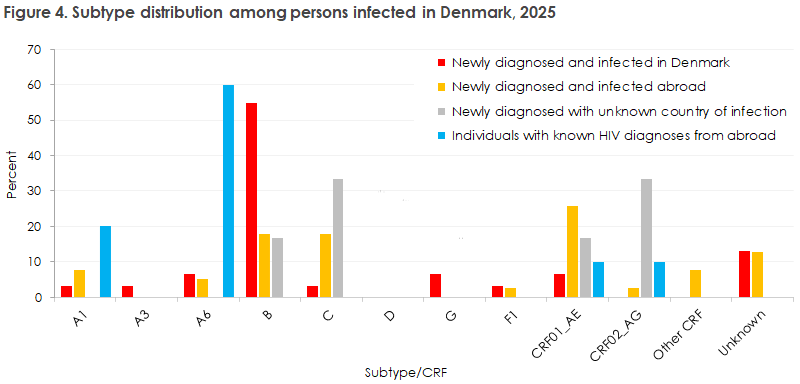
Among newly diagnosed persons who were infected in Denmark in 2025, Figure 4, subtype B was the most frequent subtype, while CRF01_AE was the most frequent among those who were infected abroad. The numbers for newly diagnosed persons with unknown country of infection and those with a known HIV-1 diagnosis are small (6 and 10, respectively) and should therefore be interpreted with caution. However, subtype A6, which predominates in Ukraine among other places, accounts for 60% among those with a known HIV-1 diagnosis from abroad.
Subtype A6 can carry the compensatory mutation L74I in the integrase gene, which can promote resistance to INSTI. The mutation was detected in eight of nine A6 integrase sequences, and in seven integrase sequences from other subtypes (CRF02_AG, A1, B, C, Unknown). This shows that L74I is found in a large proportion of subtype A6 integrase sequences, but not all, and that it is not found exclusively in these.
As sporadic occurrence of integrase resistance has been observed in several European countries, including Denmark, consideration is now being given to establishing more systematic reporting of this at European level (Eurosurveillance | Letter to the editor: When do rare events become expected in HIV drug resistance?). This is particularly because sporadic cases of resistance to some of the newest classes of integrase inhibitors (including cabotegravir), which have considerable treatment potential and are used prophylactically in the Global South, have been observed. It is therefore essential, also in Denmark, to continue monitoring the occurrence of resistance through timely notification of HIV-1 cases and submission of samples for diagnostics.
Collection and updating of epidemiological information take place continuously between EPI-NEWS publications, and changes in data may therefore occur from report to report.
This annual report is also discussed in EPI-NEWS 37-38/2026.