Gonorrhoea – annual report 2025
Gonorrhoea – annual report 2025
The national surveillance of gonorrhoea at Statens Serum Institut (SSI) is based on data extracts from the Danish Microbiology Database (MiBa) as well as clinical notifications via the Danish Health Data Authority’s electronic reporting system (SEI2), see below. MiBa contains data on results obtained by culture and/or PCR or other nucleic acid amplification testing (NAT), as all departments of clinical microbiology (DCMs) in Denmark perform combined NAT for gonococci and Chlamydia trachomatis.
If repeated positive samples are found in the same person, a new case of gonorrhoea is defined when there are more than 21 days between the positive findings. A negative testing episode is likewise defined by more than 21 days between negative findings. Surveillance of laboratory-confirmed gonorrhoea is supplemented by antimicrobial susceptibility testing of gonococcal isolates submitted to the Department of Bacteria, Parasites & Fungi (BPS), Infectious Disease Preparedness at SSI, or cultured there from primary samples submitted by the Capital Region of Denmark or the Central Denmark Region.
In addition to laboratory-based surveillance, the treating physician is legally required to notify all cases of gonorrhoea to the Notification System for Infectious Diseases (MIS), Department of Infectious Disease Epidemiology and Prevention (AIF), SSI. Since 2022, this has been done electronically via SEI2. The clinical notification system requests information that is not available from laboratory data, e.g. mode of transmission, sexual orientation, country of infection and HIV status.
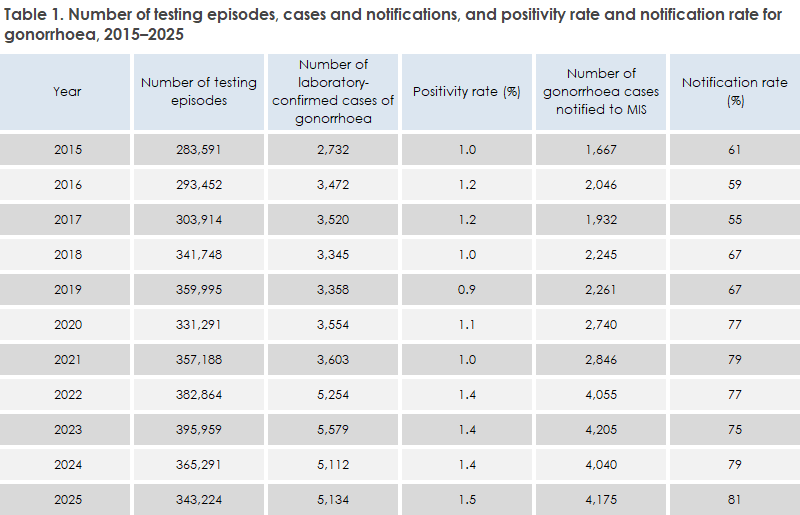
In 2025, 5,134 cases of gonorrhoea were registered in MiBa across 343,224 testing episodes. This represented a 6% decrease in the number of testing episodes from 2024 to 2025 and a 3% increase in the number of gonorrhoea cases, resulting in a positivity rate of 1.5%, 0.1 percentage points higher than in 2024. The notification rate increased slightly again from 2024 to 2025, from 79% to 81%. The 2025 figures for testing episodes and number of cases are very comparable with those of previous years. Likewise, the number of chlamydia cases has remained stable in recent years following the sharp increase in 2022.
Sex, mode of transmission, origin and country of infection
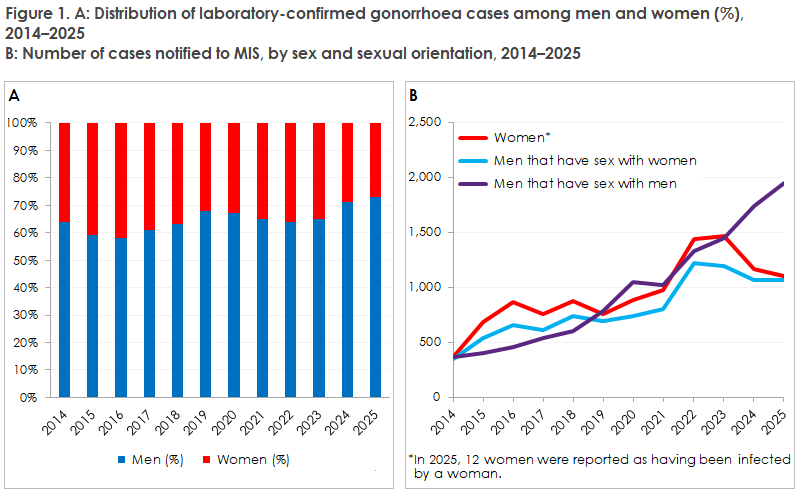
The 5,134 cases comprised 1,387 cases among women and 3,747 among men, showing a continued increase in the number of cases among men relative to women, Figure 1A. Of these, 4,175 cases were notified, showing a clear increase in gonorrhoea among men who have sex with men (MSM) and a decrease in the number of notified cases among men who have sex with women (MSW) and women, Figure 1B.
In 12 cases, transmission between two women was reported (eight in 2024). There were 27 cases among pregnant women (17 in 2024) diagnosed and notified in 2025. In 2025, 51 cases of gonorrhoea were notified among sex workers (37 in 2024). Seven cases were notified among transgender persons (11 in 2024). Country of origin was stated in 4,154 notifications in 2025, of whom 71% were born in Denmark and 29% abroad.
In 2025, information on where gonorrhoea was acquired was available for 4,013 episodes (78%), of which 8% were reported as having been acquired abroad (10% in 2024). In 2025, 338 cases were reported as having been acquired abroad, distributed across 53 countries, with most acquired in Spain, Germany, Thailand, Sweden and the United Kingdom. A larger proportion of gonorrhoea episodes among men were acquired abroad (10%) compared with women (5%). By sexual orientation, 9% of cases among MSW were acquired abroad, compared with 10% among MSM.
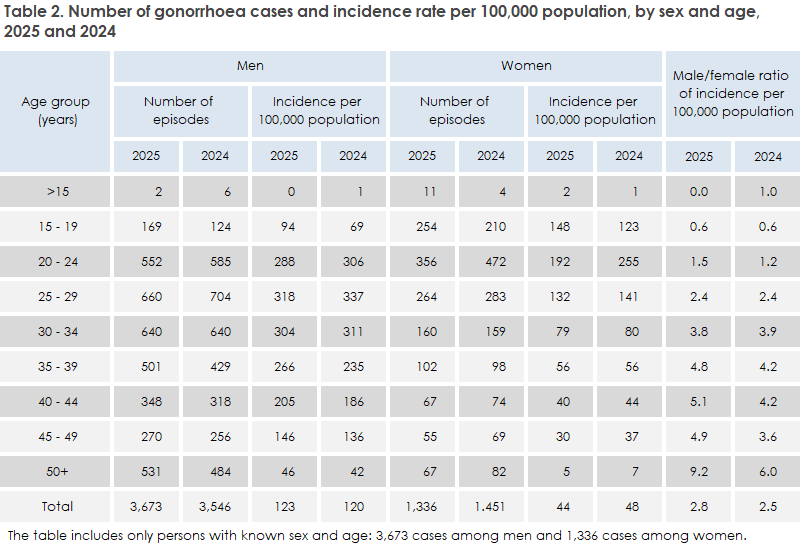
The total number of episodes of laboratory-confirmed gonorrhoea among men was virtually unchanged from 2024 to 2025, Table 2. Among persons aged 20–29 years, a decrease was observed among both men and women. Among men, increases were observed among those aged >35 years, whereas among women there was a decrease to varying degrees among those aged >40 years.
For both men and women, an increase was observed in the 15–19-year age group in 2025 compared with 2024. In 2025, men accounted for 73% of registered gonorrhoea episodes, an increase of two percentage points from 2024.
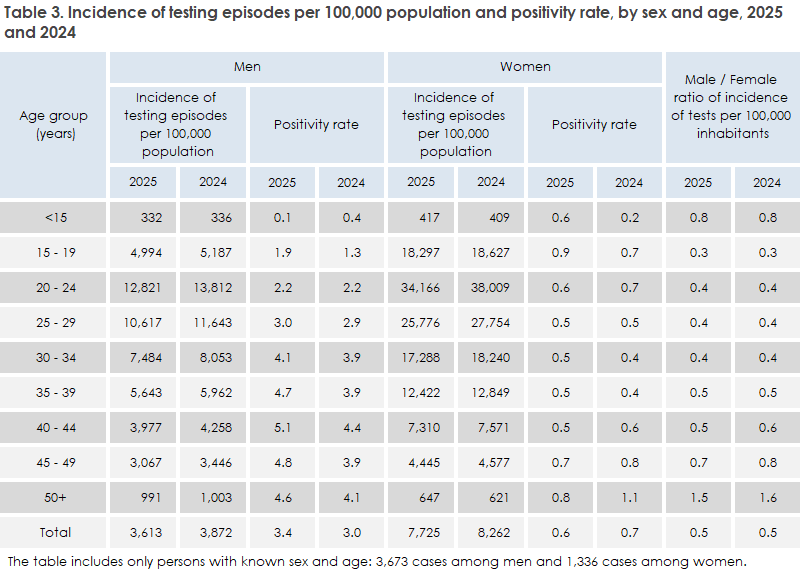
In 2025, there was a continued decrease in testing activity among both men and women, Table 3, but women continued to be tested more than twice as frequently as men. Along with this decrease in testing activity, an increase in the positivity rate was observed (with the exception of women aged 20–25 years and >40 years). The highest testing activity in 2025 was again among those aged 20–24 years, with 34,166 tests per 100,000 population among women and 12,821 tests per 100,000 population among men. Overall, there was no notable change from 2024 to 2025 in the positivity rate among women, while among men it increased from 3.0% to 3.4%, Table 3. The positivity rate among men increased in all age groups older than 24 years.
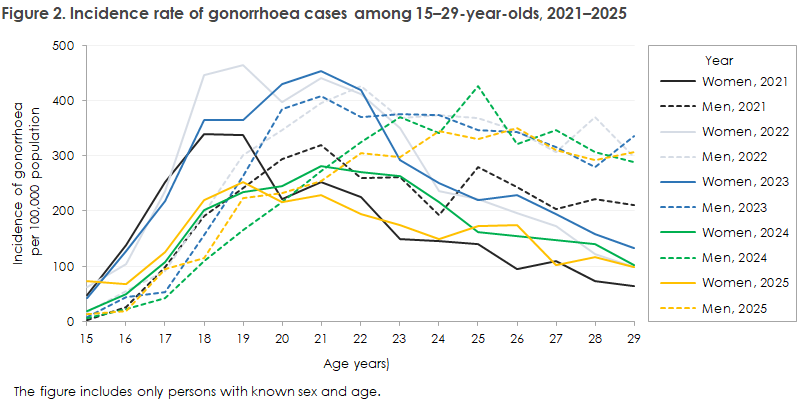
In 2025, a small increase in the incidence of gonorrhoea was observed among 15–19-year-olds. Among both sexes, a small decrease in the incidence of gonorrhoea was observed among 20–24-year-olds, while the pattern among 25–29-year-olds was unchanged from 2024, Figure 2. The highest incidence per 100,000 population was observed among 19-year-old women and 26-year-old men, respectively.
Gonorrhoea among children
In 2025, 13 cases were registered among persons under 15 years of age (ten in 2024). Several of the cases were eye infections in infants aged 0 years resulting from transmission from the mother during childbirth.
HIV and PrEP treatment among persons with gonorrhoea
In 2025, HIV status was reported for 64% of all notified cases (54% in 2024). Among the 2,676 notified cases with known HIV status in 2025, 9% were among persons with known HIV, <0.1% among persons with newly diagnosed HIV and 91% among HIV-negative persons. In 2025, 63% of notified HIV-negative MSM were receiving PrEP (60% in 2024).
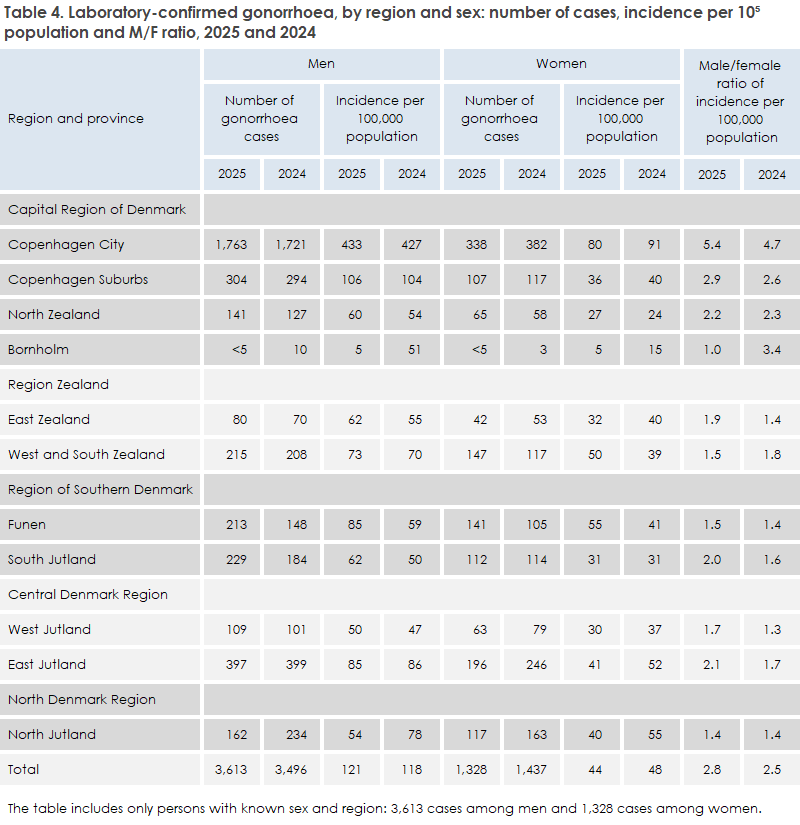
In 2025, the overall incidence rate was virtually unchanged for both men and women compared with 2024, Table 4. In the Central Denmark Region and North Denmark Region, a decrease was observed among women, whereas among men a decrease was observed only in the North Denmark Region, with an unchanged pattern in the Central Denmark Region. A decrease in the incidence rate was observed on Bornholm in 2025 compared with 2024 for both men and women, whereas a larger increase was observed on Funen for both men and women. Overall, there was an increase in the male-to-female ratio of incidence per 100,000 population nationwide. The highest incidence rate for both men and women was again observed in the City of Copenhagen, at 433 and 80 cases per 100,000 population, respectively, in 2025.
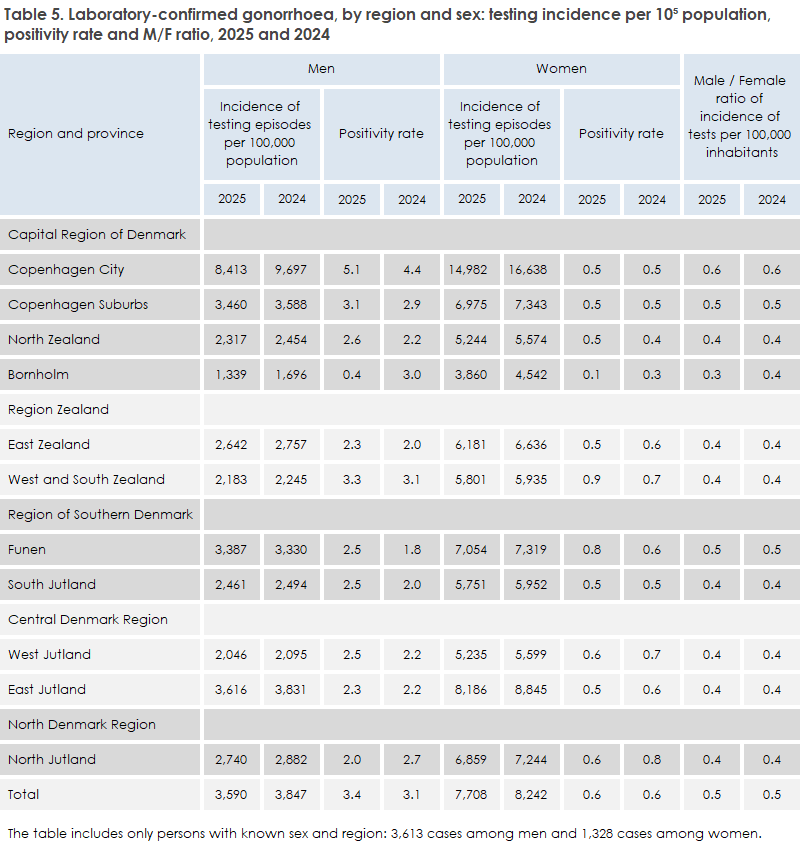
Across the country, a small reduction in testing activity was observed for both men and women compared with 2024, Table 5. Alongside the decrease in testing activity, an increased positivity rate was observed among men in 2025 compared with 2024, whereas the positivity rate among women was unchanged. The highest positivity rate among men was observed in the Copenhagen City, at 5.1%, and among women in West and South Zealand, at 0.9%.
Gonorrhoea at special anatomical sites
In 2025, in addition to the usual anatomical sites (urogenital, anorectal and pharyngeal), gonorrhoea was detected in 20 cases in samples from the eyes, synovial fluid and blood. In 2024, gonorrhoea was detected in 25 cases outside the usual anatomical sites.
Resistance among Neisseria gonorrhoeae
In 2025, 1,894 N. gonorrhoeae (NG) isolates from 1,812 episodes were examined at SSI as part of the national antimicrobial resistance surveillance (2,006 isolates from 1,802 episodes in 2024). Isolates with an associated notification in MIS no later than 60 days after sampling could be linked with information on source of infection and sexual orientation, which was the case for 1,547 isolates. MIC (minimum inhibitory concentration) is determined for NG isolates at SSI, and EUCAST breakpoints were used to distinguish between resistance and susceptibility. Resistance to azithromycin, ceftriaxone and ciprofloxacin is tested. Isolates with intermediate resistance to ciprofloxacin are treated as resistant in this report.
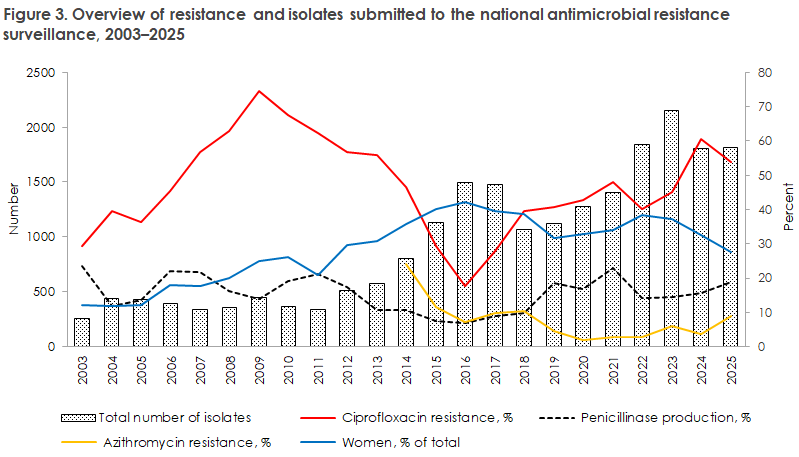
In 2025, there was no change in the number of gonorrhoea cases for which an isolate was received, Figure 3, which was consistent with the unchanged occurrence of gonorrhoea episodes. As described previously, there was a continued decrease in the proportion of isolates originating from women. The azithromycin resistance rate, which decreased from 6% to 3.6% from 2023 to 2024, increased again in 2025 to 8.9%. The ciprofloxacin resistance rate decreased from 60% to 54%.
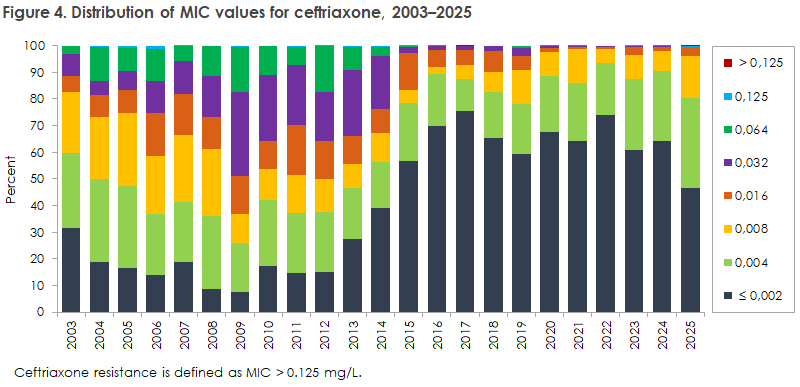
In 2025, ceftriaxone-resistant (CR) gonococci were detected in urethral swabs from two men who had acquired the infection in Southeast Asia. The minimum inhibitory concentration (MIC) for ceftriaxone was 0.19 mg/L and 0.25 mg/L (the upper limit for full susceptibility is 0.125 mg/L).
Pharyngeal and rectal swabs had been taken from one patient, and gonococcal DNA was detected in the rectal swab.
In addition, in January 2026, CR gonococci (MIC = 0.19 mg/L) were detected in a urethral swab from a man who had also acquired the infection in Southeast Asia.
All three patients were treated with ceftriaxone.
Whole-genome sequencing of the three gonococcal strains showed that they were not related. There were no signs of transmission of the gonococci concerned in Denmark.
The three cases show that CR gonococci can be imported into Denmark from Southeast Asia, as has occurred in a number of other EU countries. There was also a case in 2017 (Terkelsen et al., Eurosurveillance 2017).
SSI previously proposed, in EPI-NEWS 41/2025, that the standard dose of ceftriaxone for the treatment of gonorrhoea should be increased from 500 mg to 1,000 mg. It is the assessment of SSI that the risk of resistance development among other bacterial species is minimal, since only a limited number of persons will receive a doubled single dose.
It is extremely important that microbiological testing for gonococci is complete, i.e. that it includes not only the urethra but also sampling from the pharynx and rectum. Gonorrhoea at these sites is generally asymptomatic, and pharyngeal gonorrhoea is also more difficult to treat than gonorrhoea at other sites. Complete sampling should also be performed at the test of cure.
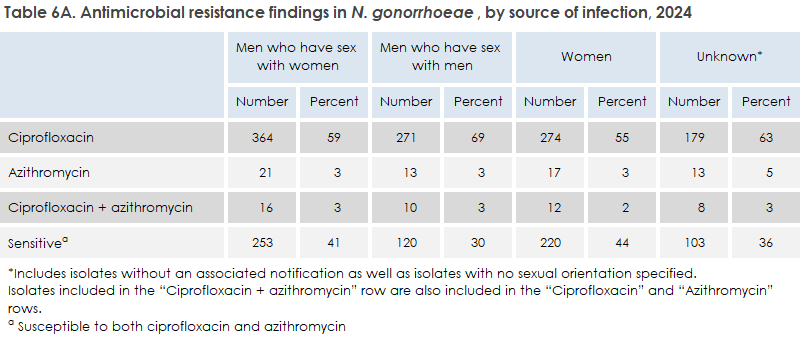
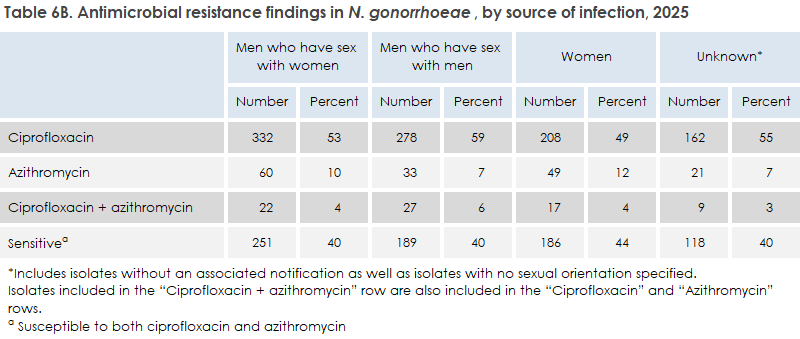
In 2025, there was a decrease in the number of gonorrhoea episodes caused by ciprofloxacin-resistant gonococci among MSW and among women, whereas the number was unchanged among MSM; however, a relative decrease was observed for all groups, Figure 3, Tables 6A and 6B. The previously mentioned increase in the azithromycin resistance rate, Figure 3, contributed to the large increase in the number of isolates exhibiting resistance to azithromycin and, at the same time, to the increase in the number of isolates exhibiting resistance to both ciprofloxacin and azithromycin.
Thus, in 2025, there was an increase in the number of isolates exhibiting resistance to azithromycin together with ciprofloxacin, against the background of the observed increase in azithromycin resistance. Among MSM, there was also an increase in the proportion of isolates in which neither azithromycin nor ciprofloxacin resistance was observed, Tables 6A and 6B.
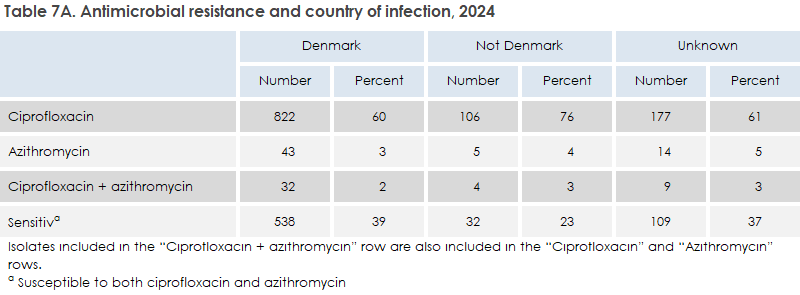
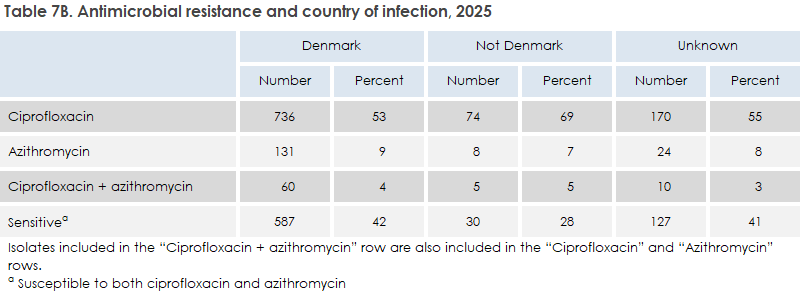
In 2025, a similar decrease was observed in the number of ciprofloxacin-resistant gonococcal isolates among cases acquired in Denmark and abroad. In both groups, increases were observed in the number of azithromycin-resistant gonococcal isolates, which was reflected in the increase in gonococcal isolates exhibiting resistance to both ciprofloxacin and azithromycin. There was a general increase in the number of gonococcal isolates susceptible to both ciprofloxacin and azithromycin, Tables 7A and 7B.
This report is also mentioned in EPI-NEWS 35b/2026.