No 11/12 - 2026
Wastewater-based surveillance of infectious diseases in Denmark
Wastewater-based surveillance of infectious diseases in Denmark
Wastewater analysis is a relatively new method for surveillance of infectious diseases in Denmark. A proportion of individuals infected with an infectious disease shed the pathogen into the sewage system, where it can subsequently be detected in wastewater using molecular methods. By analysing relatively few wastewater samples within a surveillance system, it is possible to gain insight into the spread of infection in the community. Among the advantages are that results can often be obtained quickly, and that surveillance also includes individuals who do not come into contact with the healthcare system. Wastewater surveillance is less sensitive to changes in clinical practice or laboratory testing, which, among other things, made the method particularly useful towards the end of the COVID-19 pandemic, when Denmark rapidly phased out mass testing.
Since 2021, wastewater-based surveillance has been used at Statens Serum Institut (SSI) to monitor SARS-CoV-2 in Denmark. SSI currently receives weekly wastewater samples from 29 treatment plants across the country, covering 49% of the population. At SSI, the samples are analysed using qPCR to estimate the number of viral particles in the wastewater. Since 2021, wastewater-based surveillance has developed into an established surveillance system, which SSI continues to consolidate and expand with relevant stakeholders.
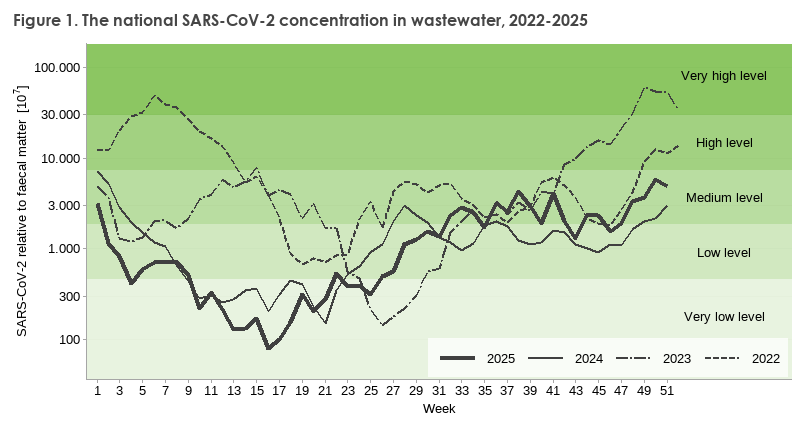
After four years of wastewater-based surveillance, it is now possible to assess infection levels relative to previous years and to identify a potential seasonal pattern for SARS-CoV-2. The concentration of virus in wastewater, and thus the level of infection in the community, has been lowest during the summer months and highest in autumn and winter—with a peak in December/January, Figure 1. It has also been observed that the level of SARS-CoV-2 in wastewater has generally been lower in 2024 and 2025 compared with 2022 and 2023, when COVID-19 transmission was very high during the winter period, particularly leading up to Christmas.
In 2025, SSI began analysing wastewater samples for influenza virus. The results from influenza surveillance are currently only used internally at SSI, as methodological improvements in measuring influenza in wastewater are ongoing. However, results are expected to be published for the 2026/27 influenza season.
Additional results can be found in the 2025 annual report, which describes wastewater surveillance with a focus on 2025.
Wastewater-based surveillance is fundamentally different from traditional clinical surveillance; the two systems do not measure the same parameters. Wastewater surveillance can be considered complementary to clinically based surveillance, and data from both systems are used together at SSI to assess the spread of SARS-CoV-2 and influenza in the community.
Results from wastewater surveillance are published weekly on SSI’s website. Work is ongoing to further develop and quality-assure the methods—this is described in several scientific publications; a list of these is also available on the website.
In addition to influenza, SSI is preparing to expand wastewater-based surveillance to include additional diseases in the coming years. This is in line with the revised European Urban Wastewater Directive, which was updated in 2024 and is now being implemented. According to the directive, EU Member States will be required to monitor pathogens in wastewater and to be able to use wastewater surveillance in the event of a public health crisis. Furthermore, it will become mandatory to monitor antimicrobial resistance (AMR) in wastewater. The operational details of the directive are currently being developed and must be finalised by July this year. It will then be transposed into Danish legislation, and Member States must begin surveillance in accordance with it by July 2028.
(N. Belusa, L.W. Krogsgaard, A.M.O. Kildemoes, S.K. Schierbech, S. Ethelberg, Department of Infectious Disease Epidemiology and Prevention)