No 46 - 2025
DANMAP 2024
DANMAP 2024
The DANMAP programme surveils the consumption of antibiotics and resistance towards antibiotics in bacteria from humans, animals, and food in Denmark. The DANMAP collaboration has existed since 1995 and publishes new reports annually that describe the key findings regarding antibiotic consumption and the occurrence of antimicrobial resistance.
Below are the most important findings from the year 2024.
Antibiotics for humans
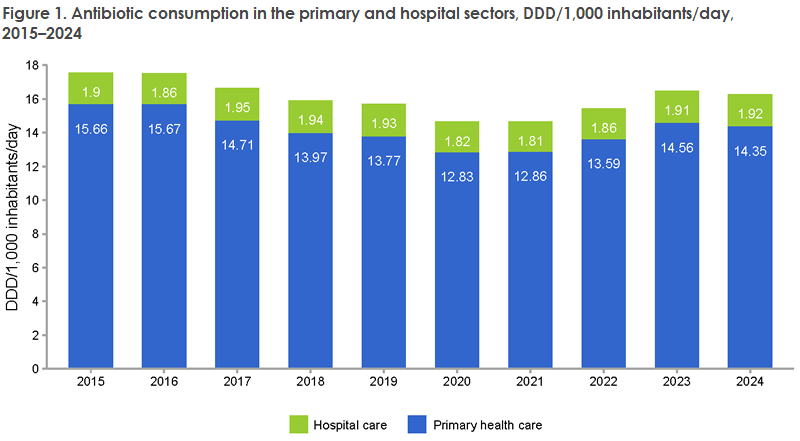
In 2024, total human antibiotic consumption was 16.27 defined daily doses per 1,000 inhabitants per day (DID), which is comparable to the consumption in 2023 (16.47 DID), EPI-NEWS 46/2024, but 7.3% lower than 10 years ago (17.56 DID in 2015). This may indicate that the observed increase in antibiotic consumption post–COVID-19 has stopped, Figure 1.
Antibiotics in the primary sector
In the primary sector, antibiotic consumption was 14.35 DID in 2024, of which penicillins accounted for 64%. The consumption of antibiotics in children in the primary sector increased sharply from 2021 to 2023, but in 2024 the consumption decreased considerably again. Among the youngest children aged 0–4 years, consumption consisted of 230 unique individuals who had received at least one antibiotic prescription per 1,000 children aged 0–4 years. This is 23% lower than in 2023 (298 per 1,000). For slightly older children aged 5–9 years, consumption decreased by 13% over the same period, from 197 to 172 patients per 1,000 inhabitants in 2023 and 2024 respectively, Figure 2.
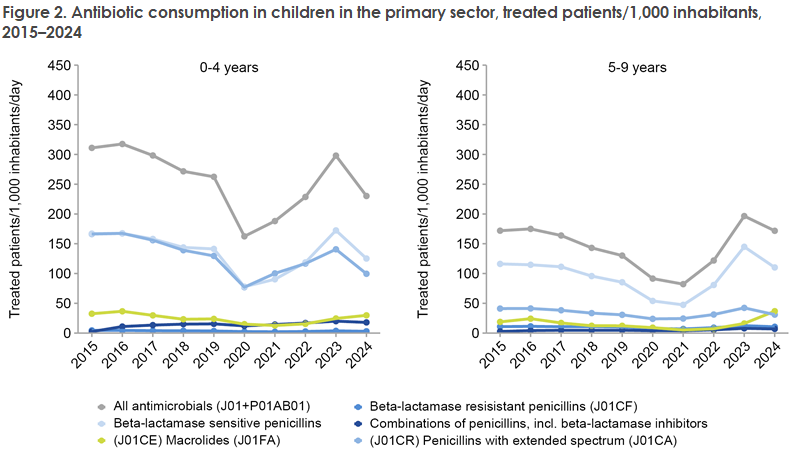
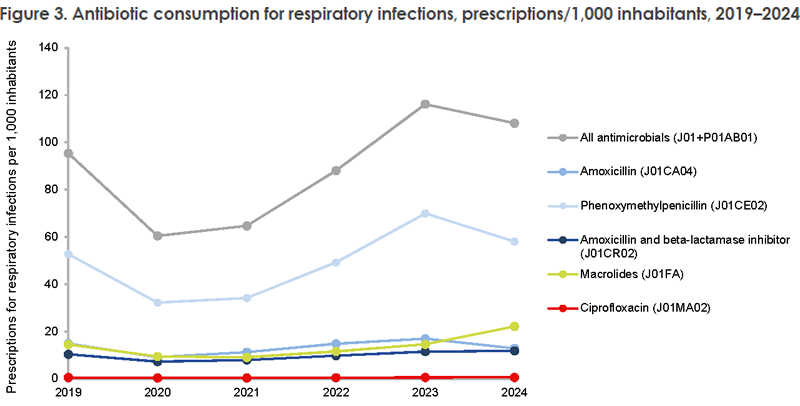
Figure 3 shows the consumption of antibiotics for the treatment of respiratory infections, which fell for the first time in 2024 (−7% compared with 2023) after a few years of increasing post-COVID-19 consumption. In the winter of 2022–2023, the usual peak in antibiotic consumption reached a higher level than in 2018–2019. This was likely due to an early RSV epidemic and influenza season as well as an outbreak of group A streptococcal infections. Viral infections may lead to secondary bacterial infections requiring antibiotic treatment and thereby contribute to increased antibiotic use.
Antibiotics for elderly patients
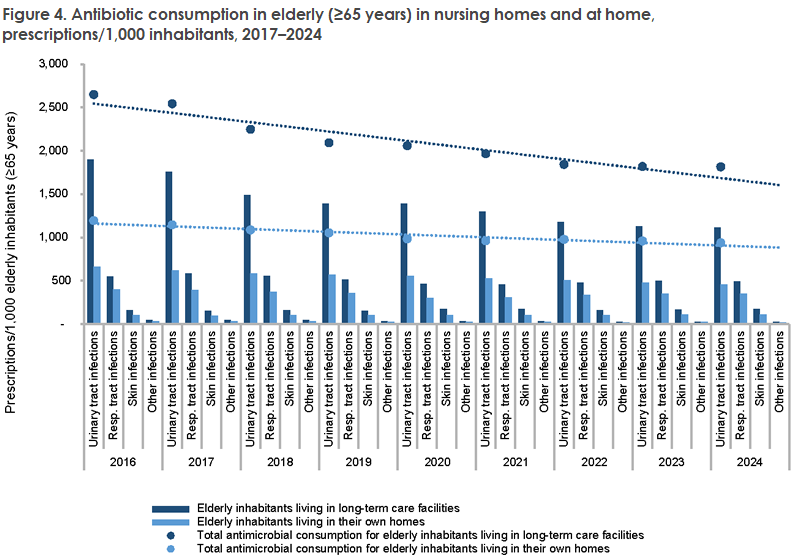
Antibiotic consumption among the elderly (≥65 years) in nursing homes was 93% higher than consumption among elderly living at home in 2024, Figure 4. The largest difference is seen in the consumption of antibiotics for urinary tract infections. Consumption among the elderly has been decreasing since 2016, with a steeper decline among those in nursing homes. In 2024, consumption was unchanged for the first time compared with the previous year, 2023.
Antibiotics for hospital patients
The trend in antibiotic consumption in hospitals depends on the measurement unit used.
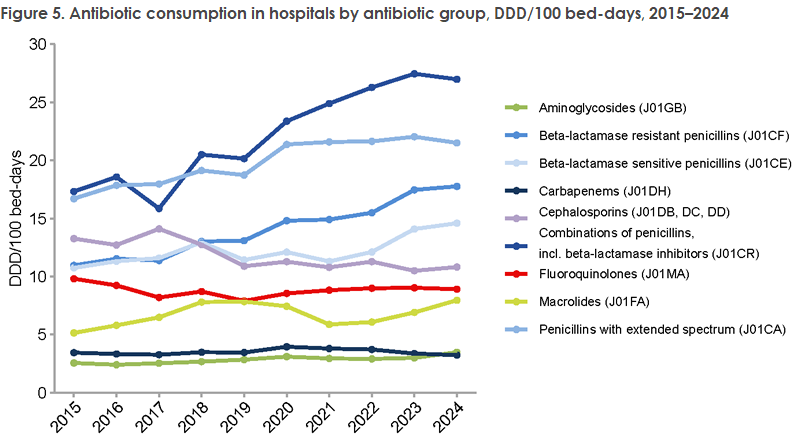
Unlike in the primary sector, hospital antibiotic consumption has increased over the past decade from 110.23 DDD/100 bed-days in 2015 to 146.17 in 2024 (+33%), and from 524.65 DDD/100 admissions in 2015 to 593.31 in 2024 (+13%). Measured in DDD/1,000 inhabitants/day, consumption showed less pronounced changes in 2024 compared with ten years ago.
The observed increase measured as DDD/100 bed-days was due to rising consumption of penicillins combined with beta-lactamase inhibitors (56% increase from 2015 to 2024) and beta-lactamase-resistant penicillins (62% increase). Over the same period, consumption of critically important antibiotics (cephalosporins, fluoroquinolones, and carbapenems) decreased by 13%, Figure 5.
In 2024, hospital antibiotic consumption was, for the first time in many years, comparable to the previous year. Most notable is the downward turn in consumption of penicillins combined with beta-lactamase inhibitors, which decreased by 2% from 2023 to 2024, Figure 5. At the same time, consumption of beta-lactamase-sensitive penicillins increased.
Antibiotics in shortage
The supply of antibiotics is increasingly challenged by delivery difficulties. In 2024, metronidazole was affected and unavailable for a long period, which handled by purchasing unregistered products via compassionate use permits from the Danish Medicines Agency. Previously, penicillin/beta-lactamase inhibitors and nitrofurantoin have also been affected by supply issues. The DANMAP team is involved in several national, Nordic, and European initiatives that seek to solve supply problems to preserve access to antibiotics, particularly older narrow-spectrum agents.
Antimicrobial resistance in clinical bacteria in humans
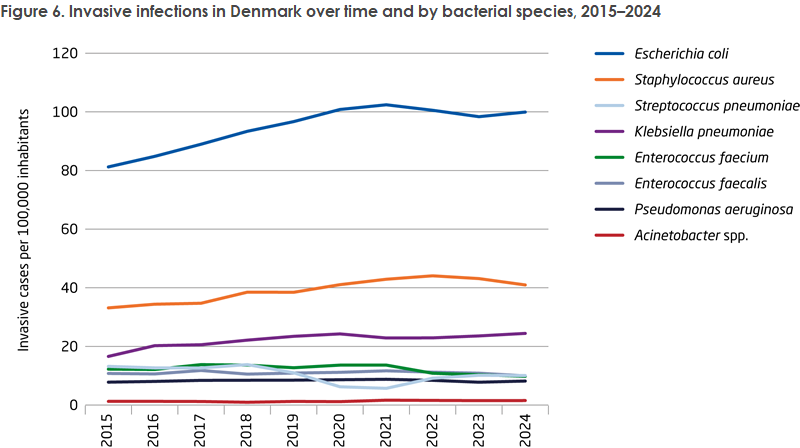
There were 12,214 cases of invasive bacterial infections from monitored species in Denmark in 2024, Figure 6. The numbers have increased for many years but seem to have stabilized since 2021.
Compared with ten years ago, invasive infections have increased by 22% (9,975 cases in 2015). Escherichia coli remained the most common cause of invasive infections (50% of all cases) in 2024, followed by Staphylococcus aureus and Klebsiella pneumoniae.
Vaccination efforts, both among children and older/risk groups, have led to a declining incidence of invasive infections with Streptococcus pneumoniae (747 cases in 2015, 600 cases in 2023), with marked drops in 2020 and 2021 (363 and 333 cases) during the COVID-19 pandemic. Since then, incidence has increased again.
After declining resistance levels during the COVID-19 pandemic across many bacteria under surveillance, resistance rates have been either stable or increasing since 2022, but remain at a generally low level. Nevertheless, reducing antibiotic consumption and using the narrowest spectrum possible remain important priorities.
After a significant decline in ESBL- and AmpC-producing E. coli bloodstream infections from 2020 to 2021 (352 and 254 cases), numbers rose to 336 in 2022 and 346 in 2023, then decreased slightly to 316 in 2024. CTX-M-15 remained the most common ESBL enzyme, present in 40% of the cases (57% in 2023). Monitoring these E. coli is important because ESBL- and/or AmpC-positive bacteria are resistant to most beta-lactam antibiotics.
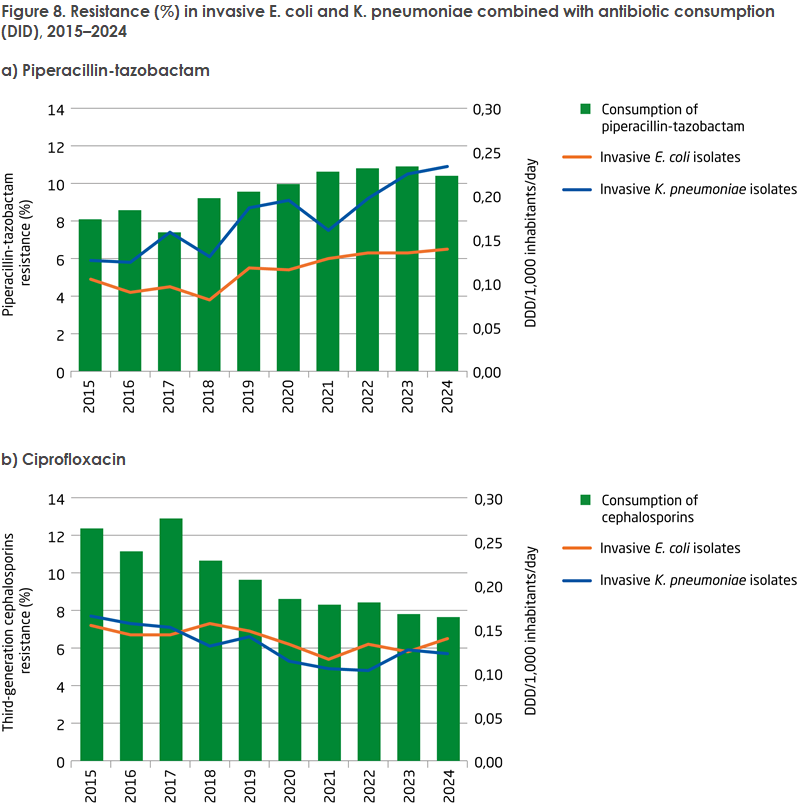
Of note, resistance towards piperacillin-tazobactam in K. pneumoniae has increased over the past ten years and exceeds 10% both in invasive infections (5.9% in 2015, 10.9% in 2024) and urinary tract infections (6.3% in 2015, 10.9% in 2024) among hospitalized patients.
Combined resistance towards 3. generation cephalosporins, ciprofloxacin, and gentamicin remains rare for both E. coli and K. pneumoniae in invasive infections (1.0% and 1.4% in 2024, respectively).
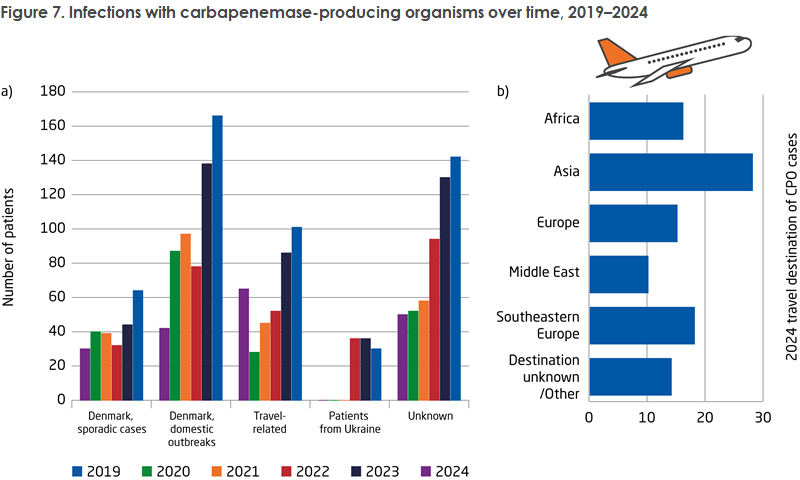
The number of carbapenemase-producing organisms (CPO) increased by 15% in 2024 (677 cases) compared with 2023 (589 cases). The primary reason for this increase is outbreaks in Danish hospitals. Increased screening and the reception of Ukrainian patients has also contributed. However, travel information was missing for 27% of cases, thus adding uncertainty to the numbers, Figure 7.
There is concern about the continued high level of transmission in hospitals. It is therefore crucial to maintain focus on general and supplementary infection hygiene measures.
While invasive enterococcal infections have decreased since 2022, vancomycin-resistant enterococci (VRE) increased until 2022. In 2024, VRE incidence decreased from 722 isolates in 2023 to 613 isolates (−15%). This continued decline should not lead to loosening of infection prevention and control measures.
After a marked rise in methicillin-resistant S. aureus (MRSA) cases from 2022 to 2023 (3,649 cases), there was a slight decrease in 2024 to 3,372 cases, EPI-NEWS 43b/2025. MRSA screening accounted for 41% of cases, while infections accounted for 59%. There were 38 MRSA outbreaks in hospitals, nursing homes, and other institutions, involving 191 cases, including 86 infections. Of these, 47 were bacteraemias, including 7 livestock-associated cases.
Relationship between antibiotic consumption and resistance
Over the past decade, the amount and composition of antibiotic consumption in humans have changed, followed by shifts in resistance patterns. For example, the steep rise in consumption of penicillins and beta-lactamase inhibitors in hospitals has been accompanied by rising resistance towards piperacillin-tazobactam in invasive E. coli and K. pneumoniae, Figure 8a.
Conversely, declining use of fluoroquinolones (ciprofloxacin) has been followed by lower resistance to these agents in invasive E. coli and K. pneumoniae, Figure 8b.
Antibiotic consumption and resistance in the veterinary sector
In the veterinary sector, there have also been notable changes in antibiotic consumption and resistance in bacteria from livestock and food. For example, following the ban on zinc oxide in pig production, antibiotic consumption in piglets increased in 2023. This increase did not continue in 2024, where consumption was similar to 2023. The proportion of resistant E. coli isolated from pigs continued to rise in 2024.
In cattle, antibiotic consumption increased by 4% despite a decrease in the number of animals.
Conversely, fewer bacteria showed resistance to most tested antibiotics, while the proportion of multidrug-resistant E. coli decreased by 10 percentage points.
Read more about antibiotic consumption in animals in DANMAP 2024 Chapter 4, and about resistance in bacteria from livestock and food in Chapters 6, 7, and 9.
New national action plan
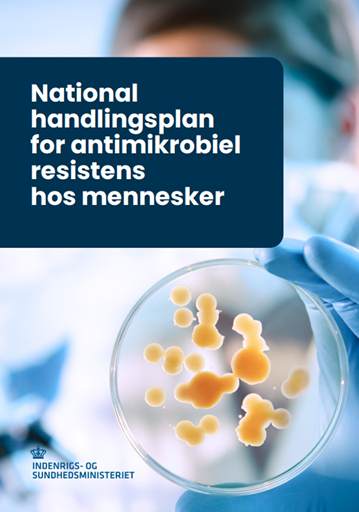
In June 2025, the Ministry of the Interior and Health published the National Action Plan for Antimicrobial Resistance in Humans. The new action plan sets the framework for a strengthened and expanded effort against antimicrobial resistance. The plan addresses the human sector through 21 initiatives distributed across the following four focus areas:
- Resistance control
- Supply security
- Infection prevention
- International engagement
Read more about the action plan here: National Action Plan for Antimicrobial Resistance in Humans.
Want to know more?
In connection with European Antibiotic Awareness Day and World Antimicrobial Awareness Week, Statens Serum Institut and DTU Food Institute invite you to the DANMAP seminar on 18 November 2025, focusing on key DANMAP findings, new action plans against antimicrobial resistance, and how to move from plans on paper to action in practice.
The seminar will take place at the Technical University of Denmark and online from 10:30 to 14:30. It is relevant for all professionals who prescribe antibiotics or have an interest in antibiotic use and resistance in Denmark. Registration is via this link: www.danmap.org/da/seminars/seminar-2025https://www.danmap.org/da/seminars/seminar-2025.
Parts of the DANMAP 2024 report can already be found at www.danmap.org.
The full DANMAP 2024 and Summary DANMAP 2024 are published on 18 November 2025.
(M. Attauabi, M. Lindegaard, U.W. Sönksen, Department of Bacteria, Parasites and Fungi)