No 6 - 2025
Elimination of measles in the European Region is under threat
Elimination of measles in the European Region is under threat
At the beginning of the 2000s, the World Health Organization (WHO) decided that measles and rubella should be eliminated worldwide. In this context, elimination means that each country achieves control of the disease through high vaccination coverage and strong surveillance. A limited number of cases may occur, but they must be detected and the source of infection identified. Cases may be both imported and endemic, i.e., infected within the country itself. The important point is to detect cases quickly so that, when necessary, preventive treatment can be given to unprotected close contacts, thereby minimizing the risk of further transmission and breaking chains of infection as quickly as possible.
Elimination is implemented and documented in each of the six WHO regions. So far, elimination of measles has only been achieved in one of the six regions, namely the Region of the Americas (AMRO/PAHO, 2016). At the beginning of 2024, measles was still circulating freely, i.e. occurring endemically, in a varying number of countries in the South-East Asia Region (SEARO), the Western Pacific Region (WPRO), the Eastern Mediterranean Region (EMRO), the African Region (AFRO) and the European Region (EURO), Table 1.
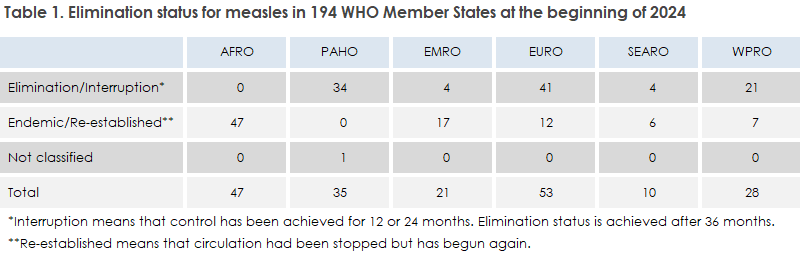
The European Region covers a very large geographical area from Greenland in the west to the easternmost parts of Russia and consists of 53 Member States. By the end of 2023, 41 countries had achieved measles elimination status, some after having lost this status along the way. At the beginning of 2024, 12 countries still had endemic measles transmission: Bosnia and Herzegovina, France, Georgia, Germany, Italy, Kazakhstan, Kyrgyzstan, Poland, Romania, Russia, Turkey and Ukraine.
Six countries in the European Region lost their elimination status in 2024
The WHO European Region has now published the final evaluation of elimination status for all 53 Member States in 2024. Unfortunately, six countries have lost their elimination status, including three in Western Europe: Armenia, Austria, Azerbaijan, Spain, the United Kingdom (UK) and Uzbekistan.
As stated, elimination does not require that no measles cases are detected at all, but that there are no prolonged chains of transmission with the same genetic virus strain (maximum 12 months), and that there is a sufficiently sensitive surveillance system to detect and diagnose measles cases, including the ability to genotype measles virus so that epidemiologically linked cases in a transmission chain can be confirmed through genotyping.
Vaccination against measles remains very important – also when travelling abroad
The prerequisite for controlling the disease is that a very high proportion of the population must be immune. Immunity can be achieved either through previous infection or through vaccination. The measles vaccine (MMR) is highly effective and safe and is recommended in Denmark in two doses for all children at 15 months and 4 years of age. Children who move to Denmark are offered alignment with the Danish childhood vaccination programme (in Danish language), including vaccination against the MMR diseases, if they are missing one or both MMR doses. In addition, adults who have not previously had measles or been vaccinated can receive the MMR vaccine free of charge (in Danish language).
During and following the COVID-19 pandemic, too many children in many countries did not receive routine vaccinations. Because measles is highly contagious, it does not take long before a sufficiently large group of susceptible individuals has accumulated, leading to outbreaks. Consequently, many European countries experienced a sharp increase in measles incidence in 2023 and 2024. In Denmark, no cases were detected in 2021 and 2022, but 9, 25 and 12 cases were reported in the following three years. There were a few transmission chains in Denmark, but these were interrupted after no more than three generations of transmission.
The most effective way to prevent and control outbreaks is to ensure that enough people are vaccinated against measles. In practice, this means that at least 95% of the population must have received two doses of MMR vaccine to prevent outbreaks and maintain the basis for elimination.
While measles has become rare in Denmark, the risk of encountering infection is increasing in many countries, including countries close to Denmark where many Danes spend their holidays. This applies, for example, to Germany, Italy and France – and now again Spain and the UK. It is therefore important to ensure protection against measles when travelling abroad throughout the year.
Measles is extremely contagious and requires only that one has been in the same room as an infectious patient – not necessarily at the same time – as measles is transmitted through the air, and the virus can remain suspended in microdroplets for up to 2 hours. Vaccination of children should therefore be given at the recommended ages of 15 months and 4 years. Adults can also be vaccinated free of charge before travelling if they have not had the disease or been vaccinated. In practice, however, persons born before 1974 can generally be considered naturally immune.
Denmark has very high vaccination coverage against both measles and rubella
In Denmark, vaccination coverage has been steadily increasing, particularly since 2015, when the so-called passive reminder system was introduced, reminding parents if their child appeared to be missing recommended vaccinations according to the Danish Vaccination Register (DDV). The current active reminder system, in which children are invited for vaccination before the scheduled vaccination time point, has further contributed to increasing both coverage and timeliness of the vaccination programme.
For birth cohorts 2019–2023, MMR1 coverage at 15 months of age has been 94%. Similarly, MMR2 coverage at 4 years of age has been 93–94% for birth cohorts 2016–2020. Although this coverage is slightly below the WHO target of at least 95% coverage for both doses, Denmark has in practice eliminated measles and received WHO confirmation of this in 2017.
Elimination has since been maintained through annual reporting to WHO, documenting surveillance by describing cases and transmission chains in detail, including genotyping results, as well as updated vaccination coverage data.
Remember also to test for rubella if clinically suspected
Denmark achieved elimination status for rubella in 2020 and has maintained this status since. For 2024 data, the Regional Elimination Committee noted that the target for the number of individuals tested for rubella is mainly achieved because all samples tested for measles are simultaneously tested for rubella. In contrast, very few samples are submitted specifically for rubella testing. It remains important to ensure appropriate testing for rubella if the diagnosis is suspected, including in Denmark.
(P.H. Andersen, J. Grau, Department of Infectious Disease Epidemiology and Prevention, K.T. Franck, L.D. Rasmussen, Virology and Microbiological Preparedness)