No 23 - 2026
Combined overview of respiratory infections in 2025/26
Combined overview of respiratory infections in 2025/26
The 2025/26 respiratory season was dominated by influenza
The 2025/26 respiratory season was characterized by high influenza activity. In addition, for the first time, an outbreak of influenza was observed outside the expected season.
In week 33 of 2025, a sudden increase was observed in the number of influenza A cases from around 20 cases weekly to 115 cases. Virological typing of the virus as well as interviews with a sample of the patients showed that it was an outbreak of influenza A(H1N1) at a music festival. During the following weeks, influenza activity again fell to a level corresponding to what is expected outside the season. Thus, the outbreak did not develop into an early season start.
In week 47, the influenza season began. This is determined on the basis of the increase in the number of laboratory-confirmed cases and hospitalizations. The season was dominated by influenza A(H3N2) clade K, a virus that had changed after influenza strains had been selected for the vaccines. This meant that the 2025/26 season became a season with high influenza activity. But despite the changes in the circulating virus, vaccine effectiveness calculations showed that there was still an effect of the influenza vaccine.
New offer to pregnant women for vaccination against RSV
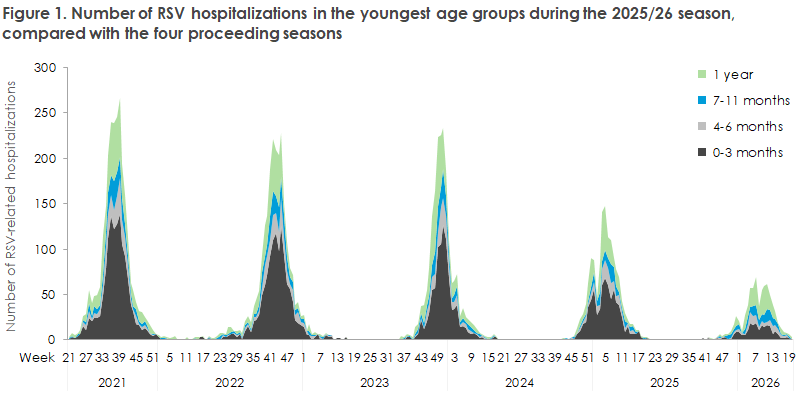
From 1 October 2025 to 31 January 2026, seasonal RSV vaccination was offered to pregnant women, EPI-NEWS 38/2025. During this period, pregnant women in weeks 32–36 of pregnancy could receive the vaccination free of charge. Uptake of the program was high: 72.7% of the children who were born between 1 November 2025 and 31 March 2026 had mothers who had accepted the offer of RSV vaccination. The high uptake was also reflected in the surveillance, where both the number of detected RSV infections and RSV-related hospitalizations among children aged 0–6 months were reduced compared with previous seasons, Figure 1.
Summary of the 2025/26 season
- Influenza: The season was characterized by high influenza activity, and from the end of 2025 onwards influenza was the most dominant respiratory infection—both measured by the number of infected individuals and hospitalized patients. For several weeks, both the number of cases and hospitalizations remained at a high level, and in some weeks the number of hospitalizations reached a very high level.
- COVID-19: The season was milder than previous seasons, as the number of cases and hospitalizations remained at a moderate level throughout 2025 and then fell to a low level in 2026.
- RSV: Overall, the RSV season was milder compared with previous seasons. The number of RSV cases and hospitalizations reached a high level in some weeks. The milder season is attributed to the fact that pregnant women were offered RSV vaccination from 1 October 2025 to 31 January 2026.
- Mycoplasma pneumoniae: The number of infections and hospitalizations was at a very low level in most weeks.
- Vaccination uptake: Influenza and COVID-19 vaccination uptake was 75% and 73%, respectively, among the older segment of the population aged 65 years and above.
(SSI’s respiratory team: H.-D. Emborg, J. Grau, I.R. Moustsen-Helms, F.K. Lomholt, L.W. Krogsgaard, S.K. Schierbech, N. Belusa, H. Bang, C. Kjelsø, C.H. Hansen, B. Søborg, Department of Infectious Disease Epidemiology and Prevention, R. Trebbien, A.B. Botnen, J. Krog, S. Hørlyck, S.S. Rasmussen, M. Rasmussen, U.V. Schneider, Department of Virology and Microbiological Preparedness, S.A. Uldum, Department of Bacteria, Parasites and Fungi, S. Gubbels, K.L. Møller, M. Galle, Data Integration and Analysis, L.E. Christiansen, S.M. Otero, Data Science and AI in Health)