No 18b - 2026
Imported cases of dengue in Denmark, 2010–2025
Imported cases of dengue in Denmark, 2010–2025
Dengue virus is transmitted to humans through bites from the mosquitoes Aedes aegypti (yellow fever mosquito) and Aedes albopictus (tiger mosquito). Dengue virus is endemic in tropical and subtropical areas and has increased globally in recent years. WHO estimates that around 96 million symptomatic cases and 40,000 deaths occur annually worldwide. In Denmark, dengue occurs only as an imported infection among travellers.
Changes in climatic and environmental conditions, urbanisation, and increased global travel and trade have likely contributed to the spread of vectors to new geographical areas, increasing the risk of local transmission from imported dengue cases among travellers, including in non-endemic regions such as Europe, where the tiger mosquito is increasingly observed.
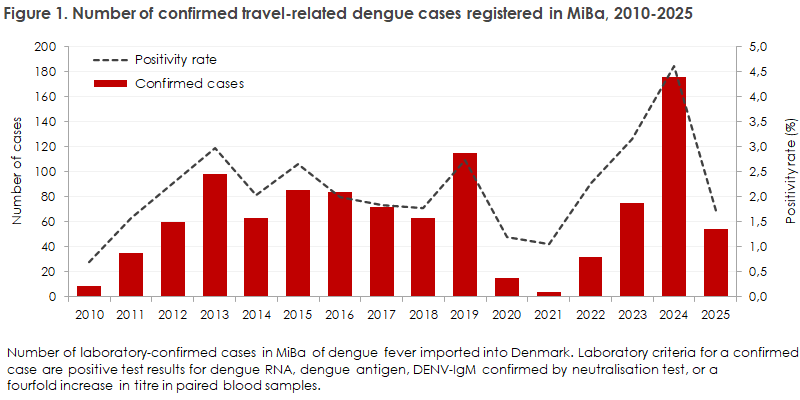
In the period 2010–2025, a total of 1,039 confirmed cases of dengue fever have been recorded in Denmark. The number of cases per year is shown in Figure 1. During this period, there was an average of 65 cases annually, ranging from 4 to 175 cases per year.
For a detailed description, see the annual report Imported cases of dengue fever in Denmark, 2010–2025.
The number of imported dengue cases has varied considerably over time. From 2010 to 2013, a steady increase was observed, followed by a relatively stable period from 2013 to 2018 with approximately 60 to 80 confirmed cases annually. In 2020–2021, a marked decline was seen in both case numbers and testing activity, reflecting reduced international travel during the COVID-19 pandemic.
From 2022, the number of cases increased again, with a notable rise in 2024, when both the highest number of cases and the highest positivity rate in the period were recorded. This increase did not continue in 2025, where the number of confirmed cases declined from 175 to 54.
The actual number of Danish travellers infected with dengue is likely higher than the recorded number. This is due to underreporting of mild or asymptomatic infections, as well as cases where illness resolves before return to Denmark and is therefore not diagnosed or recorded. In addition, probable cases that are not confirmed are not included due to uncertainty, including false-positive results. A total of 594 probable cases were recorded during the period, corresponding to 37 cases per year.
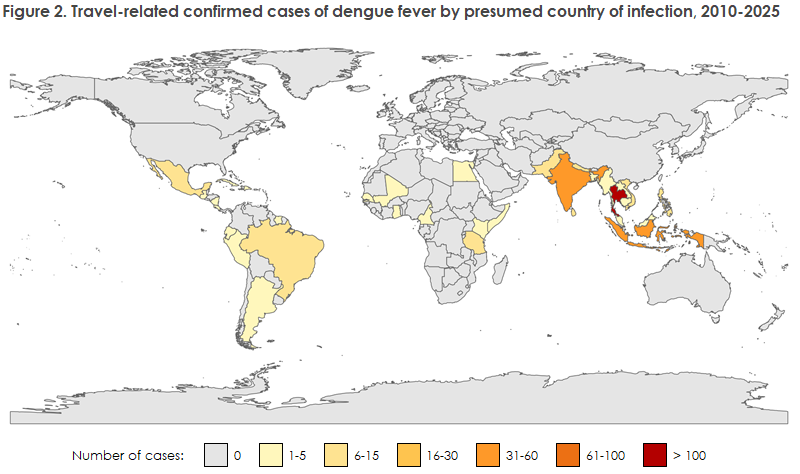
Overall, travel information is only available for 33% of cases. All of these involved travel outside Europe. The geographical distribution is shown in Figure 2. Asia was the most common region of infection. Within Asia, Thailand was the most frequently reported country (>100 cases), followed by Indonesia (47) and India (31).
Comment
Dengue fever is increasingly common globally. With approximately 65 cases annually in Denmark during 2010–2025, dengue occurs at a similar frequency as another imported mosquito-borne infection, malaria. However, the true number of infected Danes is likely higher.
The most important method to prevent dengue when travelling is protection against mosquito bites, which also protects against other mosquito-borne infections.
A licensed vaccine, Qdenga, is available. SSI currently recommends its use primarily for individuals who have previously had dengue (seropositive individuals), EPI-NEWS 7-9/2025. This assessment is shared by WHO and several other countries’ authorities. SSI continuously monitors developments and will communicate any changes via EPI-NEWS.
(A.V. Søndergaard, L.S. Vestergaard, P.H. Andersen, Department of Infectious Disease Epidemiology and Prevention. B.B Jensen, Virology and Microbiological Preparedness)