No 9 - 2026
TBE (Central European encephalitis) detected in Denmark in 2025
TBE (Central European encephalitis) detected in Denmark in 2025
Tick-borne encephalitis (TBE), also known as Central European encephalitis, is a viral infection transmitted to humans via tick bites. The disease may cause influenza-like symptoms and, in some cases, develop into encephalitis, particularly in adults/elderly persons. The 2025 annual report shows a decrease in the number of detected TBE cases compared with 2024. Transmission is limited to known and possible risk areas, and there are therefore no signs of further geographical spread in 2025.
For more detailed information on routes of transmission and trends in occurrence, please refer to TBE – overview of disease occurrence in 2024. Since November 2023, TBE has been laboratory-notifiable to Statens Serum Institut (SSI), which reports annually on the occurrence of TBE detected in Denmark. This publication covers the year 2025, and the full annual report can be read here. Reports from previous years can be found here.
Overall decrease in cases of TBE detected in Denmark in 2025
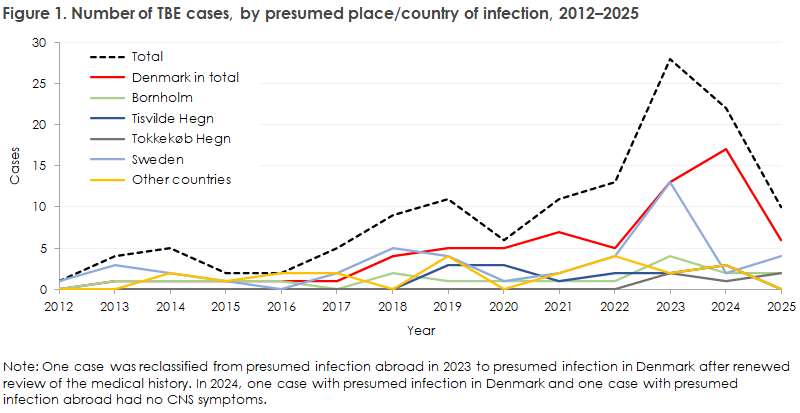
In 2025, 10 cases of TBE were detected in Denmark, Figure 1. This represents a clear decrease compared with 22 detected cases in 2024 and 28 cases in 2023, which was the year with the highest number of detected cases with infection acquired in Denmark to date.
Of the 10 cases, four persons had a presumed place of infection in Sweden. The remaining six cases with presumed infection in Denmark were distributed across already designated risk areas on Bornholm and in North Zealand.
Two cases were registered on Bornholm, two cases in Tokkekøb Hegn in Allerød Municipality, and one case in Gribskov Municipality – areas where TBE transmission has previously been detected.
Fredensborg Municipality has previously – like other forest areas in North Zealand – been designated as a possible risk area. In 2025, a case with presumed infection in Danstrup Hegn in Fredensborg was registered for the first time.
Flagging activities in 2025
By dragging an approximately 1x1 meter white flag across the forest floor (“flagging”), ticks can be collected. The collected ticks can then be tested for various tick-borne microorganisms, including TBE virus (TBEV). It is generally very difficult to identify the limited areas (microfoci) with TBEV-infected ticks, as these are typically the size of a handball court or smaller.
In 2024, TBEV was detected in ticks from a small area in Jonstrupvang in Hareskoven after two persons had been infected with TBE in the area. The area was flagged again twice in 2025, and TBEV was not detected in the collected ticks. Similarly, flagging was carried out in Tisvilde Hegn and on Bornholm in 2025, and analyses there also did not detect TBEV in the ticks. However, this does not necessarily mean that there is no longer a risk of infection in these areas.
Advice and prevention
The risk of tick bites can be minimized by covering as much skin as possible when spending time in nature, for example by wearing long trousers tucked into rubber boots and a long-sleeved shirt. In addition, some mosquito repellents may also have a preventive effect against tick bites.
It is important to remove a tick as soon as it is discovered, either with fingers, tweezers, or a special tick removal tool. It is not crucial whether the entire tick is removed.
Vaccination
A vaccine against TBE is available and may be considered if you live in or regularly stay in known or possible risk areas from spring to autumn and frequently spend time in forests or scrubland – or if you acquire ticks simply by walking on paths. The risk period in Denmark is normally from May through October, and vaccination consisting of a total of three doses should therefore be initiated before this period. The vast majority of citizens are not expected to need vaccination. Persons at particular risk may include hunters, forestry workers, orienteers, and berry/mushroom pickers. It is rare for children to develop TBE, which may be because they often experience only a mild infection that is not detected.
(A. Søndergaard, P.H. Andersen, Department of Infectious Disease Epidemiology and Prevention, B. Bødker, Virology and Microbiological Special Diagnostics)