No 4 - 2026
Advice for healthcare professionals
Advice for healthcare professionals
Since the summer of 2025, the Department of Infectious Disease Epidemiology and Prevention has experienced an increase in enquiries to the advisory service. The advisory service offers telephone advice to healthcare professionals on, among other things, the childhood vaccination programme, other vaccines included in public vaccination programmes, prevention of infectious diseases, and the provision of vaccines and immunoglobulin following exposure to certain infections.
The telephone is open on weekdays from 8.30–11.00 – though, on Wednesdays from 12.30–15.00 – on the telephone number: 3268 3037.
In case of urgent provision of vaccines and immunoglobulin following exposure to infection, serious infections and disease outbreaks, enquiries can be made outside the telephone opening hours on weekdays between 8.00–15.30 (Friday 8.00–15.00) on the telephone number 3268 3038. In the evening/night, weekends and public holidays, the epidemiological on-call duty can be contacted on the number 4131 7404.
The advisory service does not offer advice about travel vaccinations – for guidance on travel vaccination, please refer to the website Travel vaccination.
During periods of increased activity, longer waiting times on the telephone may occur. We recommend using our website ssi.dk, where answers to many questions can be found. There is also the option of written advice via e-mail to: epiinfo@ssi.dk.
Based on experience from our daily advisory work, we have in this EPI-NEWS compiled answers to frequently asked questions with references to where more information can be found on the website.
New structure on the website
SSI conducted a user survey of the communication on the vaccine pages of our website, ssi.dk. The survey particularly pointed to a need for:
- more simplified and clear information
- a more intuitive structure
- target group–specific pages
- increased use of visual elements.
This work is well underway, and continuous efforts are being made to make the vaccine pages as user-friendly as possible. Among other things, new tabs have been created targeted at pregnant women, people aged 65 years and over, and people with chronic diseases. In addition, a number of pages have been rewritten and simplified to strengthen readability and clarity.
As part of the update, a number of new graphics have been developed to supplement the text. These will gradually be added to the website.
Frequently asked questions in the advisory service
General information on vaccines and handling
Where can I find information on the different vaccines?
Information on the individual vaccines – e.g., intervals, side effects, contraindications and protective efficacy – can be found in the Vaccine Lexicon ( Vaccineleksikon, in Danish language). For more detailed information, please refer to the vaccine’s summary of product characteristics, which is linked directly from the Vaccine Lexicon.
Are there limits to how many vaccines I can give at one time?
No, the body’s immune system can easily handle receiving many vaccines at the same time.
Which vaccines may be given simultaneously?
All vaccines can be given simultaneously. Separate injection sites must be used with a minimum of 2.5 cm between them. Vaccines must not be mixed unless this is specifically stated on the packaging. Read more on the page Handling of vaccines (in Danish Language).
What about intervals between inactivated and live attenuated vaccines?
All vaccines can be given simultaneously. The table below shows the recommended minimum intervals between vaccination with live attenuated and inactivated vaccines.
| Combination | Recommended minimum interval between doses |
| Two or more inactivated vaccines | None. Can be administered simultaneously or with any interval between doses. |
| Two or more live vaccines | Four weeks – if they are not administered simultaneously. |
| Inactivated and live vaccine | None. Can be administered simultaneously or with any interval between doses. |
Read more here Handling of vaccines.
How do I know whether a vaccine is inactivated or live attenuated?
This information appears in the summary of product characteristics and in the Vaccine Lexicon, where it is stated at the top under the vaccine name (in Danish language).
The entire vaccine dose was not injected – what should I do?
A new vaccine is given immediately to ensure sufficient protection.
- Inactivated vaccines: If the new vaccine is not given immediately, it should be given as soon as possible afterwards.
- Live attenuated vaccines: If the new vaccine is not given immediately (max. 24 hours after), 4 weeks must pass after the too small dose.
I forgot to mix the Hib component in Pentavac – what should I do?
Give a correctly mixed Pentavac as soon as possible. Alternatively, Act-Hib can be ordered as a monovalent vaccine for children under 6 years of age. Act-Hib must be ordered by telephone via the Order Reception at SSI, tel. 3268 3111. Read more in EPI-NEWS 5/6 - 2025.
Should the vaccine be discarded if it has not been stored correctly in the refrigerator?
Vaccines must be stored in accordance with the summary of product characteristics. In case of doubt as to whether a vaccine has been stored correctly, the manufacturer should be contacted via Temperatur@ssi.dk, so they can assess whether the product should be discarded.
A guide to handling vaccines as well as good reminders for storage in the refrigerator can be found on the page Guide to handling vaccines (in Danish language).
I have accidentally given a vaccine where the expiration date has passed – what should I do?
If the expiration date has passed, the effect of the vaccine cannot be assured, and a new vaccine should be given.
- Inactivated vaccines: If the new vaccine is not given immediately, it should be given as soon as possible afterwards.
- Live attenuated vaccines: If the new vaccine is not given immediately (max. 24 hours after), 4 weeks must pass before a new dose.
Intervals in vaccination series
Can I shorten the interval between vaccines in a series?
No, the minimum intervals must be kept in order to achieve sufficient protection. If the minimum interval is not kept, an additional dose must be given with the correct interval from the last vaccination given.
Intervals between doses are described in the Vaccine Lexicon as well as in the vaccine’s summary of product characteristics. An overview of minimum and maximum intervals for the vaccines in the childhood vaccination programme can also be found on the page The Danish childhood vaccination programme (in Danish language).
Should I start a vaccination series over again if more time than recommended has passed between vaccines?
No, you simply continue with the next dose in the series. An overview of minimum and maximum intervals can be found on the page The Danish childhood vaccination programme (in Danish language).
- Specifically for HPV-vaccination: Children under 15 years of age are vaccinated in a two-dose programme. The minimum interval between the two doses is 5 months. If more than 13 months pass between the two doses, one switches to a 3-dose programme. Read more on the page Vaccination against human papillomavirus (HPV) (in Danish language).
Questions regarding the childhood vaccination programme
Can I start the childhood vaccination programme before the child is 3 months old?
It is generally not recommended to start the childhood vaccination programme before the child is 3 months old.
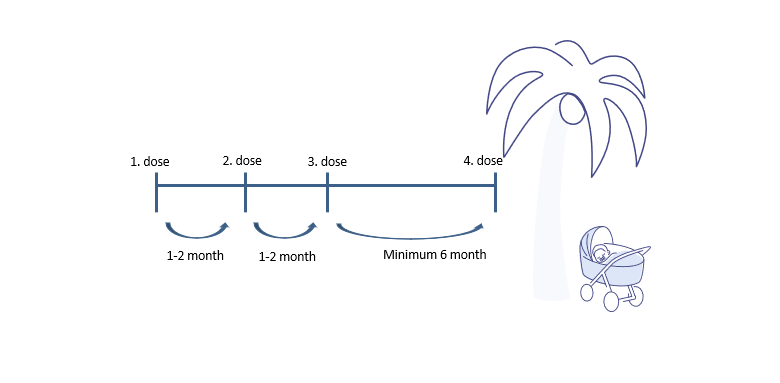
If the family is travelling, DiTeKiPol/Hib vaccination (Pentavac) may be considered started at 2 months. In this case, a primary programme consisting of 4 doses is recommended with:
- 1–2 months between the 1st and 2nd dose
- 1–2 months between the 2nd and 3rd dose
- at least 6 months between dose 3 and 4.
Ideally, the child should receive the first two vaccinations before departure. The costs of additional doses are borne by the parents.
Pneumococcal vaccination can, if needed, be started from 2 months of age. In this case, the child should ideally have received the first two vaccinations with a two-month interval before departure.
Read more on the page Travel vaccination of children (in Danish language).
May the MMR vaccine be given earlier than 15 months?
There may be various reasons for wishing MMR vaccination before the recommended time at 15 months of age. This may, for example, be in connection with travel to countries with a high incidence of measles or to areas with ongoing outbreaks.
- If MMR vaccination is given before 12 months of age, two additional vaccines must be given, as recommended in the childhood vaccination programme. The extra dose is at own expense.
- In the event of measles outbreaks, children can be vaccinated from 9 months, in special cases from 6 months (off-label).
Read more on the page Vaccination against measles (MMR) (in Danish language).
The intervals in the HPV vaccination series have not been observed – what should I do?
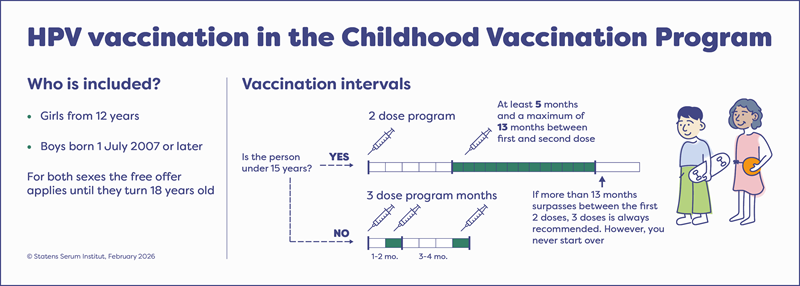
The HPV vaccination programme consists of two or three doses, depending on age at first vaccination:
- Persons who start the vaccination series before turning 15 years of age
o The vaccination series consists as a general rule of two doses with a minimum interval of 5 months and a maximum interval of 13 months.
o If less than 5 months pass between the two doses, a 3rd dose is given after 3–4 months.
o If more than 13 months pass between the two doses, a 3rd dose is given 3–4 months after the 2nd dose. - Persons aged 15 years and over (always vaccinated in a 3-dose programme)
o The minimum interval between the 1st and 2nd dose is 1–2 months. If the minimum interval is kept, a 3rd dose is given after 3–4 months.
See the graphic below and read more on the pages Vaccination against human papillomavirus (HPV) and Handling of vaccines (both in Danish language).
Can persons aged 18 years and over who are missing one or more doses of HPV be fully vaccinated free of charge?
No, for persons aged 18 years and over, HPV vaccination is at own expense.
Adaptation to the Danish childhood vaccination programme
We receive many questions about adaptation to the childhood vaccination programme. You can get help to adapt a child’s vaccinations to the Danish childhood vaccination programme by following the guidance on the page Adaptation to the Danish childhood vaccination programme (in Danish language).
I have a child under 10 years of age who has never been vaccinated – what should I do?
DiTeKiPol (Hib):
- All children under 10 years of age are recommended primary vaccination with three doses of Di-Te-Ki-Pol (high dose) and possibly Act/Hib (Pentavac) – see table 1 on the page Adaptation to the Danish childhood vaccination programme. On the same page, information can be found on at which ages it is relevant for the child to be Act/Hib-vaccinated. If the child is not to be Hib-vaccinated, Pentavac without the Hib component (dry substance) is used.
- The three doses of DiTeKiPol (Hib) are given with a 2-month interval between dose 1 and 2, and a 6-month interval between dose 2 and 3 – see table 2 on the page Adaptation to the Danish childhood vaccination programme (in Danish language). After completion of the primary vaccination, at least 3 years must pass before the child can receive a booster vaccination.
MMR: Two doses of MMR are given with a minimum interval of four weeks.
Pneumococcal vaccination is only a free offer to children under 2 years of age. If the child has not followed the Danish vaccination programme, the programme is adapted in relation to the child’s age at first vaccine – see Adaptation to the Danish childhood vaccination programme (in Danish language).
I have a child over 10 years of age who has never been vaccinated – what should I do?
DiTeKiPol (Hib):
- Persons aged 10 years and over can be primary vaccinated with low-dose di-Te-ki-Pol (see table 1 on the page Adaptation to the Danish childhood vaccination programme (in Danish language).
- The primary vaccination is given in three doses in accordance with minimum intervals – see table 2 on the page Adaptation to the Danish childhood vaccination programme (in Danish language).
- After completion of the primary vaccination, at least 3 years must pass before the child can receive a booster vaccination.
MMR: Two doses of MMR are given with a minimum interval of four weeks.
Pneumococcal vaccination is only a free offer to children under 2 years of age.
Side effects and allergy
The patient has developed an aluminium granuloma after vaccination – what should I do?
- Granulomas are not a contraindication for further vaccination.
- Children who have developed a granuloma should as a general rule continue the childhood vaccination programme. In case of doubt, the child should be referred to the local paediatric and adolescent department.
Read more about granulomas and vaccination on the page Side effects and allergy (in Danish language).
Can I vaccinate a child who has a fever?
In cases of acute illness with high fever, vaccination should be postponed. Mild infections such as a common cold, with or without fever, do not give rise to postponing vaccination. Children who have a disease condition possibly under development or are under investigation should not be vaccinated until the condition is stable and diagnostically clarified.
For further information on contraindications, please refer to the Vaccine Lexicon (in Danish language) and the specific vaccine’s summary of product characteristics.
Vaccination of pregnant women
When is whooping cough and RSV vaccination recommended?
- Whooping cough vaccination is recommended in gestational week 25.
- RSV vaccination is recommended in gestational week 32 in the period 1 May up to and including 31 January.
- It is recommended that at least two weeks pass between vaccination against whooping cough and RSV.
Read more in the Vaccine Lexicon for whooping cough and RSV respectively, and on the page Vaccination of pregnant women (all three in Danish language).
May the RSV vaccine be given later than week 36?
Protection of the infant against RSV depends on the transfer of antibodies. The RSV vaccine must therefore be administered between gestational week 24 and 36. Read more in the summary of product characteristics.
What if I have accidentally given the RSV vaccine before the whooping cough vaccine?
It is recommended that at least two weeks pass between vaccination against whooping cough and RSV. If the RSV vaccine is given first, the whooping cough vaccine is given after two weeks – however no later than one week before the due date.
Read more on the page Vaccination of pregnant women.
Should pregnant women be vaccinated against whooping cough in every pregnancy?
Yes, whooping cough vaccination is recommended in every pregnancy – regardless of the interval since the last diTe-/diTeki vaccine. However, the risk of a local reaction is greater if a diTe-containing vaccine has been given within 12 months.
Read more on the page Vaccination of pregnant women.
Should pregnant women be vaccinated against RSV in every pregnancy?
The Danish Health Authority recommends that pregnant women be vaccinated against RSV with each new pregnancy if the pregnant woman is due from July to March. Vaccination is therefore recommended in connection with the second pregnancy examination in week 32 of pregnancy from 1 May to 31 January. Read more on the Danish Health Authority's website (in Danish launguage).
Vaccination of persons with chronic diseases
Is there a recommendation for revaccination with RSV vaccine?
It has not been clarified whether there is a need for revaccination. Read more in the Vaccine Lexicon (in Danish language) and in the vaccine’s summary of product characteristics.
The patient was vaccinated with Pneumovax 5 years ago and now presents for revaccination – which pneumococcal vaccine is recommended?
For persons who have been vaccinated with the polysaccharide vaccine Pneumovax, revaccination can be offered every 6 years. If revaccination is desired earlier than after 6 years, vaccination can be carried out with one of the conjugated vaccines Prevenar20 or Capvaxive. Read more on the page Pneumococcal vaccination (in Danish language).
Which vaccine should I use for protection against severe pneumococcal disease?
When choosing a pneumococcal vaccine, several factors may play a role – e.g. price, possibility of conditional reimbursement, how broadly the vaccine covers, and the need for revaccination. Read which groups can receive conditional reimbursement on the Danish Health Authority’s website.
Persons at increased risk of severe pneumococcal disease can be vaccinated with either:
- a conjugated pneumococcal vaccine – Prevenar20 (PCV20) or Capvaxive (PCV21) or
- a polysaccharide pneumococcal vaccine – Pneumovax (PPV23).
Read more on the page Pneumococcal vaccination (in Danish language).
Registration of foreign vaccines in the Danish Vaccination Register (DDV)
How are foreign vaccines registered in DDV?
If the child has received vaccines abroad, these can be registered using “register previous vaccination”. Search for the vaccine by entering either the vaccine name, medicinal product or disease. Select the vaccine via the drop-down menu. For further information, please refer to Guidance for The Danish Vaccination Register (DDV) (in Danish language).
(Advisory team, Department of Infection Epidemiology and Prevention)