No 35a - 2026
Updated recommendations for the use of human immunoglobulins for measles PEP (post-exposure prophylaxis)
Updated recommendations for the use of human immunoglobulins for measles PEP (post-exposure prophylaxis)
Following exposure to measles in non-immune persons, MMR vaccination or human immunoglobulin can prevent symptoms of measles or reduce their severity if administered sufficiently early.
- MMR vaccination must be given within 72 hours/3 days after exposure
- Human immunoglobulin may be effective up to 6 days after exposure
In Denmark, the human immunoglobulin Beriglobin for intramuscular administration has been available for use as PEP, but the manufacturer has discontinued its production, and the remaining stock at SSI will expire on 31 August 2026 (5 ml vials). (Beriglobin in 2 ml vials expired on 30 June.)
SSI has conducted an analysis of any equivalent products authorized in the EU for IM administration. There are currently no other authorized products, meaning that any PEP in future will have to be given using immunoglobulins that are only authorized for IV (or possibly SC) administration.
It is considered inappropriate to switch to a general recommendation for the use of IV immunoglobulins instead of IM immunoglobulin. This would require establishing IV access, which in practice would only be possible in a hospital.
SSI therefore recommends that the use of IV immunoglobulin (and possibly SC immunoglobulin) for PEP in future be limited to special groups at increased risk from measles infection:
- Pregnant women (cannot receive MMR vaccination, as the vaccine contains live, attenuated virus)
- Immunocompromised persons (cannot receive MMR vaccination, as the vaccine contains live, attenuated virus), see below
- Infants under 6 months whose mother has not had measles, is not vaccinated or has unknown vaccination status
- Infants between 6 and 12 months where more than 3 days have passed since exposure (and up to 6 days)
- Possibly other persons who, based on a medical assessment, are considered to be at particular risk from measles and who have not received MMR vaccination within 3 days after exposure.
The updated recommendations can also be read on SSI’s website.
Immunocompromised persons
Immunocompromised persons must, regardless of vaccination status, receive IV immunoglobulin. This applies to cancer patients, bone marrow or organ transplant recipients, persons with immunodeficiency, and people living with HIV who have a low CD4 cell count. PEP is particularly important in the following conditions:
- Hematological malignancy, high-risk patients:
o Allogeneic hematopoietic stem cell transplantation within 2 years or with chronic GvHD (Graft-versus-Host Disease)
o Malignant lymphoma under active treatment
o CLL (chronic lymphocytic leukemia) under active treatment
o Multiple myeloma under active treatment
o MDS (myelodysplastic syndrome) and acute leukemia
o Malignant B-cell disease with anti-CD20 antibody treatment within 12 months
o Myelofibrosis under treatment with a JAK inhibitor - Solid organ transplantation
- Cancer and active chemotherapy or chemotherapy completed within the past 3 months
- HIV with 1) CD4 < 200 cells/µL, or 2) viral load >1,000 copies/mL and CD4 < 350 cells/µL
- Severe primary immunodeficiency
- In special cases, patients with other severe immunosuppression (e.g. a combination of medicines or particular conditions), or primary immunodeficiency following individual assessment in consultation with a specialist department.
IV immunoglobulin treatment should not be delayed until the result of immunity status is available, but treatment should be administered promptly, preferably within three days and no later than six days. It is recommended that treatment of immunocompromised persons be discussed with the treating specialist. Immunoglobulin must be given again in the event of renewed exposure to measles after 21 days. In cases where exposure is recognized late, there may be an indication for treatment with immunoglobulin for up to 18 days after exposure, but this should be discussed with specialists, e.g. an infectious diseases physician or pediatrician.
Available IV immunoglobulins
There are a number of authorized immunoglobulins for IV administration. Privigen, Octagam and Panzyga have “measles PEP” as a registered indication in the SmPC/product information, but Kiovig is also considered suitable for use (off-label) at appropriate dosages if none of the other products are available, see below.
These currently comprise:
Privigen solution for infusion 100 mg/ml (registered indication)
Octagam solution for infusion 100 mg/ml (registered indication)
Panzyga solution for infusion 100 mg/ml (registered indication)
Kiovig solution for infusion 100 mg/ml (off-label)
See further information about the different IV immunoglobulins here (Human immunoglobulins for IV use – information for healthcare professionals – Medicin.dk).
Immunoglobulins for IV use can be ordered from a hospital pharmacy in the relevant region.
Available immunoglobulins for SC use
Hizentra solution for injection 200 mg/ml (must NOT be administered IV or IM)
Xembify solution for injection 200 mg/ml (must NOT be administered IV or IM)
Cutaquig solution for injection 165 mg/ml (must NOT be administered IV or IM)
HyQvia solution for infusion 100 mg/ml (must NOT be administered IV or IM)
In principle, these products could also be used, but subcutaneous administration is generally considered impractical, particularly outside hospital.
See further information about the different SC immunoglobulins here (Human immunoglobulins for SC or possibly IM use – information for healthcare professionals – Medicin.dk).
Dosage of IV immunoglobulin
Internationally, IV immunoglobulin is recommended at doses ranging from 150 mg to 400 mg per kg body weight.
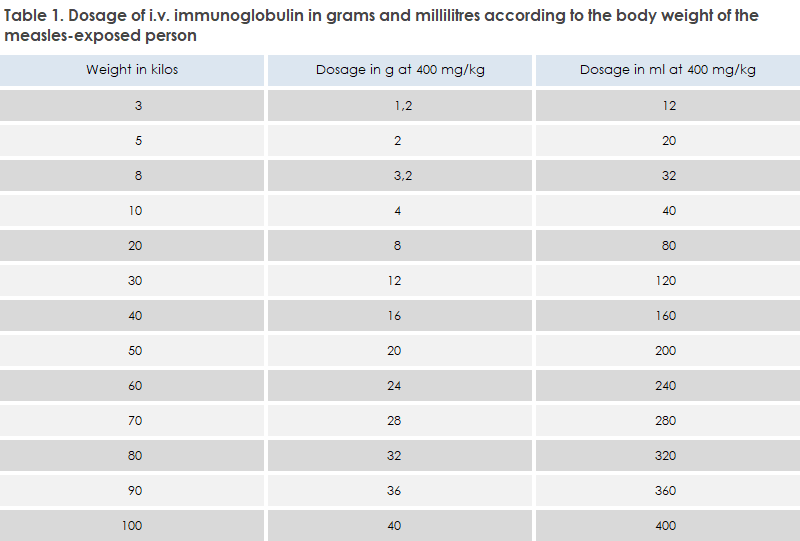
As the specific content of measles antibodies in the individual products is not known/stated for most IV immunoglobulins, SSI recommends using a dosage of 400 mg/kg body weight, which is the recommended dosage for the products that have measles PEP as a registered indication.
As stated, the four IV products currently available in Denmark all have a concentration of (predominantly IgG) immunoglobulin of 100 mg/ml.
Table 1 shows the dosage table (3, 5, 8 and 10 kg body weight for infants and thereafter per 10 kg increase in body weight) for persons who are to receive IV immunoglobulin as measles PEP.
The four available IV immunoglobulins are available in different pack sizes with solution for infusion ranging from 10 ml to 400 ml, which may influence the choice of the specific product in order to minimize waste.
For patients receiving regular maintenance treatment with IV (or SC immunoglobulin who are not immune to measles and are exposed to measles infection, there will normally be no need for additional treatment. However, it may be relevant to bring forward the planned immunoglobulin treatment so that the next dose is given as close as possible to the time of exposure. After administration of IV immunoglobulin (or possibly SC) at the recommended measles PEP dosage, at least 8 months must pass before the patient can receive MMR vaccination.
Dosage of SC immunoglobulin
As the available immunoglobulins for SC administration vary in strength, and there are no international recommendations for dosage, SSI does not provide specific guidance on their dosage.
(T. Katzenstein, Department of Infectious Diseases, Rigshospitalet, A-B. Eg Hansen, Department of Infectious Diseases, Hvidovre Hospital, A. Poulsen, T. Masmas, Department of Paediatrics, Rigshospitalet, P.H. Andersen, Infectious Disease Epidemiology and Prevention)