No 47 - 2025
Annual report for invasive pneumococcal disease for the year 2024
Annual report for invasive pneumococcal disease for the year 2024
- In 2024, a total of 613 cases of invasive pneumococcal disease (IPD) were registered in Denmark. This is at the same level as what was recorded in 2023.
- The most frequent cause of invasive pneumococcal disease in 2024 was detection of pneumococci in blood (526 of 613 cases).
- A temporary increase in cases was observed among children under 2 years of age. This was primarily due to a rise in a particular subtype of pneumococci (serotype 38). This increase has not continued in 2025.
- IPD can be prevented by vaccination, and pneumococcal vaccination should therefore be considered for people with increased risk. Details about groups with increased risk, and the available vaccines, are described on SSI’s website.
For a more detailed description, please refer to the annual report on invasive pneumococcal disease in 2024 .
Invasive pneumococcal disease, an overview
Statens Serum Institut surveils the occurrence of sepsis and meningitis caused by pneumococcal bacteria. Such infections are also known as “invasive pneumococcal disease,” or “IPD.” Read more about pneumococci and IPD here .
IPD may arise as a complication of severe pneumonia caused by pneumococcal bacteria. IPD is seen primarily in the winter season, but occurs throughout the entire year.
It is mainly very young children under 2 years of age, as well as older adults, who develop IPD, but it occurs in all age groups.
Children are offered free pneumococcal vaccination as part of the childhood immunisation programme. Persons older than 2 years who are at increased risk of IPD must pay for pneumococcal vaccination themselves. However, conditional reimbursement may be granted to certain groups.
Invasive pneumococcal disease in 2024
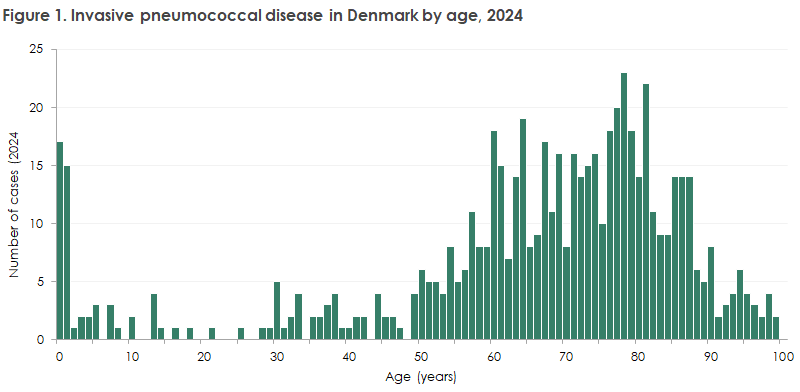
In 2024, 613 cases of IPD were registered in Denmark. For comparison, 623 and 556 cases were registered in 2023 and 2022, respectively. 61% of the cases in 2024 were among persons aged 65 years and older, and 5% were under 2 years of age. Figure 1 shows the number of IPD cases by age in 2024. There was essentially the same distribution between men and women, with 314 men (51%) and 299 women (49%). The months January–April and December accounted for a combined 57% of recorded cases.
In 2024, there was a higher proportion of cases among children under 2 years compared with the two previous years (32 cases; 5.2%). The primary reason was an increase in cases caused by a specific pneumococcal type (serotype 38). A total of seven cases of serotype 38 in children under 2 years were recorded in 2024. For comparison, only three cases of serotype 38 were found in this age group in the period 2020–2022, and, so far, none have been identified in 2025 (January throughOctober). Serotype 38 is not included in available pneumococcal vaccines, and IPD caused by serotype 38 does not differ from IPD caused by other serotypes.
Of the 613 cases of IPD in 2024, there were 71 cases of meningitis, 526 of sepsis, and 16 with invasive infection of joints, pleura, or peritoneum.
Pneumococcal disease can be prevented by vaccination
All children under 2 years of age are offered pneumococcal vaccination as part of the Danish childhood vaccination programme. Most children are vaccinated, and among children born in 2024, 97% received the first two pneumococcal vaccines which are given at 3 and 5 months of age. Uptake of the third pneumococcal vaccine at 12 months has not yet been compiled for 2024, but is normally 95–96%.
The likelihood of invasive pneumococcal disease among children under 2 years dropped markedly after the vaccination programme started in 2007. Some children still develop IPD, usually because they are infected with serotypes not covered by the vaccine, or because they were too young to have received the first vaccine dose.
Adults can also be vaccinated against pneumococci. The vaccines included in SSI’s recently updated guideline for vaccination of adults at risk of severe pneumococcal disease have been selected because they cover the serotypes that most frequently cause invasive pneumococcal disease in adults.
(F. Kristensen Lomholt, T. Dalby, Department of Infectious Disease Epidemiology and Prevention; A. Ronayne, Bacteria, Parasites & Fungi)